

Divided lives on both sides of Indo-Bangla border in Meghalaya
The 1947 partition has impacted history & the progress of Meghalaya in recent years, & deformed the lives of both indigenous & non-tribal populace, writes Binayak Dutta


They found themselves away from their homes and hearth, kinsmen and their cultivable lands. The story of these communities with their experiences with boundary-making between India and Bangladesh (formerly East Pakistan), deprivation and anxiety over a space that they have traditionally cohabited from the pre-colonial to the contemporary times has escaped the attention of policymakers and academics alike. But bordered lives were a lived reality, and therefore, when 20 years ago, the Government of India and Bangladesh decided to undertake a joint survey, the leaders of these local organisations operating in the Indo-Bangla border also resolved to make physical verification of the Main Pillars of Indo-Bangla border, hold meetings, conduct awareness campaigns among people and their Dorbars in the Indo-Bangla areas.
These communities, indigenous to Meghalaya, a state born in 1972, were victims of continuous harassment and trauma, like the displaced from the plains of Sylhet and Bengal, with whom they cohabited a shared geography. While the partition of 1947 did not deal with Meghalaya per se, it had a disruptive role in the geography that formed the southern boundary of Meghalaya, once the state was born and the people who resided there.
Boundary Commission & concomitant tension
When the focus shifted to the Boundary Commission after the Sylhet referendum, to complete the process of partition and boundary demarcation, the Khasi-Jaintias agitated before it, but to no avail. It is interesting to note that the Dewan of Cherra State, David Roy, pointed out in his memo that the Khasi State, Cherra, would have to take necessary steps if this Commission were to deal with the boundary with the Khasi States, and Bholaganj and Cherra State in particular.
The first task that the Government of India had was the challenge of completing the accession of the Khasi Chiefdoms, more than two score in number, and to deal with the proper demarcation of the boundaries on the ground. While the Government was able to complete the accession of the 25 Khasi States into the Indian Union by 1948 — the last being the Syiem of Nongstoin, a chiefdom located on the India-Pakistan border — who signed it on the 19th of March, 1948, the completion of boundary demarcation was a far cry and could only be accomplished by 2016 when India and Bangladesh signed the Land-Boundary Agreement.
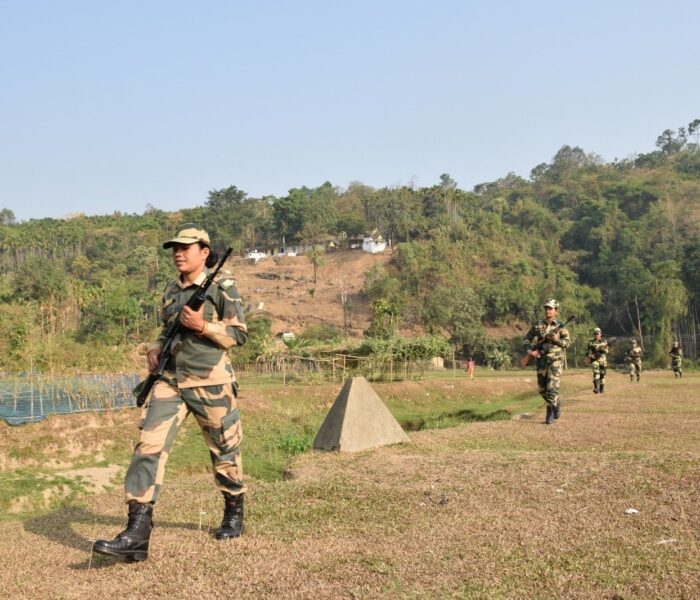 A jawan from the women’s wing of the border forces on patrolling duty. Photos sourced
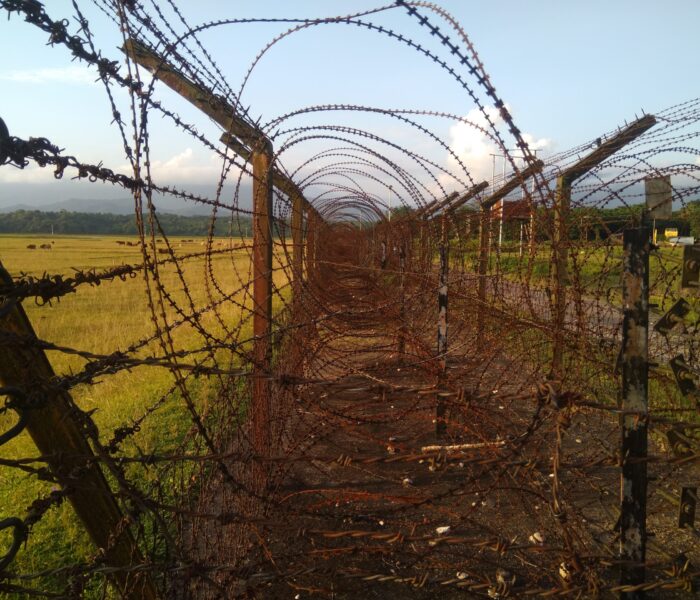
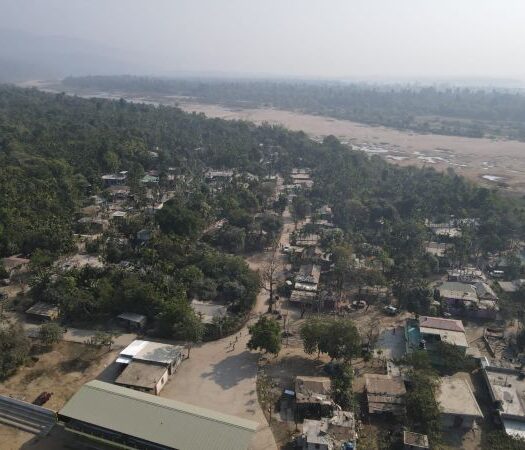
But as records and news reports from the grassroots would inform, the demarcation had been followed by a series of protests and obstructions by local communities to border fencing.
While the partition of Assam and the loss of Sylhet made the northeastern region landlocked, it also disrupted the traditional links that the tribal communities, such as the Khasis, Jaintias and the Garos had with the East Pakistani districts of Sylhet and Mymensingh, respectively. These tribes
were settled not only in the hill districts of Assam but also in the plains of Sylhet and Mymensingh. At the stroke of a pen, these people were internally split into Indians and Pakistanis depending on their residence.
The traditional inter-community linkages in the area were so strong that these hill tribes “for ages depended on their trade with the plains…”. A centuries-old, prosperous border-trade-based economy was killed by closing the borders and the erection of check-posts. This had an indelible mark on their life, livelihood and socialisation.
Many persons belonging to the indigenous community lost their livelihood and their homes, and were forced to relocate to other parts of the Khasi and Jaintia Hills. The Census Report of 1951 says that, ‘… after partition, the Khasis near the Sylhet border have lost the facilities for marketing of their produce, especially their oranges, pan leaves and potatoes in the hats (local markets) on the Sylhet border and buying rice and poultry in exchange. The action of the Pakistan authorities in often stopping the export of eggs, fish, apart from the usual ban on the export of rice, has caused the people on the border many hardships after August 1947…’
While the Khasis faced the utmost hardship, they could never reconcile to their loss of livelihood and the hardship of life because of partition. This hardship had an imprint on the Khasi and Jaintia people living in Shillong and coloured their attitude to life and administrative changes that came about after partition. Writing a Note on Relief and Economic Rehabilitation Programme Of The Border People of United K-J Hills, Nichols Roy pointed out that, “It has all along been recognised both by the State Government as well as the Government of India that before partition, the economy of the border people of United Khasi-Jaintia Hills was linked up with the adjoining areas of Sylhet now falling in Pakistan…Due to trade restrictions imposed by the Pakistan authority the border produce has lost its market in East Pakistan and the border people have now not only to depend on alternative market in the Indian Union for their border produce but also for supply of foodstuff and other essential commodities…”
This hardship had a major impact on the Khasi-Jaintia psyche as they felt a sense of betrayal. Partition, therefore, had a much deeper impact on the common people and also coloured their attitudes in post-colonial politics.
The refugee imbroglio
But the greatest impact of partition on Assam was through the migration of refugees and demographic transformation of Khasi, Jaintia and the Garo Hills. Partition also made life difficult for non-tribal plainsmen communities who shared space with the indigenous. When the displacement of people and continuous flow of refugees from erstwhile East Pakistan came about since 1948, the Census of 1951 revealed that as many as 14,509 persons moved into the hill areas, mostly to Shillong, as it was the capital of the composite state of Assam, born after the partition of the province in 1947.
This decision of the displaced from East Pakistan to settle down in Shillong was informed by the fact that it was a popular and familiar destination, as they were not only acquainted with the town as the provincial capital. The Census Report for 1951 informs that “displaced persons have contributed an increase of 5,990 to the total increase of the district i.e., United Khasi-Jaintia Hills, most of them, 4,698 having settled down in the capital i.e., Shillong. Only 1,292 having gone to the other areas of the interior.”
But one of the most difficult fallouts of partition in the areas that constituted Meghalaya was inter-ethnic social tensions, which ran very high with the migration of refugees to Khasi-Jaintia and Garo Hills district.
Shillong was a witness to a big cleavage in social relations in the Khasi and Jaintia Hills between the communities since the 1950s, when social tension subsisted at subterranean levels. Partition had an indelible effect on indigenous life, livelihood and socialisation as many persons belonging to the indigenous community also lost their livelihood and their homes in the border areas and were forced to relocate, but never really received any attention or support from the Indian state, which was otherwise available to the refugees from East Bengal and Sylhet.
Therefore, when the new Constitution of India was drafted, constitutional protectionism came to be popularly perceived by emerging tribal leaders as the only opportunity to convert these tribal areas into exclusive zones of tribal hegemony to regain prosperity lost to the Khasi and Jaintia, post-partition.
But parallel to the constitutional transition and unrest was the inflow and settlement of minority communities from East Pakistan into areas that would constitute Meghalaya. In Shillong, in the Khasi Hills district, about 66 acres of land were requisitioned by the Government of Assam in two blocks of Bhagyakul estate and Umpling village for the settlement of 351 families on August 14, 1953. The population of Shillong subdivision had increased by 28.39%, from 295,968 in 1951 to 380,005 in 1961.
Over a period of time, displaced persons/refugees came to be settled in different localities of Shillong, such as Umpling, Laitumkhrah,(Bhagyakul), Malki, Dhankheti, Kench’s Trace, Rilbong, Laban, Mawprem, Bara Bazar, Thana Road, Quinton Road, Umsohsun, Riatsimthiah and Jaiaw, spread across Shillong where they lived amicably with the indigenous communities and accentuated the cosmopolitan character of the capital town of the composite state of Assam.
Post-partition displacement of people from East Pakistan brought many people to Shillong. Bengalis had a deep bond with Shillong as the capital of colonial Assam and with the Khasi and Jaintia Hills because of the geographical adjacency and commercial contacts over hundreds of years. As the displaced Bengali-speaking people relocated to Shillong, they set up educational institutions for the education of their children, but never made those institutions exclusive. One such institution is Laitumkhrah New Colony School, which was initially set up in 1940. It was relocated to New Colony in 1948 and upgraded to a government-aided school in 1959 under the inspiration of Sushila Sen, Subarna Prava Sen and Prava Dutta, and teachers like Shanti Lata Dutta and Bijali Dasgupta.
Influential and public-spirited persons
Those who were at the forefront of the institution in the initial years since 1947 were Arabinda Prasad Dutta, Amulya Bhushan Choudhury, Dhiren Chandra Dutta, Prava Dutta, PS Guha and his wife, Nishi Bhattacharjee and Ganendra Choudhury. The inflow of Bengali displaced gave a boost to these institutions at a difficult juncture of history, as students and teachers relocated themselves and rededicated themselves to public service in their new location of Shillong. Prabha Dutta, the secretary of the school, in her letter to the Government of Assam, pointed out that, “practically all the guardians whose children or wards are reading in the school are very poor children of displaced persons… I therefore approached the Relief and Rehabilitation Department with the request that they may be please (sic) to sanction necessary grant…”
Similar is the case of many other educational institutions. Another institution was the Lumparing Vidyapith, which was established with the initiative of Nripendra Chandra Dey and Rajendra Kumar Bhattacharjee, who was a teacher and had relocated from Panchakhanda in Sylhet to Shillong. Rasamoy Bhattacharjee, Rashendra Das, Gopesh Das, Provash Deb and Sitangshu Sekhar Das were at the forefront of the construction of the school in the initial years. While Rajendra Kumar Bhattacharjee was its first headmaster, Swaati Dey and Prithi Prabha Das were its first teachers.
Besides the school at Lumparing, the other educational institutes set up by the Bengalis were Rilbong PN Choudhuri Higher Secondary School, Tagore Memorial School, Rynjah, Dr Sarvapalli Radhakrishnan High School, Rynjah, Smt. Sarojini Naidu Girls High School Rynjah, The Shillong Academy, The Polo Ground Buddha Bidya Niketan and The Hindu Mission Schools that became the nurturing ground for hundreds of refugee children and by default the transformatory platform for the refugee families that had migrated to the Khasi Hills.
The Shillong College was another major institution that came to be established on public initiative. The proposal for the college came in 1950, and a steering committee was formed with Rohini Kr. Choudhury as the chairman, Dr PK Gupta and Prof DP Chakraborty as joint secretaries. AC Roy, KN Dutta, AB Choudhury, KR Bhattacharjee and PG Mazumdar as members. The formal public meeting for the opening of the college was organised at the Bangiya Sahitya Parishad, Jail Road, in 1956 at the initiative of Satyen Kr. Kar and Subhash Chatterjee, and Binode Behari Ghosh as president. Sudhindra Chandra Dutta was the founder Principal.
The Women’s College was established by the initiative of public-spirited individuals such as Bidhu Bhushan Dutta, Bishnu Pada Dutta, a lawyer by profession, and Basudeb Dutta Roy, a retired teacher of Political Economy from St Edmund’s College.
Public-spirited Bengali lawyers such as Dhirendra Nath Dutta, JN Deb Choudhury, Nripendra Mohan Palit and Prabin Kr. Choudhury played an important role in establishing the Shillong Law College, the first
law college in the Khasi-Jaintia Hills, in 1964 — an initiative that was carried forward by the next generation of lawyers, such as Bishnu Pada Dutta, who played an important role in streamlining the teaching programme since the inception of the college.
It is interesting to note that most of the public-spirited people traced their roots to East Bengal and Sylhet and who had lost their homes and hearths to the political vastitudes of partition. But this process has almost come to a standstill since anti-outsider agitations shook the state, primarily around the major towns like Shillong and Jowai, since 1979. Now, exodus of the non-tribal populace is the only reality here.
The dark cloud of partition
In recent years, the shadow of partition appears to have resurfaced with the debates surrounding the project of border fencing along the Indo-Bangladesh border and the outbreak of protests by the indigenous communities of Meghalaya. The gradual out-migration of the Bengali middle-class population from Meghalaya to other cities of India due to political disturbances has only contributed to the erasure of the history of post-partition institution-building in Meghalaya.
While there was no doubt that the partition transformed the political and social situation in areas that constituted Meghalaya, its greatest impact was on the way the history of the state and its progress came to be perceived and represented in recent years. The shifting of central government offices to Assam and the criticism of the local organisations against the recruitment of non-tribals in public offices led to a steady exodus of non-tribal government servants, many of whom were second-generation partition refugees, to the plains of Assam.
Non-tribal settlers, especially the partition-displaced who had descended to Shillong, sold their properties and relocated outside the new state. Small business holdings closed their businesses. Three major communal conflagrations and many small inter-community skirmishes since 1979 remind that despite the passage of more than seven decades since partition and 53 years since the statehood of Meghalaya, partition still resonates in the lives of the people who were displaced from East Pakistan.
For the indigenous population living in the border areas and who traced their origin to the War-Khasi and War Jaintia areas, the recent proposal of border fencing dashed all their hopes of recovering their lost control over lands that they originally owned and were now permanently part of Bangladesh, despite their claims of adverse possession. It was evident that both the plains people and the indigenous hill people of Meghalaya were affected by the dark clouds of partition. This is a reality that scholars are gradually coming to terms with.
(Dr Binayak Dutta is an associate professor in the Department of History at North Eastern Hill University, Shillong)