


Pynkmen Phankon
There are places where democracy is not merely a system of governance but a lived expression of identity, and for generations, Garo Hills has been one such place. Here, community and culture have long existed in quiet alignment—festivals marked by drumbeats, traditions passed through memory, and political life woven gently into the rhythms of everyday existence. But when such a place begins to echo not with song but with unrest, the rupture feels deeper than politics. It feels personal.
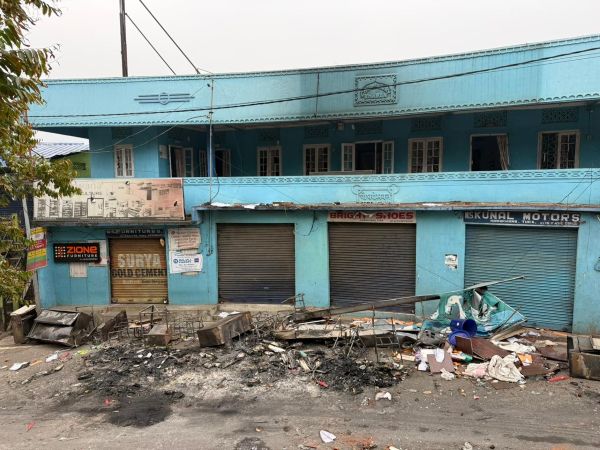
In recent weeks, towns like Tura and Chibinang have witnessed a shift that is as unsettling as it is revealing. What began as a dispute over eligibility rules in the Garo Hills Autonomous District Council elections has escalated into something far more volatile. A court decision altering the framework of participation was enough to ignite anxieties around identity and representation—anxieties that quickly spilled onto the streets. Protest gave way to confrontation. Confrontation gave way to violence. And in that moment, the line between democratic dissent and disorder dissolved.
The consequences were immediate and stark. Lives were lost. Security forces opened fire. Curfews were imposed, internet services suspended, examinations postponed. The ordinary rhythms of life—school schedules, market activity, daily movement—were interrupted not by natural calamity, but by fear. And fear, once it settles into a community, rarely confines itself to a single event. It lingers, reshaping behaviour, altering trust, and leaving behind questions that are far more difficult to answer than the crisis itself.
At the heart of this unrest lies a deeper tension—one between identity and inclusion. For tribal communities, institutions like the autonomous district council are not merely administrative bodies; they are symbols of cultural preservation and political autonomy. When those symbols appear threatened, the response is rarely measured in legal terms alone. It is emotional, instinctive and often immediate. Yet when that response escalates into violence, it risks undermining the very foundations it seeks to protect.
Democracy, by its nature, is not meant to be quiet. It is meant to accommodate disagreement, even discomfort. But it is also meant to contain that disagreement within the boundaries of dialogue. When those boundaries collapse, when protest turns into confrontation and enforcement turns into force, something more than order is lost. Trust begins to erode—trust between citizens and the state, between communities, and within the system itself.
The cost of that erosion is already visible. Students find their futures delayed as examinations are postponed. Businesses close under the pressure of uncertainty. Families remain indoors, not by choice but by necessity. These are not abstract consequences. They are lived disruptions, reminders that political instability rarely remains confined to political spaces. It spills into homes, into routines, into the quiet expectations that define everyday life.
In moments like this, it is easy to assign blame—to decisions, to institutions, to individuals. But the deeper failure is often less visible. It is a failure of conversation. When concerns around identity, representation, and fairness are not addressed early, they accumulate. And when they finally surface, they do so with force. Leadership, in such contexts, is not defined by the ability to respond after crisis, but by the willingness to listen before it.
Because democracy, at its core, depends not just on rules, but on trust. Without trust, procedure becomes hollow. Participation becomes reluctant. And governance begins to resemble management rather than representation. The events unfolding in the Garo Hills are not simply a breakdown of order; they are a signal that this trust is under strain.
Yet within this moment of fracture lies a possibility. The crisis exposes not only what has gone wrong, but what must be rebuilt. A democracy that balances identity with inclusion. A system that recognises the legitimacy of fear without allowing it to dictate action. A leadership that prioritises dialogue over declaration, empathy over expediency.
The hills have endured before. They will endure again. But endurance alone is not enough. What is required now is restoration—the careful rebuilding of trust, the reopening of conversation, the reaffirmation that disagreement need not lead to division. Because the alternative is not merely instability. It is a gradual acceptance of it.
And that is a cost no society can afford.
The question, then, is no longer about the immediate crisis. It is about what follows. Whether the response will be limited to containment, or whether it will extend to reflection and reform. Whether the lessons of this moment will be absorbed or quietly set aside.
Because in the end, the future of the Garo Hills will not be decided by a single election dispute or a single episode of unrest. It will be shaped by how the state, its leaders, and its people choose to respond to this rupture.
And in that choice lies something larger than politics. It lies in the preservation—or the loss—of trust itself.