



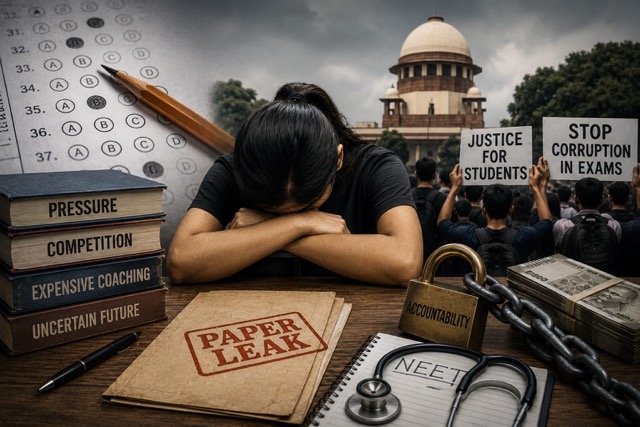
 For lakhs of students in the country, NEET is considered as a merit-based gateway to medical education. However, after repeated controversies, paper leak allegations and cancellations, that trust is rapidly waning.
The NEET controversy first exploded in 2024 with allegations of paper leaks, grace marks and irregularities, triggering protests across cities, including Delhi, Patna and Hyderabad. Student groups and opposition parties accused the National Testing Agency, which conducts the examination, of failing to protect the integrity of one of India’s most important examinations.
Two years later, the crisis has deepened further. NEET-UG 2026 was cancelled after fresh allegations that the question paper was leaked before the exam. Investigations across several states reportedly uncovered networks selling leaked “guess papers” for lakhs of rupees, raising concerns about organised examination rackets.
But beyond the administrative failure lies a far bigger issue — the emotional toll on students.
More than 22 lakh aspirants prepare for NEET every year, often sacrificing years of their lives, family savings and mental peace for a single exam. When repeated incidents of administrative failures happen, students begin questioning whether hard work still matters. Many describe feelings of anxiety, burnout and betrayal, with social media flooded by one repeated question: “What is the point of honest preparation if papers can be bought?”
The psychological baggage and the apprehensions that students have to bear before writing the exams are immense. This is besides the academic pressure that they are already undergoing. There were reports where anxiety drove students to the edge and some finally gave up by killing themselves.
What would be the health scenario if the medical professionals have to face such malpractices in the beginning?
The anger has also reached Meghalaya, where opposition political parties staged protests at Kyndailad in Shillong, demanding accountability over repeated examination failures. Protesters argued that every leak destroys not only an exam, but also the confidence of an entire generation of students.
The controversy has also sparked larger questions about the country’s examination systems. Many students and parents now ask why paper leaks continue despite the country successfully operating secure systems like Electronic Voting Machines (EVMs), digital banking networks and Aadhaar infrastructure.
Critics argue that high-stakes examinations still rely too heavily on physical paper movement, creating opportunities for organised leak networks. There should be encrypted digital transmission of question papers, secure printing systems at centres and stronger technological safeguards to prevent future breaches.
There were promises of reforms in the examination system, which are yet to be done. This only shows how much the government cares for the future of the youths.
Ina situation such as this, shouldn’t there be strict action agaisnt NTA and its director general? After two major lapses, the current NTA system must be dissolved or reformed to make the agency fool-proof. However, so far, no such action has been seen.
There are suggestions from many state governments that it should be left to state boards or agencies to conduct tests and NTA should be done away with till a credible agency is established by the Centre. And this suggestion should be considered.
At its core, the NEET crisis is no longer just about one examination. It is about trust.
For countless families, NEET represents the hope of social mobility and a better future. But repeated controversies have shifted the conversation from merit to malpractice. And unless confidence in the system is restored, the damage may extend far beyond examination halls — into the faith young Indians place in fairness itself.
WATCH MORE VIDEOS: