




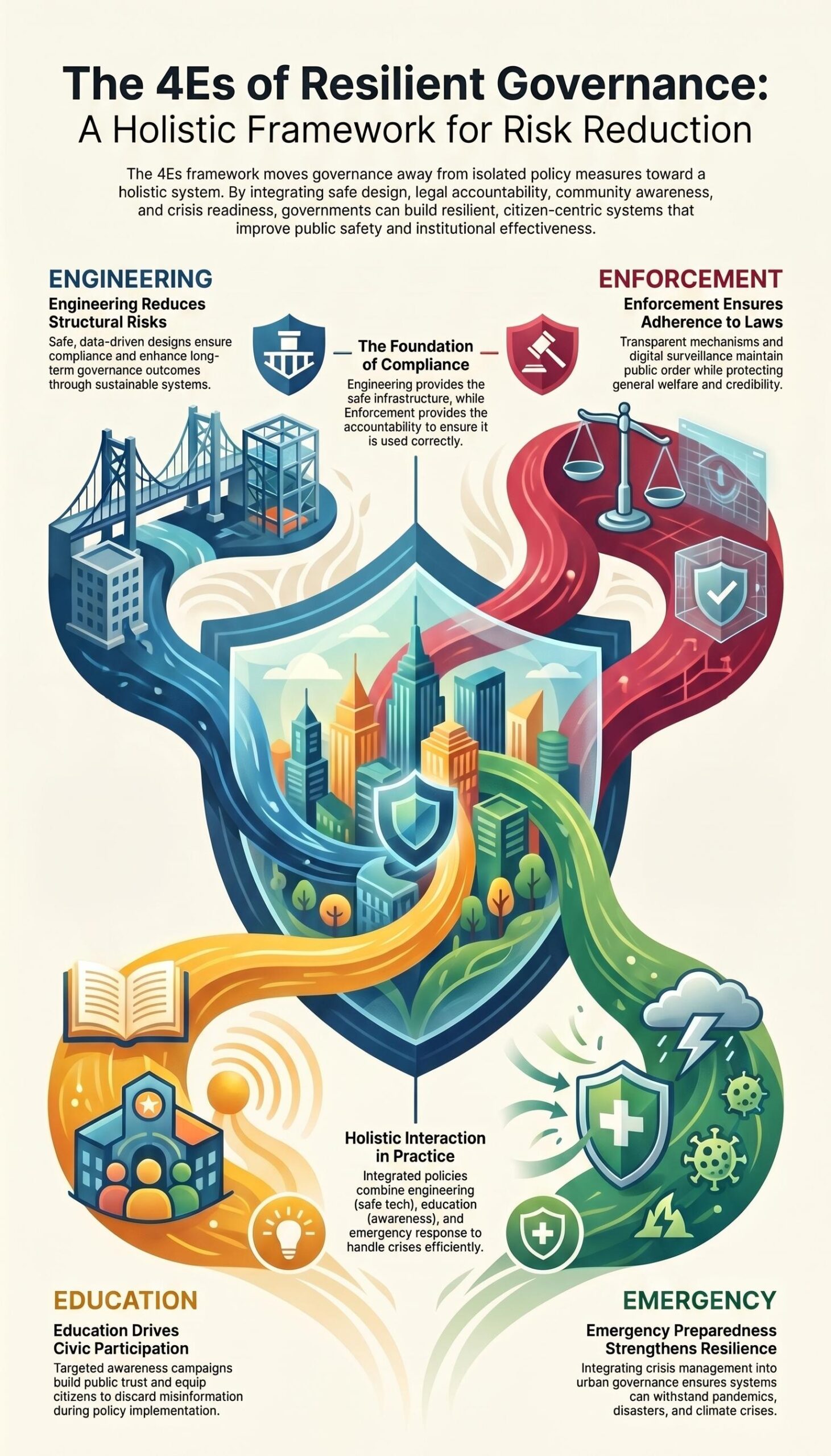
 The 4Es — Engineering, Enforcement, Education and Emergency — has become an important element in public administration and in developing a governance framework. Initially it was applied only to road safety and disaster management but in the current scenario, it is applicable to all domains — health, nutrition, environment, governance and transportation.
This is important because it promotes a holistic and integrated approach to governance rather than relying on isolated policy measures.
Context
The 4Es approach becomes relevant and effective when it involves institutions, systems and emergency preparedness and ensures that they all work in tandem. It encourages policymakers to take a holistic approach in addressing key issues. The 4Es framework supports risk reduction by:
- Designing safer systems
- Enforcing safety standards
- Educating communities
- Preparing emergency response mechanisms.
This is ensured through:
Engineering-Ensuring Safe Designs and Sustainable Systems
This is the basis of the 4Es framework. In the space of public policy, it helps in aiding holistic policymaking. Due to very nature of engineering factor, it increases efficiency of governance and reduces structural risks, ensures compliance, builds community engagement and participation and enhances preparedness during disasters and emergencies. The very nature of public policy in these days is to encourage public participation by encouraging awareness campaigns, consultations, conducting training programmes to ensure that trust is built. As a result, as active participants, people/communities become aware of policies and challenges which improves acceptance and accountability.
Engineering also promotes evidence-based and governance where data, technology, institutional learning come into force which ideally improves long-term outcomes in governance.
Enforcement- Ensuring Accountability and Rule of Law
 Implementing policies cannot go without enforcement, otherwise it becomes a failure. It refers to mechanisms where the government ensures the compliance of laws and regulations. By doing so, public order and discipline is maintained, illegal practices and violations are prevented, public welfare is protected and the credibility of governance systems is enhanced.
Today, technology has increased the role of enforcement through various mechanisms to include digital surveillance, e-governance platforms, data driven regulations to name a few. As a result, public trust has increased and are in tune with policies due to transparency and consistency. But policymakers need to understand the importance of balancing enforcement with transparency and accountability.
For example, environmental laws require enforcement in controlling pollution. Traffic regulations need enforcement to reduce accidents and improve road safety. Public health policies rely on enforcement during health emergencies to ensure compliance with safety protocols.
Education: Building Awareness and Civic Participation
The government has understood the importance of delivering awareness programmes where education plays an important part. It is also a known fact that any policy will succeed only when it is understood and accepted by people. For example education helps people become aware of policies related to health or education. A simple campaign on environmental policies makes people become aware of waste management, conservation and adapting sustainable practices.
Through education, people become aware of fake news and misinformation. They also understand the difference between myths and realities. Education equips people to be better informed, make decisions and discard misinformation which may hamper implementation of policies. On the other hand, education encourages people to actively participate in stakeholder consultations, hold government to accountability and contribute to policy decisions.
Civic responsibilities is encouraged through education apart from promoting long-term social transformation through social cohesion.
Emergency: Strengthening preparedness and resilience
Public policy should ensure that the government should be prepared for emergencies and known risk factors which affects the lives of people. For example, sensing disasters, pandemics and climate related crises. Being prepared for emergency resonates with resilience governance systems. For example, including emergency planning into urban governance, environmental policy and public administration becomes vital for sustainable development. During COVID-19 it was clearly seen that emergency governance played an important role in handling and controlling the virus. Risk preparedness, crisis management, recovery and rehabilitation and emergency response systems become important components in public policies.
The 4 Es are integrated into public policies through a combined approach. For example, engineering focuses on designing safe and efficient systems like infrastructure, technology etc. Enforcement ensures that laws and regulations are implemented properly, and most importantly, adhered to. Education creates awareness, encourages public behaviour and increases public participation.
Emergency mechanisms control disasters, encourage preparedness and help in handling crises efficiently. In short, the 4 Es help governments develop holistic, resilient and citizen-centric policies that improve public safety, sustainability and institutional effectiveness.
Banner image by Pixabay: https://www.pexels.com/photo/close-up-photography-of-yellow-green-red-and-brown-plastic-cones-on-white-lined-surface-163064/