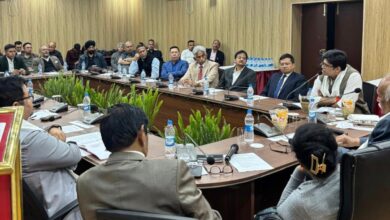


“This influx of people will put at risk the security, public order, and legal rights of the citizens of Meghalaya. The Government of Meghalaya is legally empowered and duty-bound under various provisions of laws and state-specific administrative powers to regulate entry, conduct verification, and enforce measures necessary to prevent disturbances to public order. Given the current circumstances, inaction or delayed action could amount to an administrative failure with significant implications for internal security and lawful governance”.CoMSO wanted the government to restrict the entry of individuals into Meghalaya until proper verification and risk assessment are completedIt suggested mandatory registration, identity verification, and documentation for all persons entering the state from regions affected by SIR-related disturbances.
Besides, it wanted deployment of police and district administration personnel at all major entry points, activation of emergency coordination mechanisms to assess potential security implications, with instructions issued to DCs, SPs, and border management authorities; immediate issuance of a formal government notification or order, clarifying administrative measures, legal basis, and expectations for public cooperation and inter-state coordination with West Bengal and Assam authorities to obtain verified information and prevent undocumented movement of people from these states into Meghalaya.
NESO had, on November 19, petitioned Meghalaya Governor CH Vijayashankar to urge the Centre to immediately detect and deport all illegal migrants, seal the Indo-Bangla border and implement the Inner Line Permit (ILP) in the North East region.
The eleven-point demand submitted through the governor said that the Centre should strengthen border control and monitoring, particularly in vulnerable areas, by deploying adequate security personnel and modern surveillance technology, ‘total exemptions of the applicability of Citizenship (Amendment) Act 2019 and the Immigration and Foreigners (Exemption) Order, 2025 from the whole of the Northeastern region, implement the historic Assam Accord in letter and spirit, provide constitutional safeguard to the indigenous people of Assam as per the recommendations of the Justice Biplab Kumar Sarma Committee which was formed by the Govt. of India and also provide constitutional safeguard to the indigenous people of Tripura, prepare National Register of Citizens (NRC) for the whole of North East with a specific base year according to the unique history of each state and to re-examine the NRC of Assam, provide Inner Line Permit (ILP) for the whole of North East, coordinate with neighbouring states and relevant agencies to ensure that migrants are not simply relocated within the region, preserve and protect indigenous rights, culture, language, political and land ownership through appropriate legal safeguards and policy measure and to set up a Special Review Committee to address population explosion in certain areas,” NESO chairman Samuel B Jyrwa said.
In the memorandum, NESO chairman Samuel B. Jyrwa pointed out that unchecked illegal influx since 1947 has become a grave threat to the socio‑cultural fabric, demographic balance, and political stability of the North East.
He gave the example of Tripura, where indigenous people have been reduced to a minority, and the prolonged anti‑foreigners’ movement in Assam culminating in the 1985 Assam Accord.
NESO pointed out that the promises made then remain unfulfilled.
The waves of agitation in Meghalaya (1979, 1987, early 1990s) and the current demographic shift in Assam reflect a crisis spilling into neighbouring states, including the plains of Garo Hills.
According to NESO, the problem is existential for indigenous communities, endangering languages, traditions, and cultural identities.
NESO said it is against the central policies, like the Citizenship (Amendment) Act 2019 (partially exempted in the North East) and the Immigration and Foreigners (Exemption) Order 2025, which it points out exacerbate the situation by allowing certain migrants from Afghanistan, Bangladesh, and Pakistan to remain in India.