
I am in love with Meghalaya and its people: Anna Notsu
The research scholar, whose illustrative storybook in Biate was launched at Shillong Literary Festival, talks about her experience in Jaintia Hills, her research on Niamtre and her interactions with the Biate community

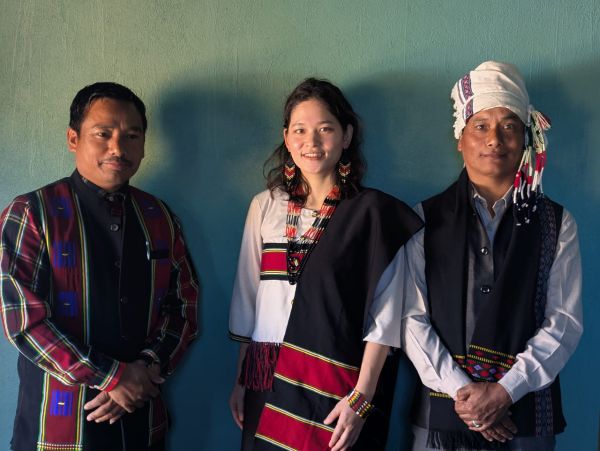
 Languages can never be barriers to establishing connections with people and places, and Anna Notsu stands as testimony to it. From Japan to Jaintia Hills, Notsu traversed a long distance to study the Biate tribe and its language. In the process, she was enamoured of the pristine beauty of Meghalaya and fascinated by the culture and tradition, especially of the people of Jaintia Hills.
“I live in the Netherlands, in Europe. And, when we say India, we think of Delhi, Mumbai, Kerala and other parts of the country, but never the North East, never Meghalaya… I was just in love with the state, the kindness of people, their warmth and how they treated me. That’s when I was already certain that I wanted to have a long-term research project here,” said Notsu.
Notsu is a PhD scholar and lecturer at the Institute of Cultural Anthropology and Development Sociology at Leiden University, the Netherlands. Her five-year research project brought her to Meghalaya, and now, she is the author is an illustrated children’s book in Biate, a language from the Sino-Tibetan family that is yet to be included in the Eighth Schedule to the Constitution of India. The bilingual book, Is She Wise?, was recently launched at the Shillong Literary Festival. The young author spoke to Sunday Monitor from Kolkata about the book, the research project, her time in Meghalaya and future endeavours. She recounted her stay with a Biate family and her experiences at Saipung.
Excerpts:
Tell us about your connection with Meghalaya.
I’m part of a five-year research project called Futuring Heritage: Conservation, Community and Contestation in the Institute of Cultural Anthropology and Development Sociology at Leiden University in the Netherlands. As part of this project, I have been working in Meghalaya since 2023. Actually, I went to Meghalaya before my PhD project officially started. It was the winter of 2023. A lot of people ask me how I ended up in Meghalaya. I have various reasons, but one of them is my then-colleague and now supervisor, Prof. Erik de Maaker, who has been working in the Garo Hills for over 20 years.
Our conversation about Meghalaya started around 2021, at a time when I was looking for a new research site… and I had heard so much about Meghalaya that my interest was piqued, and I wanted to know more. I must say I fell in love with the people of Meghalaya, the landscape and the scenery of Shillong. It felt like homecoming.
Meghalaya somehow reminded me of my grandparents’ place (in Tottori, Japan).
All the rice-based food and seasonal vegetables, and you know, all kinds of food that I’ve been exposed to for the first time in my life created an immediate connection. Somehow, there was already a strong connection between me and Meghalaya because it really reminded me of my home country, Japan.
My research focuses on human and nature connections, exploring how current environmental changes impact the landscape and cultural practices of people at this juncture. Over time, I got to know more about the Jaintia community, which has become my main collaboration. And then, around the same time, I also heard about the Biate community. Someone told me that if I were to do research in Jaintia, I should know about another community there called Biate, and that not many people knew about it.
When I visited, they (the Biate community members) were so warm, welcoming and really, really treated me as if I had already been part of the community. I was not from Meghalaya, not even from India.
But they greeted me with such warmth and kindness that I was so touched by this community. And even though my research focus is actually the Niamtre people, I couldn’t ignore my connection that I built with the Biate community… I lived with a family, and now they are what I call my Biate family, and (I have) so many friends in Saipung village.
I have done all sorts of everyday things, like washing clothes in the river. Everything that they did was something that I wanted to do. So, I joined their everyday life. As we forged this strong relationship, I wanted to return that favour to the community. Hence, I came up with the idea of making a picture book together.
The Biate tribe is spread over Assam, Meghalaya and Mizoram. Have you also visited these states?
Only Assam. Apart from that, I have not visited any other places. The Biate community is under the Sixth Schedule. But they don’t have the ST status yet in their name. [The Assam State Cabinet, in 2023, had demanded a distinct tribal status. In 2024, VPP wanted an amendment to the Constitution (Scheduled Tribes) Order, 1950, to exclude STs of other states, but wanted an exemption for Biate as an indigenous tribe from the Jaintia Hills]
Why did you choose an illustrative children’s book to tell the stories of the Biate?
Thank you for that question. I think, personally, I have always been drawn to this medium because you have to pay attention to the details of life when drawing. And, there is also an element of imagination, a creative representation of what is in front of you.
It is a picture book, a literary and visual storytelling. So, illustrations or words alone won’t make sense. They must be seen in their entirety. However, this book is not just for children but for adults, too. Anyone can read the book and know about the Biate community from many different perspectives.
Is this the first book in the language?
It is the first secular book in Biate. The community has the Bible and some other religious books in its language.
What is the Kirzai project that you mentioned in some articles?
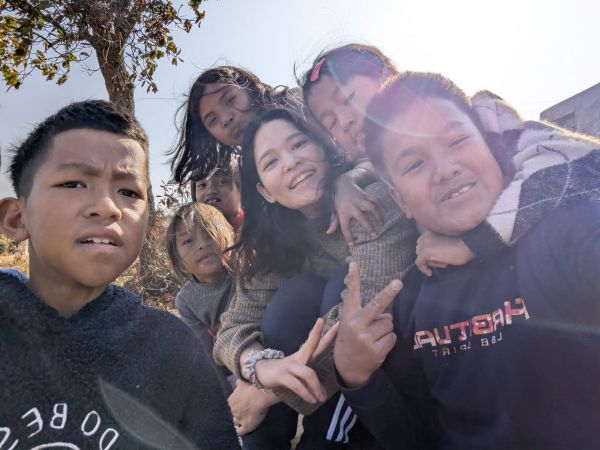
As I said, my project is focused on human-environmental relations. So, I wanted to know how the Biate community, over generations, sees the landscape, how they understand their own imbalance. The project started with my personal desire to understand how they interpret the relationship with their changing environment. The first part was to let school children collect any stories related to the environment. I did not say bring folktales. The only condition I set for them was to collect any stories related to the environment, undocumented and original. Over 20 children submitted stories… They collected stories from their neighbours, grandparents, and village elders.
The second part was drawing. I organised a drawing workshop there in one of the local schools. We read out some of the selected stories from the ones they had collected. And then, hearing the story, the school children were to draw based on their imagination. Then, these two components were later brought together.
What are the important differences you found between the Pnars and the Biates during your stay in Jaintia Hills?
It’s a difficult question to answer, partly because everything is different, but at the same time, there’s always some kind of connection. They all belong to Meghalaya. So, there’s something that ties them together. You mentioned that the Biate community are living in other states. So, there will be differences in lifestyle.
On the Meghalaya side, where I stayed, there are many similarities… for instance, the jainkyrshah worn by the Khasis and Pnars is also worn by the Biates. But those living in Mizoram or Assam will not be using jainkyrshah.
Again, communities in Meghalaya practise matriliny. But the Biates follow patriliny. That is one major difference. At the same time, women in the Biate community do take centre stage in many ways.
To what extent do you think your research will help the Biate preserve its language and culture? And, to what extent are you planning to work in preserving and promoting the language and the culture?
Thank you for that question. Actually, my ultimate goal was not cultural preservation. As an outsider, I feel that it’s not in my place to do that job. It’s completely up to the community. My goal with this book publication was to let them see and reflect on their own environment through their own stories, also document who they are and what it means to be a Biate today. So, it is not a preservation of, let’s say, the Biate folktale per se, and the story in my book is an adapted version of the collected Biate story… I hope that more Biate students or Biate people write stories and publish in their own language about who they are in the future.
You collaborated with local translators and illustrators for the book. How would the collaboration work?
I speak Biate at a basic level, enough to buy bananas at a shop. So, I would need a translation. The work has gone through several layers of translation. The first stage was for me to understand the story. Then we made a committee to select stories from the collection. At one point, there was confusion, and I had to figure out what went wrong. The stories had to be re-translated even from Biate to Biate… It was a challenging process; it was very emotional, and then very joyful in the end. It was such a great process. So many people have been involved, and it was truly a collective effort.
So, you have initiated a process, and you have made connections with people and the place. Do you want to come back to the place and further research on the place and its people?
Yes, yes, yes. Now, I don’t know how many mothers, uncles, brothers and sisters I now have in Meghalaya. I have so many families and friends… I would return again and again. My relationship with Meghalaya will not end with the end of my research project. I really hope to return to Saipung in the future, even after my research is finished. I am deeply grateful for this project, through which I met all these people whom I wouldn’t have met otherwise.