

 Are you someone who prefers to keep the cards close to the chest? Or, do you wear your heart on your sleeve? Are you known among friends as a goody two-shoes, or is there something sinister about you that makes others fear you? Do you enjoy a good gossip of the ton, or does the tittle-tattle get your goat? One way or the other, you must be as curious as a cat to know the history of the words that best describe you.
If you are feeling rather discombobulated and perhaps a little embarrassed by your ignorance of the evolution of the language that you speak today, then rest assured, for you have Sumanto Chattopadhyay to guide you through the etymological maze.
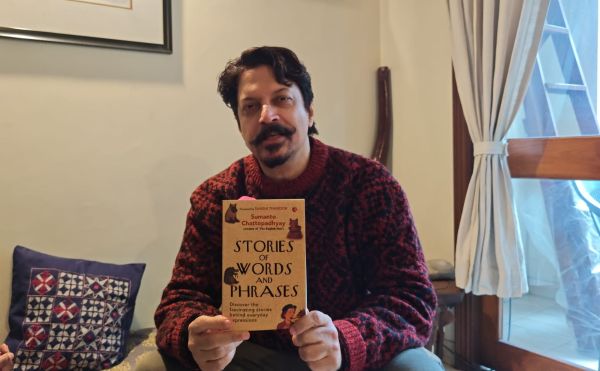
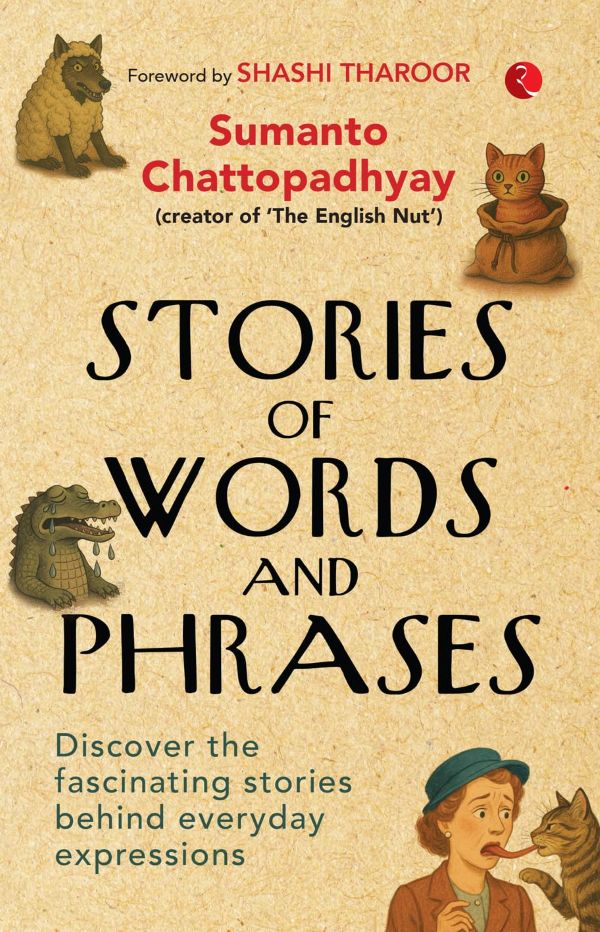
For many cybernauts, Chattopadhyay may be The English Nut, but he is also a fine teacher who can explain the dynamism of the English language without the burden of academics. It will, indeed, be a cakewalk for readers of his debut book, Stories of Words and Phrases, to learn and enjoy the etymologies, and all thanks to Chattopadhyay’s lucid presentation.
 Language is dynamic and holds in itself stories that, over the ages, have shaped and sharpened it to become acceptable to speakers and writers in a given period. As American philosopher Ralph Waldo Emerson would say, “… language is the archives of history, and, if we must say it, a sort of tomb of the muses.” He terms language as “fossil poetry”. So, when etymologists, such as Chattopadhyay, perform a ‘carbon-dating’ on words, they are actually exploring stories buried under the burden of mere communication.
English, which is every Indian’s colonial inheritance, has long undergone ecdysis to have an indigenous identity. And yet, it is fascinating to know the roots of many words and expressions that extend to the West. It is also interesting to know that our colonial cousins borrowed, or at times ‘looted’, some of the words from the East. The book has a collection of many such words and phrases, such as thug, loot, dacoit and chess. Whether looted or borrowed, these words, and many more, have, over time, created a cornucopia of expressions that enrich the language today.
Chattopadhyay’s research is deep, and that is evident from the elaborate ‘References’ section at the end of the book. He not only writes about the history of many words and expressions, but also cites valuable anecdotes.
If the book leaves readers wanting more, then there is always the Nut(ty) professor offering online classes. And if that also falls short of the readers’ ravenous appetite to know more about the language, then be as patient as Job until the author comes up with more intriguing language stories. In an interview with Meghalaya Monitor, Chattopadhyay hinted at the possibility of a sequel to the book.
While Chattopadhyay, who had an illustrious career in advertising, needs little or no validation for his scrupulously researched book and sincere efforts to share his knowledge with all and sundry, a foreword by Shashi Tharoor, whose linguistic prowess is known to all, and the generous words of none other than Ruskin Bond add value to the book. It is indeed a great addition to your collection on the shelf for a quick reference to words and phrases that may help your conversations pack a punch.
Book: Stories of Words and Phrases; Author: Sumanto Chattopadhyay; Publisher: Rupa; Pages: 277; Price: Rs 395