

Malik Ayaz: A great administrator, trader par excellence
Malik Ayaz’s contribution to the history of Gujarat speaks volumes; it was because of him that the Portuguese could not get any foothold in Gujarat

 As a student of history, I did my PhD in Indo-Portuguese history way back in 1989. To be precise, my title was ‘Social and Economic Aspects of Gujarat in the Sixteenth Century-A Study Based on Portuguese Sources’. One thing that fascinated me during my research and while writing my thesis was reading about Malik Ayaz. It has stuck with me ever since, regarding the type of man Malik Ayaz was, and since my PhD thesis did not focus on him, I left it at that.
Recently, I was reading some chapters from my thesis, and I once again saw the name Malik Ayaz. I started reading about him and found that he was called Meliqueaz by the Portuguese. He was one of the most distinguished warriors, a naval officer and the Governor of Diu around 1507-1509.
Making of the ‘Malik’
Malik Ayaz was a Georgian by birth and rose from slavery to higher ranks, becoming the Governor of Diu in the 15th century. According to history, he was born in 1451 in the Eurasian race.
History says that he was caught by the Turks and sold to a Middle East Arab trader who frequented Gujarat. This saw his entry into Gujarat, where he was gifted to Mahmud Begada, Sultan of Gujarat. He impressed the Sultan by killing a falcon and was freed from being a slave and awarded the title “Malik” for his sharpness and agility.
Soon, Ayaz got appreciation for his skills and integrity, and he was appointed the Governor of Diu. He served as an administrator and commander under the Sultanate of Gujarat and was appointed by Mahmud Begada.
His skills included building a strong navy, which not only made him powerful but also established him as a merchant. The naval army ventured into the Indian Ocean to win many battles, and Malik Ayaz soon became a powerful business mogul.
As a result, he became a successful strategist and an able ruler. His skill as a merchant warranted him to trade with several of the Southeast Asian countries (China and Indonesia), Arabia and Egypt. Internally, he focused on Malabar, Chaul and Coromandel.
Life of the great administrator
After Malik Ayaz became the Governor of Junagadh, he started looking after the trade in Diu. He revived the trade both nationally and internationally. He had the best military in the entire kingdom and commanded great respect from other nobles on account of his influence with the Sultan. He managed to disregard Malik Gopi, another powerful noble, and got him murdered. Whenever the Sultan was confronted with enemies and was in difficulty, it was Malik Ayaz to whom he would resort for help. Even though the Sultan was obliged to give a site to the Portuguese for building a fortress, Malik Ayaz kept them at bay. As a result, the Portuguese could not get any foothold in Gujarat.
It is well-known that Malik Ayaz owned four ships of 500 to 800 tonnes. One of the most crucial wars fought by him was the Battle of Diu in 1509. Despite the strength and naval power of the Europeans, he survived the battle and continued this with the Estada da India till his death in 1522.
Malik Ayaz observed that the Sultans neither had the experience and capability of waging fierce battles nor were they equipped with weapons to defend themselves. He used his naval strength and warfare equipment to defeat the enemies.
Using this as a clever ploy, he launched himself as a businessman. It is stated that he improved the infrastructure of the port of Diu to attract and encourage trade activities. He reduced the customs duties to attract foreign and local traders.
Life as a merchant
His naval strengths encouraged him to venture into trade in the Indian Ocean. He became a successful businessman, and under his leadership, the port of Diu got an improved infrastructure that enabled safe anchoring of ships for both loading and unloading trade goods. In addition, he reduced the duties and taxes of Diu to attract and encourage foreign tradesmen. Malik Ayaz proved himself as an able administrator, competent merchant, diplomat, statesman, naval commander and the creator of the port of Diu.
Ayaz was known to live a luxurious life. His love of good food led him to employ chefs from around the world who cooked world-class cuisine. His kitchen was also open to the hungry, and he hosted several parties. His crockery and cutlery were made of silver, and his servants were given expensive velvet uniforms.
Malik Ayaz died in 1522 on the Una Island near Diu. He was buried near Shah Shamsuddin’s grave. His solitary grave remains even today. Though his estates were given to his son Ishak, he could not equal his father’s naval powers, might and business acumen.
Malik Ayaz’s contribution to the history of Gujarat speaks volumes. He was known for his diplomacy, strategic approach to military warfare, and excellent craftsmanship. He was not a kingmaker but became a great asset to the Sultanate of Gujarat due to his unwavering commitment and knowledge.
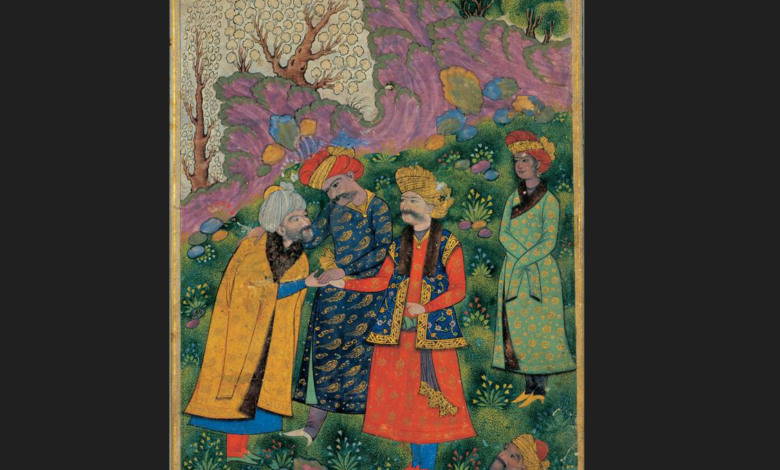
Banner image by Muhammad Ali, Public Domain, https://commons.wikimedia.org/w/index.php?curid=359948