
Modi’s Manipur visit an eyewash that ignores ground realities
People of Manipur deserve more than symbolic gestures, they deserve justice, rehabilitation & a future free of fear

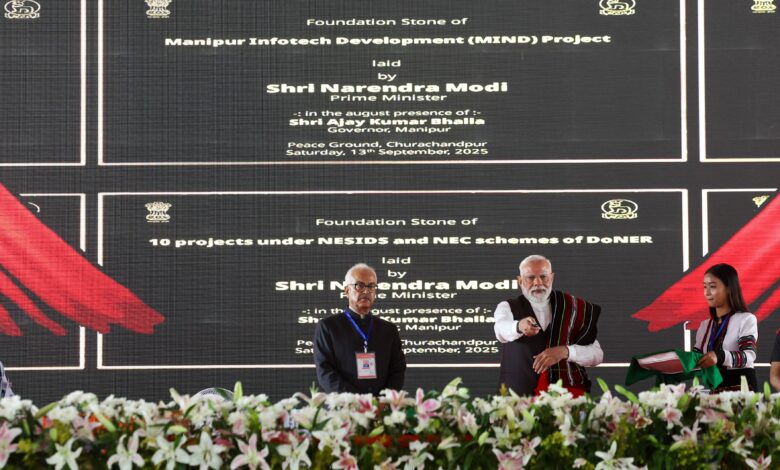
 After more than two years of silence and absence, Prime Minister Narendra Modi finally set foot in Manipur — a state torn apart by ethnic violence, political mistrust, and humanitarian suffering since May 2023. His visit, long-awaited by the people, came amidst mounting criticism from the opposition and civil society. For many, his presence was supposed to signal hope and a new chapter in peace-building. Yet, on closer examination, his trip appears less about healing Manipur’s wounds and more about optics — a calculated move to silence critics rather than to genuinely resolve the crisis, an eyewash that ignores ground realities.
For a region reeling under violence, displacement and deep ethnic fault lines, the Prime Minister’s belated arrival was expected to bring concrete plans for reconciliation, justice, and rebuilding. Instead, Manipur received a carefully choreographed tour designed to project control, without addressing the burning questions of accountability, rehabilitation, and dialogue.
The backdrop of the conflict
Manipur, often described as the ‘jewel of India’s Northeast’, has long been a mosaic of communities — the valley-dwelling Meiteis and the hill-dwelling tribes, including Kukis, Nagas, and others. Coexistence has always been uneasy, marked by competition for resources, land, and political power.
In May 2023, simmering tension erupted into full-scale conflict after a controversial court order sought to grant Scheduled Tribe status to the Meiteis. Tribal communities perceived this as a threat to their land rights and identity, sparking violent clashes between Meiteis and Kukis. The violence spiralled: homes torched, churches destroyed, families displaced, and hundreds killed.
Entire districts became no-go zones for rival communities. Armed militias roamed freely. Relief camps swelled with tens of thousands of displaced people, most still living in dire conditions. Even as the humanitarian toll grew, the central government remained largely absent, with the Prime Minister maintaining a conspicuous silence.
Against this backdrop, Modi’s sudden visit seems less a commitment to peace than a reluctant political necessity.
The Centre’s delayed response
One of the sharpest criticisms of the central government has been its lethargic response. While Manipur burned, the Prime Minister refrained from visiting or addressing the issue directly. His silence stood in stark contrast to daily appeals from opposition leaders and citizens.
Parliament witnessed heated debates, with the opposition demanding that Modi break his silence. His refusal fed the perception that Manipur was not a priority for the leadership. When the visit finally came, it seemed driven not by compassion but by political calculations.
Ground realities ignored
To those in relief camps, Modi’s visit brought little but disappointment. Conditions remain dire: inadequate food, limited healthcare, and no educational facilities for children. Families displaced from their ancestral homes remain stuck in limbo.
The social fabric of Manipur lies in tatters. The trust deficit between Meiteis and Kukis has widened into a near-unbridgeable chasm. Roads connecting the valley and hills are heavily militarised. Armed groups still dominate, while ordinary people feel unsafe despite a heavy security presence.
People expected from Modi an honest acknowledgement of these realities, a road map for rehabilitation, and a commitment to dialogue. Instead, they saw staged interactions and vague assurances. No plan was laid out for resettling families, no timeline for reconciliation was offered, and no accountability was fixed for governance failures.
Symbolism vs. substance
The Prime Minister’s trip was marked by symbolism. He met with selected delegations, visited certain camps, and spoke of unity. But symbolism cannot substitute for substance.
There were no major policy announcements, no declaration of a reconciliation process, and no blueprint for rebuilding trust. Even on relief and rehabilitation, the visit lacked clarity. Presence without purpose deepens disillusionment. For many Manipuris, the visit felt like a performance crafted for national audiences, not a genuine engagement with their suffering.
READ NORTH EAST STORIESDevelopment as distraction
A striking feature of the tour was the inauguration of a new railway connectivity project in Mizoram. The stopover in Imphal was projected as a show of commitment, but the timing was odd. With Manipur still struggling under conflict and displacement, ribbon-cutting ceremonies appeared disconnected from ground realities.
In Manipur itself, the Prime Minister announced or laid foundation stones for projects aimed at both Meitei and Kuki-Zo areas. The intent was clear: to appease both sides and project a balanced investment narrative.
Yet, many asked: what good are new foundation stones when homes lie in ashes and families are scattered? Even the announcement of development projects worth ₹7,300 crore cannot quell the suffering of Manipuris who continue to live in relief camps, far from their homes and livelihoods. Development cannot substitute for reconciliation, nor can it erase the trauma of violence.
Politics, not compassion
The timing of the visit raises questions: why now, after more than two years? The answer lies in political calculations.
The BJP, ruling both the Centre and the state, has faced mounting criticism for mishandling the crisis. With elections approaching, the government could not afford to let the opposition dominate the narrative. The visit was, therefore, a political necessity — a way to reclaim lost ground and project responsiveness.
But by treating Manipur primarily as an electoral issue rather than a humanitarian tragedy, the government risks alienating its people. Communities already feeling unheard see their suffering instrumentalised for politics, deepening resentment.
Voices from the ground
Civil society groups, student bodies and displaced families have been vocal in their criticism. Many feel betrayed by both the state government and the Centre’s indifference.
Their demands are simple: displaced families want safety to return home, accountability for violence, justice for those killed, and compensation for destroyed property. Civil society calls for structured dialogue that includes grassroots voices, not just political leaders.
These are not radical demands — they are basic requirements for peace. Yet the Prime Minister’s visit did not engage with them meaningfully. By ignoring these voices, the government reinforced the perception that optics mattered more than solutions.
What real leadership requires
Manipur does not need tokenism; it needs leadership. That begins with acknowledging failures at both the central and state levels. It requires mechanisms for accountability, ensuring those responsible for violence face justice, regardless of political links.
Leadership also means investing in rehabilitation. Relief camps cannot be permanent. Families must be resettled in their homes, children must return to schools, and farmers must go back to their fields. Without such measures, peace will remain elusive.
Most importantly, leadership requires dialogue. The gulf between Meiteis and Kukis cannot be bridged by token gestures. It demands sustained talks, facilitated by neutral mediators, with the aim of rebuilding trust. The Centre must lead this process with sensitivity, impartiality, and humility.
Modi’s visit to Manipur, after more than two years of absence, was billed as a moment of healing. Instead, it revealed the hollowness of a leadership that prioritises optics over substance. The visit may have silenced critics in Delhi, but in Manipur, it did little to restore hope.
The people of Manipur deserve more than symbolic gestures. They deserve justice, rehabilitation, and a future free of fear. Until words are matched with action, the Prime Minister’s visit will remain what it truly was: an eyewash.