
Shaping the future of Pnar language
The Jaintia literary body is preserving & promoting the language to protect the unique identity, write Prof. PM Passah & Dr Omarlin Kyndiah


According to some people, the Jaintia language is just a dialect of Khasi. But, considering what an eminent linguist, RH Robins, has stated in his General Linguistics: An Introductory Survey, the Jaintia language is a language in its own right. Robins said, “…. the linguist must either recognise some mutually unintelligible tongues as comprised within one language, or better divide the area into several languages is with the admission that some dialects of one may be also intelligible with some dialects of another that lie adjacent to them. Or he may fall back on extra-linguistic, political, or geographical division.”
In addition to its core mandate of preservation, development and scholarly research on the Jaintia language and literature as outlined in Article 8 of its Constitution, the Jaintia Language and Literary Association actively advocates for the official recognition and institutional implementation of the Jaintia language on par with other recognised languages in Meghalaya and Northeast India.
The Association strives to ensure that Jaintia is included in educational curricula, government communication, media and public life, thereby affirming its status not merely as a dialect but as a distinct linguistic and cultural heritage. By promoting its use in formal and informal domains, the Association seeks to empower Jaintia-speaking communities, safeguard intergenerational transmission and secure the language’s rightful place within the multilingual fabric of the region.
Publication of the Jaintia language
Whatever may be the case, the Jaintias who continue to accept Khasi as a medium of instruction in schools would not give up their mother tongue. The Jaintia language has been written down since at least 1900, when two early pieces about it appeared in the Linguistic Survey of India. Even though many Jaintias use Khasi as the medium of instruction in schools, they have always held on to their mother tongue.
Over the years, writers and scholars have published many books, articles and documents in the Jaintia language, using a writing system based on the Roman script similar to the one used for Khasi and adapted from the English alphabet. Some early examples include Kiri Dkhar’s writings on the 1897 earthquake and Albin Pariat’s Ka Kot Rwai Pnar (1937). Since then, numerous works have continued to be published, helping to preserve and promote the Jaintia language up to the present day.
The Jaintia language movement
A movement has always been there to preserve the Jaintia language since education was introduced in the Khasi and Jaintia Hills by the British in the last century. But an organised movement not only to preserve but also to develop and research the language and its literature was first started in 1974 and resulted in the formation of the Jaintia Language and Literary Association the next year.
According to late Albin Pariat, who used to be regarded as the national poet of the Jaintias, there was a strong and enthusiastic move among the members of the Jaintia Labour Corps, which joined the war service during the First World War in France and the Middle East, to initiate attempts for the development of the Jaintia language.
But after the war, according to Pariat, the erstwhile members of the Corps could not be contacted and brought together to achieve their declared goal. He, on his part, however, was completely absorbed in composing songs and poems in the Jaintia language as soon as he returned from the War. His poems were subsequently published in his Ka Kot Rwai Pnar in 1930. Continuing this legacy, L Sungoh another devoted Jaintia writer, composed the song I Rwai Lai Thma France, which poignantly captures the wartime experience and sentiments of the Jaintia Labour Corps.
Mih na yung khyruiñ thadoh
U Khublei sa shisien
Ya ki kha ki man waroh
U khublei dei mynsiem
Kitbok khadar Dalloi
Yoh i cha yung u poi
Ham ya diaw ya kiwa lai
Cha yung u poi dei rakhai
Kattu da toh i por
U ya æh yei lum yei thor
Chawa sep ka sngi u lai
Chynrang wow khih wow kamai
Further, according to the late Rev. Lowel Gatphoh, an attempt was made by the late Rev. G Angel Jones, a Welsh missionary, to get the Bible translated into the Jaintia language. Jones made his proposal in one of the meetings of the Assam Branch of the erstwhile Bible Society for India, Pakistan and Ceylon, of which Gatphoh was also a member.
According to Gatphoh, most of the members present at the meeting felt that the Jaintias could easily cope with the Khasi language because of its fairly long usage among them, and hence, Jones’ proposal was dropped. Jones, who was stationed at Jowai, was fluent in the Jaintia language and was convinced that the Holy Bible could be translated into that language.
The people of Jowai, especially the Jaintia community, have long been writing in their own language not just for books or schools, but for their vibrant cultural life. Every year, during festivals like Bam Phalar, Chad Sukra, Behdeiñkhlam, and other social gatherings, they create plays, songs and dances performed entirely in Jaintia.
Bam Phalar, in particular, is held annually by the seven localities of Jowai known together as Poh Chnong. Each locality traditionally stages at least three original dramas every year, all written in the Jaintia language. If we take a modest average of 14 dramas performed yearly, this means around 1,100 drama scripts have been written in Jaintia over the past 78 years alone.
After India’s Independence, the Jaintia language programme was also introduced on All India Radio. Over the last 75 years, this has led to the creation of a vast collection of radio scripts, stories and dialogues in Jaintia, much of it preserved in archives or memory, even if not formally published.
Together, these efforts show how deeply the Jaintia language lives — not only on paper, but in performance, voice and community celebration.
Activities of the Association
The Jaintia Language and Literary Association (Ka Sein I Ktien Wei Thoh Jaintia) has played a key role in promoting and preserving the Jaintia language. It has organised five major conferences where all activities, including speeches, debates, extempore talks, quizzes and literary competitions, were conducted entirely in Jaintia.
In 1984, the Association honoured the legacy of the renowned Jaintia poet Albin Pariat by hosting a special Memorial Lecture in his name, delivered in the Jaintia language. It also published Kyrsu, a quarterly journal dedicated to Jaintia literature and language. Structured under its Constitution, the Association operates through five sub-committees: the Script and Spelling Committee, Research and Publication Committee, Textbook Committee, Literary Committee, and an Editorial Board.
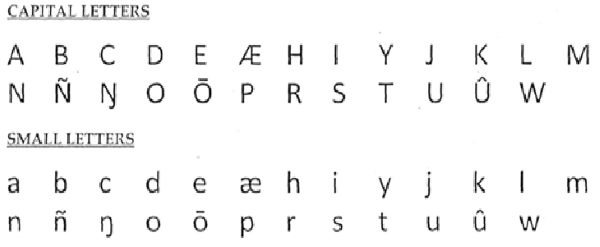
A major milestone came in 1975, when under the leadership of Professor B. Pakem, then Vice-Chancellor of North Eastern Hill University, the Association formally adopted a standardised Jaintia alphabet in Roman script. Developed by the Script and Spelling Committee, this alphabet consists of 33 letters: 28 borrowed from the Khasi version of the English alphabet and five specially added to represent distinct Jaintia sounds. The system is largely phonetic, ensuring that written forms closely reflect spoken pronunciation.
Efforts to standardise and promote the language
Building on these efforts, the Jaintia Hill Autonomous District Council (JHADC), on January 25, 2017, constituted the Jaintia Alphabet Committee to further refine and standardise the script. A sub-committee chaired by Professor PM Passah submitted its report in July 2018. Most significantly, the JHADC officially notified the Jaintia Phonetic Alphabet in July 2022, which was published in the Meghalaya Gazette on August 11, 2022. This formal recognition marks a crucial step in institutionalising the Jaintia script and reaffirms the community’s enduring commitment to linguistic preservation, education and cultural identity.
Keeping the language alive
The Jaintia language is more than just words; it carries the history, culture and identity of the Jaintia people. For generations, it has been used in songs, plays, radio programmes and daily life, even when it was not taught in schools. Thanks to the hard work of writers, scholars and community leaders, the language now has a standardised script and official recognition from the JHADC.
But the work is not finished. The next important step is to bring the Jaintia language into classrooms so that children can learn and grow up speaking, reading and writing it confidently. Teaching the language in schools will help ensure that it survives and thrives for generations to come.
Every child deserves to learn in their mother tongue, for it builds confidence, strengthens cultural roots, and keeps traditions alive. Let us support this cause and make teaching Jaintia in schools a reality, not just a dream.
It is now for the JHADC to implement the Jaintia alphabet as urgently as possible. It can start with the introduction and teaching of these alphabets to their own schools, which are now more than 70 in number. The JHADC has the power to do this in its own schools. The teaching of these alphabets could be one period of 40 minutes or so on any day of the week.
(PM Passah is a retired professor of Economics, North Eastern Hill University. Dr Omarlin Kyndiah is Associate Professor and Head of the Department of Biochemistry at St Edmund’s College, Shillong)