

SHORT STORY: A House for Mrs Biswas
The ageing house demanded constant attention, and Mrs Biswas took care of it. But for how long? Nilanjan P Choudhury tells her story

Mrs Biswas’s face fell. “They’ve thrown you out of your job, isn’t it!” she exclaimed. “I knew it. I told you! If you show your face in the office only on payday, then who will keep you? Even the government of India is not so kind. I told you! But do you ever –”
“No, no, I haven’t lost my job,” Mr Biswas interrupted. “On the contrary, you have gained a house,” he twirled the ends of his bushy moustache. “That too, on Jail Road.”
“Spare me your tall tales,” she replied. “House indeed! Is your job –”
“Oh, forget my job, will you!” he exclaimed. “I’m talking about our house, our very own house!”
“Our own house, huh?” she scoffed. “And that too on Jail Road. You wouldn’t even be able to afford a handkerchief there with your AG office salary. Speaking of which – you’re sure you still have your job?”
“Will you stop, please! Have you ever heard of anyone in the AG office losing their job? They don’t fire even certified lunatics.”
There was a grain of truth in this. The Accountant General’s office was the Hotel California of Shillong. Once someone got in, they never left. Mr Biswas had been employed there as a clerk for the last twenty years. It was a dream job. Every morning, he would make a brief appearance in the office, sign the attendance register and then vanish, spending the rest of the day gallivanting about town and busying himself with all sorts of social causes.
A few years ago, Mr Biswas and a few other quixotic individuals had together founded a social service organisation named the Shillong Citizens Forum. The forum had recently embarked upon two ambitious projects for the betterment of the town – shoshaan ghat (crematorium) and bhashaan ghat (immersion point), as Mrs Biswas would sarcastically call them.
The first was to persuade the government to build an electric crematorium in a non-tribal area. The only crematorium in those days was located deep inside a Khasi-dominated neighbourhood. Most Bengalis were scared to go there, especially after dark. It wasn’t ghosts that struck fear into their hearts, but memories of the ’79 riots that still haunted them.
Non-tribals dreaded having to carry their dead through hostile Khasi territory to reach the crematorium. They had a niggling fear that if they got unlucky, their own last rites might have to be performed, alongside the deceased. And so, people on their deathbeds received gentle hints from their well-wishers that it would be nice if they could manage to die well before sunset.
Mr Biswas thought this was intolerable. “Aamrar dekhi ikhano moriyao shanti nai,” he would mutter angrily in Sylheti, “no peace in this place, even after death.” So, he spent his days drafting petitions, writing indignant letters to the local newspapers, meeting ministers and politicians, and soliciting public support for his shoshaan ghat.
The remaining time was spent collecting donations for his second pet project, the bhashaan ghat – a concrete pier that was to be raised on the banks of the Wah Umkhrah stream in Polo Grounds. This was where the idols of goddess Durga were immersed during the visarjan on Vijaya Dashami. A muddy, slippery slope led to the stream and the young men carrying the massive idols would often lose their balance and tumble into the mud. This was no way to send Ma Durga and her family back home to Mount Kailash, thought Mr Biswas, and he took it upon himself to give them a more dignified farewell.
With Mr Biswas more concerned about the mother goddess and her children, the responsibility of taking care of their own children fell squarely on Mrs Biswas.
***
The Biswas-es had two children – Tinku, a girl of fourteen and Tublu, a boy of ten. They lived in a rented house in Malki – all crammed into a tiny two-room tenement with a common toilet that had to be shared with the landlord.
Mrs Biswas often dreamt of a house of her own. Nothing grand or fancy — just a small cottage with a private toilet. Perhaps a little garden to grow a few roses, eke out a cabbage patch — that would be bliss. But she had little hope that her dreams would ever come true. Houses were for the worldly-wise, not wild goose chasers with no money, like Mr Biswas. So, when he told her that he had bought a house in a prime locality like Jail Road, she brushed it aside.
But Mr Biswas twirled his moustache and gave her an enigmatic smile. “Just wait and watch,” he said. “Before this month is over, you will move into your new home on Jail Road.”
***
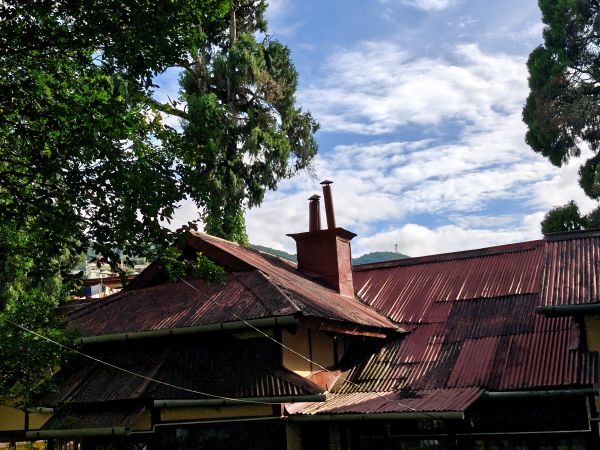
He wasn’t lying. The following week, much to her disbelief, Mr Biswas took her to Jail Road and showed her the house that he had bought for her. It was just as Mrs Biswas had imagined — a pretty little Assam type cottage, crowned by a slanted red tin roof that stood upon whitewashed walls of wattle and daub. It even had a small garden, overrun though it was with weeds and wild lantana bushes. But for Mrs Biswas, it was no less than the garden of Eden, for she could already see the clumps of crimson gladioli, waxy-leaved camellias, and monkey-faced pansies that would soon bloom there. A wooden nameplate nailed to the front gate read: ‘Nirmal Niketan’.
“You really bought this house!” Mrs Biswas gasped in bewilderment. “But how? It must have cost a fortune!”
“Only thirty thousand rupees,” Mr Biswas replied airily.
“That’s impossible!” Mrs Biswas said. “A house like this would cost at least two or three lakhs — if not more.”
“Well… let’s just say I got a discount from the owner,” Mr Biswas said.
The reason for the discount soon became clear. There was a fly in the ointment. A fly named Photol Choudhury. Photol-mama (as he was universally known) had been staying in Nirmal Niketan as a tenant for the last ten years. And by the looks of it, he had every intention of staying there for the next twenty. An imposing, well-built man, he ran a body-building club on Jail Road and had the reputation of being a bit of a ruffian.
The owner of Nirmal Niketan, a retired bank officer now settled in Calcutta, was keen to sell off his Shillong house. But the formidable Photol-mama dug in his heels, chasing away any prospective buyers with the ferocity of a Cerberus at the gates of Hades. A protracted legal battle now commenced between owner and tenant, and the house remained unsold for years.
Until Mr Biswas arrived on the scene and made the long-suffering owner an offer that he could not refuse — the princely sum of rupees thirty thousand for the property, with Photol-mama and his family thrown out for free.
***
“You are mad,” said Mrs Biswas, her face blanching, after she learned of her husband’s doings. “Do you know who Photol Choudhury is? Everyone in Jail Road is scared of him. How will you ever evict him from our house?” she demanded.
“Just wait and watch,” replied Mr Biswas with a twinkle and a twirl of his moustache.
The next day, Mr Biswas hired a troupe of kirtan singers. They were instructed to arrive at Nirmal Niketan every night by ten o’clock, occupy the verandah and sing as loudly as possible all through the night. Of course, they could rest whenever they wanted, as long as they kept the kirtan going until dawn.
It was a most peculiar assignment, but the kirtaniyas jumped at it, for it was a full month’s work at a handsome fee. And so, every night after dinner, they would arrive at Nirmal Niketan and sing for all they were worth. Their raspy voices would join the harmonium’s wail, the beating of drums and the clapping of the kartal to make a most terrific sound that would explode inside Photol-mama’s sleepy head like a thunderstorm at midnight.
Photol-mama was in a fix. He could have easily thrashed the kirtaniyas black and blue and sent them packing. But he was a devout Hindu and did not dare strike these men of God. Being an illegal occupant, neither could he complain to the police. He appealed to the neighbours to stop this circus, but they were politely indifferent to his woes. Yes, the nocturnal ruckus was a pain, but it thrilled them no end to see someone finally giving it back to Photol-mama.
Within a week, the severe sleep deprivation had reduced Photol-mama to a bundle of nerves. But he was made of sterner stuff. The louder the kirtaniyas sang, the stronger became his resolve to stay put. Mr Biswas now decided to play his next card.
One morning, soon after the kirtaniyas had departed, a pair of cows sauntered into the garden of Nirmal Niketan. They were followed by a wizened old Bihari milkman bent double under a huge sack of hay. “Biswas-babu told me he wants to build a cow shelter here,” he informed Photol-mama. “Babu is a great man. Kishan bhagwan will bless him,” he said, chuckling fondly as he watched a cow nibble a lungi flapping on the washing line.
The cows did what the kirtaniyas could not. After one week of living with them, Photol-mama and his family fled from Nirmal Niketan. Mrs Biswas finally had a home that she could call her own. And she instantly fell in love with it.
She loved the way the sunbeams slanted across the kitchen table in the morning as she brewed her first cup of tea. She loved watching the mist rolling past the hills in the distance as Tublu and Tinku chased dragonflies in the garden, and Mr Biswas read his newspaper. And most of all, she loved pottering around the garden amidst the flowers and vegetables she had raised with her own hands.
“I will never leave this place. And if I do, it will be to go to my mister’s shoshaan ghat,” she said to herself, as a deep peace came over her.
***

But twenty-five years later, she wasn’t so sure anymore. Mr Biswas had died a few years ago, and with him, had died the shoshaan ghat project. In deference to his memory, Mrs Biswas herself had tried to keep it going, along with the few remaining members of the Shillong Citizens Forum. But after a while, the apathy of the government and her increasing age forced her to give it up.
She was all by herself now. Tinku was in Bangalore with a software company. Tublu had become a lawyer in Delhi. All their old friends and relatives had either died or left Shillong in the belief that they had no future there. She hardly recognised anyone these days.
Shillong itself had changed beyond recognition. Everyone seemed to own a car, and the traffic jams rivalled Bangalore’s — a dense, unbroken chain of vehicles winding through the heart of Shillong like a giant, poisonous snake of steel and smoke. If only people walked like they used to in the olden days, they’d reach wherever they wanted much faster, thought Mrs Biswas, and look much better too. But what dismayed her most were the ugly concrete apartments and shopping malls that had mushroomed all over town. Every day, someone was selling off their traditional Assam-type cottage to some builder, who would tear it down to construct a high-rise.
Jail Road bore the brunt of the construction boom. Nirmal Niketan was now besieged by monstrous concrete apartments, towering precariously above the sloping hillock upon which they stood. The hills and the stars had vanished from sight to be replaced by petticoats and underwear flapping in the breeze. Not everything had changed for the worse, of course. After decades of turmoil resulting from the tribal non-tribal conflict, peace had finally returned to the town. And that was no small thing. Yes, Shillong had changed beyond recognition, in more ways than one. But it was a Shillong that Mrs Biswas still loved — like a grown-up child one no longer understands but continues to adore.
And in this fluid, uncertain world, it was the house that had been her anchor and her refuge. Friends, children, husband, even Shillong itself, they had all deserted her — only the house had remained behind like a faithful companion. It had kept her going, given her a purpose in life, a reason to get out of bed.
For, like a cranky senior citizen, the ageing house demanded constant attention — its tin roof would leak in the heavy Shillong rains, old wooden floor planks would suddenly collapse, and the garden had to be defended from lantana attacks. Mrs Biswas took care of it as she would her own child, and the results were visible. The spruce little cottage and its blooming garden sparkled like a little green emerald amidst the grey concrete that had sprouted all around it. But she didn’t know how much longer she could keep it that way.
Like the house, she was also getting old — as Tinku and Tublu would remind her from time to time. How long could she manage everything by herself, they would ask. Stay all alone? What if she fell and broke her hip? What if the house was burgled? It was high time she left Shillong and lived with them.
Mrs Biswas’s head told her that the children were right. But her heart wanted to tell them to buzz off. Yes, she was old, alone. But she was fine. She would much rather live in her own house and on her own terms than be imprisoned in her children’s flat in the chaos of Delhi or Bangalore. And yet she knew a day would come when she would have to bend to the hard logic of her children’s wishes.
It came soon after her seventy-fifth birthday. Tinku and Tublu put their foot down. She would have to leave Shillong and move in with one of them. She could not be allowed to live alone anymore. Naturally, the house would have to be sold. With her gone, it was sure to fall into disrepair or worse — into the hands of a vile occupant like Photol-mama.
After much persuasion and much more reluctance, Mrs Biswas finally gave in — very well then, she would go. And with her would go the house.
***
A buyer was soon found — Ranajit Deb, a wealthy Bengali businessman who was suspected of having a finger in the illegal coal mining pie. Mrs Biswas took an instant dislike to him. But she finally decided to sell him the house because he was the only buyer who promised not to tear it down and build an apartment.
“What will I do with flats?” Mr Deb laughed. “By god’s grace, I have enough money. All I want is a traditional cottage just like this. Hardly any left in Shillong these days.”
The money bit certainly seemed to be true, for he was offering a breathtaking amount for the house that Mr Biswas had bought for only thirty thousand rupees.
“One crore and fifty lakhs,” Mr Deb said. “If you just sign here Mrs Biswas, it’s all yours. And your children’s of course,” he grinned at Tublu and Tinku, who were standing beside their mother. They had come down to Shillong so that they could all stay together for once last time in the old house, like in the old days.
Mr Deb pushed the sale deed towards Mrs Biswas and offered her a pen. She took it from him and uncapped it. The nib trembled over the paper. “Go ahead, Ma,” Tinku said gently to Mrs Biswas. Tublu placed a hand on her shoulder.
“Yes, just give me a minute, please,” Mrs Biswas said, her eyes abnormally bright. She drew a deep breath. “One minute, please, before I sign away twenty-five years.”
She sat still as a rock. All of a sudden, she shot out of her chair and strode into the garden. The children followed her, watching silently as she removed a yellowing leaf from a hydrangea bush. She stood quietly for a while and then turned abruptly to face Tinku and Tublu.
“Please tell Mr Deb that I’m sorry. But I cannot sell the house. It is my home. I cannot leave it,” she said.
“But Ma!” the children exclaimed.
“Not today, at least. Today I cannot go. I’m sorry. But I just can’t. And I don’t have to, do I? I am only seventy-five, still in good health. I can take care of myself. In fact, I can take care of more than just myself.”
“Meaning?”
“Something has been niggling at me ever since the day I decided to go. You see, I still have some unfinished work here — your father’s shoshaan ghat. I’d like to give it another try. Your father would be happy — even if I failed.”
“You can’t be serious, Ma!”
“I am cent per cent serious. Eighty-year-olds are running marathons these days. I’m only seventy-five. I can try. I might even do it. Shillong is a different place today. People are more open to new ideas. Things are happening. Who knows, maybe even your father’s shoshaan ghat will finally happen. And if it does, I’d like to go there myself when the time comes.”
“Not that I intend to go anywhere, anytime soon,” she chuckled loudly and straightened her shoulders.
It was as if the weight of half a century had suddenly rolled off her back.
(Nilanjan Choudhury is a novelist, theatre-maker and science communicator)