
Story of Balpakram and Garo beliefs in children’s book
New book under The Forgotten Folktale Project authored by Jemimah Marak talks about the tribe's rituals & afterlife

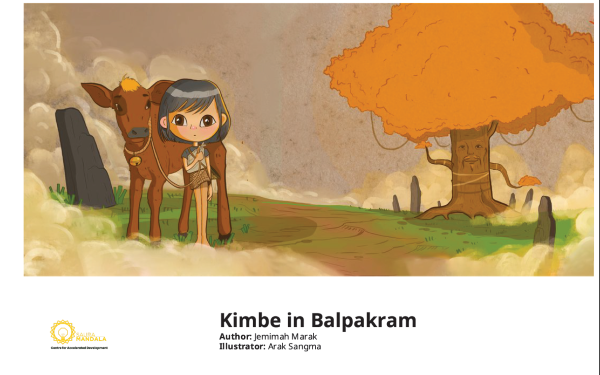
 Folktales are stories about people, nature and their coexistence. These stories, through simple narrations, can create indelible images. Hence, folktales are a perfect medium to teach children about their cultural roots. Kimbe in Balpakram is one such addition to The Forgotten Folktale Project by Sauramandala, an NGO that has been working in Meghalaya since 2019.
“Folklore is one of the strongest foundations a child can grow up with,” says educationist Jemimah Marak, who has authored the children’s book in illustrations.
It is the story of Kimbe, a little girl, whose spirit watches her family mourn her death. Initially, she finds it difficult to comprehend the situation. But she gradually comes to terms with reality. She sees her grandmother sing dirges for her, and her parents and siblings in bereavement.
Through this poignant story, Marak has narrated the Garo beliefs about Balpakram, the national park in South Garo Hills.
“Balpakram is considered purgatory, a temporary abode of spirits, where souls go to be cleansed before entering the Dal•gipa Nalsa (the great beyond),” says Marak.
The author also talks about mangona, a solemn and elaborate ceremony to guide the spirit (memang) to its final resting place. During mangona, a special structure called a delang (a small bamboo shrine) is often built to honour the deceased. The ritual involves singing funeral dirges called the ajea, sacrificing animals and communal feasting to ensure the spirit is well-provided for during its journey to Balpakram, she explains.

Kimbe’s parents send her favourite calf with her spirit as a companion. Together, they reach Balpakram where they find the Chidimmak pool.
“Chidimmak literally translates to ‘Black Water’ or ‘Soot Water’ (Chi= water, dimmak= soot). The Chidimmak is the Pool of Ashes, where the spirits wash the remnants of their cremation,” Marak says.
They also find the Matchu Boldak Karam, a huge needlewood tree that is believed to be the place where spirits tether their companion animals.
The simple story and beautiful illustrations by Arak Sangma will help children understand the tribe’s culture and know the importance of the biodiverse Balpakram in Garo beliefs.
In a short interview with Sunday Monitor, Marak shared her thoughts about folklore, Kimbe’s story and her upcoming projects.
How important is folklore for children?
Folklore is one of the strongest foundations a child can grow up with. It helps children be curious about and understand better who they are and where they come from by connecting them to their roots and the values their ancestors lived by. Folklore also teaches lessons about bravery, honesty, and respect for nature etc, through exciting stories and memorable characters.
Tales of mysterious places like the Matchu Boldak Karam or the Chidimmak pool encourage children to see the natural world with curiosity and wonder, not just as something to be used. Reading folklore from different cultures is equally important because it helps children realise that even if our stories sound different, the feelings behind them, such as love, loss, fear and awe, are shared by people everywhere.
Why did you choose to tell the story of Balpakram?
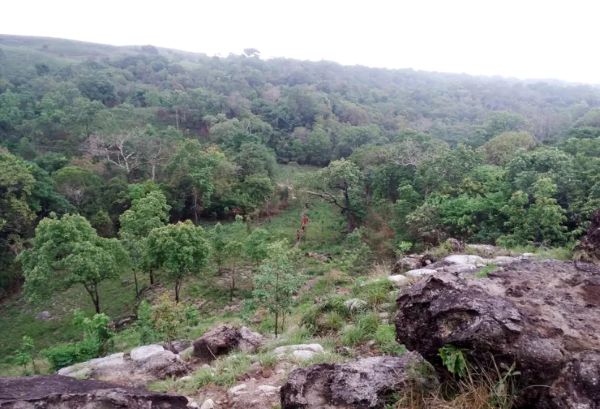
As someone who grew up listening to stories and was deeply fascinated by folklore from around the world, I also had the opportunity to hear many compelling folktales from my own community, especially those connected to the spirit world and Balpakram.
I chose Balpakram because it is one of the most culturally significant landscapes in Meghalaya and Northeast India. Often referred to as the “Land of Perpetual Winds” and/or the “Land of Spirits”, Balpakram represents a powerful intersection of natural beauty and metaphysical mystery. It offers a unique lens through which the Garo people understand life, death, and the environment.
I chose Kimbe as a narrative guide to help readers connect emotionally with these stories and enter the world of Garo folklore in a relatable way.
What is your next project?
Balpakram is vast and rich with myths and legends, so much so that it would require a dedicated series to explore all or even most of its stories. I am currently working on another story set in Balpakram, which, like this book, draws from folklore and is woven around a relatable character. Through these narratives, I hope to continue exploring the cultural and spiritual depth of this remarkable landscape.