

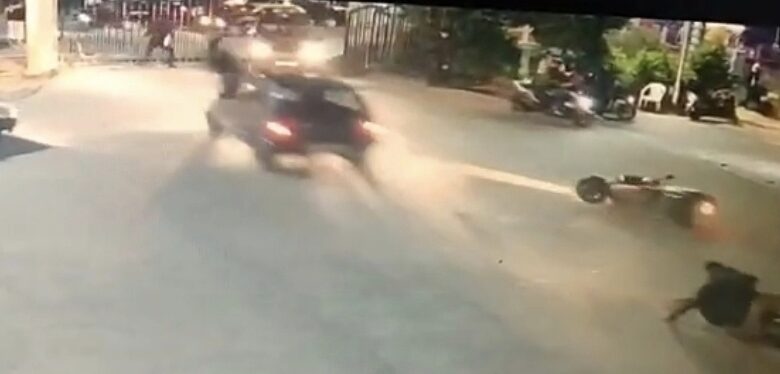
 On the night of November 18, a car driven by a drunk security guard of the North-Eastern Hill University mowed down two students on the campus. The girls are still in the hospital in critical condition.
On October 5, two people died at Quinine in Ri Bhoi after a truck lost control, crossed over to the other lane and hit a vehicle.
Just two days before that, four girls died in a road accident at Mawlasnai in Ri Bhoi.
A month before that, a 39-year-old biker rammed into a bus from the wrong direction on the Shillong-Guwahati road.
The list can go on, as road accidents in Shillong and other parts of Meghalaya have become a regular occurrence. Road accidents have increased in the last 10 years, with the highest number of accidents in 2017 and a record low in 2020, which was a pandemic year.
We must acknowledge that Shillong roads are becoming increasingly unsafe, as are other parts of the state.
Meghalaya has long recorded relatively low totals of road accidents compared to larger Indian states, but the state’s road-safety picture is more complicated than a single headline number. Though the number of accidents has gone down by about 9% between 2022 and 2023, the number of fatalities has gone up by over 3% — points to increased severity of collisions and/or delays or gaps in emergency response.
Meghalaya’s steep slopes, narrow two-lane roads and unpredictable mountain weather magnify risk. A single loss of control on an escarpment road is far likelier to cause multiple fatalities than the same crash on a straight highway.
But beyond terrain, there are several other factors which cause accidents and fatalities. One important reason is the apathy among most of the citizens, both on the wheel and in the navigator’s seat, to use seat belts. Let me speak from my personal experience — every time I ask a friend or a colleague sitting in the front of a car to use the safety belt, the answer is common: “It is uncomfortable.”
This complete disregard for traffic rules and safety measures goes unpunished not only in the urban areas but also in rural areas because there is hardly any police personnel to keep a check on this. While the rule is strict about wearing helmets, it is disappointingly lax when it comes to using seat belts.
Another reason, which is the scariest, is rash driving, which is a result of drunkenness. Drinking and driving is a common thing in the state, and this is practised without remorse or fear of the law. There is no breath analysis on the road after dark. In fact, one would barely see police on most of the Shillong roads after 8 pm. This gives rogue drivers the opportunity to treat city roads and highways as Formula 1 tracks. The result? Innocents like the NEHU students are in hospitals or six feet under.
Even after such accidents and fatalities, the government has taken no strict or constructive measures. There is no consolidated data, no awareness programmes, no strict enforcement of MV rules and no conviction. There had been high-profile cases too, but all that was done was to hush up the incidents.
As an immediate measure, the government must install crash barriers, guardrails, and chevrons on known black spots and on all hairpin bends, and widen shoulders where terrain allows.
There has to be a time-bound drive on seatbelt enforcement, strict checks on vehicle overloading and commercial vehicle fitness — combined with visible, predictable enforcement.
The emergency response time needs to be reduced, and more ambulances need to be introduced in the wake of an increase in road accidents.
Besides, the district police must publish machine-readable monthly accident bulletins. This improves transparency, allows independent verification and enables rapid hotspot action.
Meghalaya’s official figures show a modest decrease in recorded accidents from 2022 to 2023, but a rise in deaths — a paradox that underlines the need to move beyond counting crashes to preventing the most deadly kinds.