

The adman & actor who became the English Nut
Sumanto Chattopadhyay's stories of words and phrases are delightfully engaging and liked by people from all age groups

EM Jose & Nabamita Mitra
The word celebrity has its origin in Latin celebritas, and initially meant ‘fame’ or ‘the state of being busy or crowded’. It came into English at the beginning of the 15th century. The Oxford English Dictionary first recorded the word in its current meaning, which is ‘well-known or famous person’, in 1831. Another source says the OED found the first printed use of the word as applied to a person in 1849, in the English novel, The Ogilvies.
Though the above etymological insight is not relevant to the introduction of Sumanto Chattopadhyay, alias The English Nut, it is probably the right way of introducing someone who is an authority on the English language and who has recently authored a book on the etymologies of words and phrases.
Having been an illustrious adman, an actor who worked with directors like Kumar Shahani and Aditya Vikram Sengupta and a known face in the late-nineties’ television advertisements, Chattopadhyay is undoubtedly a celebrity.
However, his virtual persona, The English Nut, which debuted in 2018, is more popular than the adman-model-actor combined. This is because he has made learning the English language — which has long unfettered itself from its British rigours and attained a unique Indian identity, not to mention its constitutional recognition as one of the two official languages in the country — delightfully engaging.
The making of The English Nut
Chattopadhyay has always been an English nut, who “had the terrible habit of correcting people”.
“I suddenly found myself in school in England, and I learned the language overnight. Reading was always encouraged at home. Every time I came across a word I didn’t know, I would ask my parents. So, they gave me a dictionary. I would always get fascinated with words which were similar to Italian, Bengali or any other language,” he told Meghalaya Monitor during an interview at his Kolkata residence.
“When I was in advertising, my colleagues would come to me for copy checks,” he said, adding that he started a blog about the language before the YouTube channel.
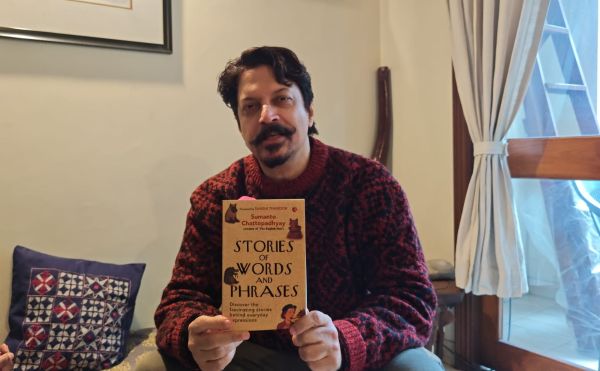
A conversation with The English Nut and his debut book — Stories of Words and Phrases, which was released last year and has a foreword by Shashi Tharoor, whom The English Nut had interviewed — could not be without stories about words and phrases. “One phrase that I can remember is going doolally. It comes from the British sanatorium in Deolali in Maharashtra, where shell-shocked soldiers would be sent… You know, the word ‘punch’ comes from the Hindi word ‘paanch’.”
WATCH THE INTERVIEW:
The book
Chattopadhyay’s channel became so popular that Rupa Publications approached him to write a book on the subject. “I wrote a much longer book, but the publisher said it had to be concise. I did a lot of research, and I have a lot of material for a sequel to the book,” Chattopadhyay said when asked about his next project.
Chattopadhyay also wanted Ruskin Bond, whom he had interviewed for The English Nut channel, to write “one or two sentences, (and that) would be a blessing for my book”.
“His quote came in late when the book was going for printing. But the publisher made it a point to put it in the book,” he said.
From ad films to movies
Those who remember the television advertisements in the late nineties and early 2000s might recognise Chattopadhyay from ads like the Kodak ‘first baby steps’, Wills Made for Each Other ‘diary’ with Sushma Reddy and Peter England with Kareena Kapoor. He also appeared on the cover of Sananda, a popular Bengali women’s magazine.
Chattopadhyay’s “latent interest in acting” became a passion over time, when he acted in both plays and movies. His first theatre acting beyond the school stage was in Barefoot in Mumbai, which was an adaptation of Barefoot in the Park by Neil Simon that was later made into a Hollywood film starring Robert Redford and Jane Fonda.
Later, he played Gautama Buddha, for which “I did a lot of research and studied Buddhism… and I grew my hair”.
“I studied all the hand gestures from the statues in a museum in London. I learnt what each gesture meant,” he recollected his preparation process for the play.
When the play opened at Bodh Gaya, the monks among the audience were so overwhelmed that they “told me that they can’t put the scarf (Tibetan khada) around my neck because ‘you are Buddha’”, Chattopadhyay narrated his “great experience”.
“Many in the audience were weeping… I felt it was a great responsibility as an actor to do something like that. It was a huge learning experience for me,” he added.
He has also acted in movies like Kumar Shahani’s Char Adhyay (1997), Aditya Vikram Sengupta’s Jonaki (2018) and Shoojit Sircar’s Piku (2019).
During the conversation, Chattopadhyay confessed that he always loved to be a student. And, it is this thirst for knowledge and insatiable curiosity about all things unknown that has prompted Chattopadhyay to learn more about acting and further prepare himself as an actor.
The Bengali bhodrolok
Chattopadhyay is a quintessential Bengali bhodrolok who does not have an ersatz accent (it was surprising and impressive at the same time) despite his upbringing in Manchester, Tanzania and the US. On the day the Meghalaya Monitor interview was scheduled, Chattopadhyay was unwell, and he was apologetic about it, too. But the interview continued beyond the permitted time limit as the conversation tempo changed with each topic.
Chattopadhyay is also a good raconteur, which makes his videos about the stories of English words and phrases interesting for people of all age groups.
If one has to examine the origin of his name, one can find how aptly it is connected with his innate qualities. Sumanto, in Sanskrit, means wise or good thinker (Su: good/great and manta: mind). His knowledge about the semantic development of the English language is admirable, and his deep interest in the evolution of other languages is infectious for anyone interested in linguistics.