

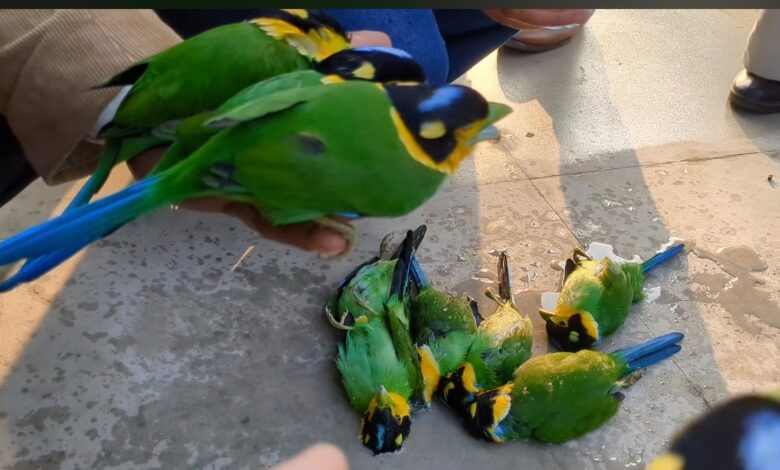
 Recently, 10 long-tailed broadbills died while flying from the Umiam lakeside towards the city. They collided with the glass façade of a car showroom, and many died of shock. Locals could revive some of the birds. According to forest officials, the birds must have mistaken the forest’s reflection on the glass for their destination.
This is probably the first time that Meghalaya witnessed such a tragic incident. Yes, it is a tragedy, and one caused by us.
Fatal flights are becoming common incidents around the world as development clashes with wildlife existence. Such tragedies are common during the migration season when birds travelling long distances pass through cityscapes full of ubiquitous glass fronts. In India, a 2025 study titled ‘Glass Traps’, recorded 35 incidents involving 22 species. The most vulnerable among the migratory birds was the Indian Blue Robin, and among the resident birds was the white-cheeked barbet.
The changing urban designs in the country have made such flights of death a common phenomenon here. The North East, too, is transforming the urban pockets, which still have substantial forest areas around them. Shillong too has seen fast concretisation and the vanishing of green cover. Nonetheless, the town has some great green patches, and the Umiam lakeside is among those.
The Umiam Lakeside is a birders’ delight. According to a 2025 census, there are about 14 species of water birds in the area. So, when urbanisation is happening around this avian haven, there has to be coordination between the Urban Development Department and the Forest Department. When permissions are given to showrooms and modern buildings, it must be made clear in the guidelines that builders have to either avoid glass facades or use bird-friendly glasses, such are etched, fritted and UV-coated glasses. These are common in the market nowadays. There are also some cheap methods to treat your glass façade so that birds are not attracted to the reflection on it.
Also, residents living in glass houses must be made aware of the fact that reflections of exterior or interior trees or plants on the glass or the reflection of interior lights are harmful to birds in flight. Birds not only get confused with their flight path but often end up meeting the same fate as those of the broadbills.
An initiative that is gaining momentum in American cities is ‘Lights Out’. The all-night lights of office buildings and streetlights in cities are responsible for drawing migrating birds off course, delaying their migrations and making them vulnerable to window collisions. True, Shillong is yet to attain the typical urban razzmatazz, but concretisation is a reality and individuals can choose any design. So, the Lights Out initiative should be popularised in urban pockets around forest covers in Shillong and in other northeastern states. N
Turning off nonessential lights and using downward-facing lighting are simple ways to reduce the problem of artificial light at night.
However, these are only precautions and cannot guarantee that the problem will be completely solved. So, what can we do? Should we not invest in development? That can never be an option for the human race. What can be done is have sustainable development. The government’s blueprint for urbanisation must consider the forested areas in and around Shillong and the ecology that is thriving there. There must be thorough checks before permitting any builder to raise a modern structure close to green patches and marked forests. In this case, there has to be zero tolerance for any corruption, and the Forest Department must be a stakeholder in monitoring the situation.
But before guidelines are laid down, the government must initiate a research and data collection process to determine the avian population, migratory birds and their routes, urban pockets hindering the routes and expert opinion on mitigating potential dangers.
We humans are encroaching on the habitats of animals and birds, and it is our duty to find a way to save what remains of the animal kingdom.