

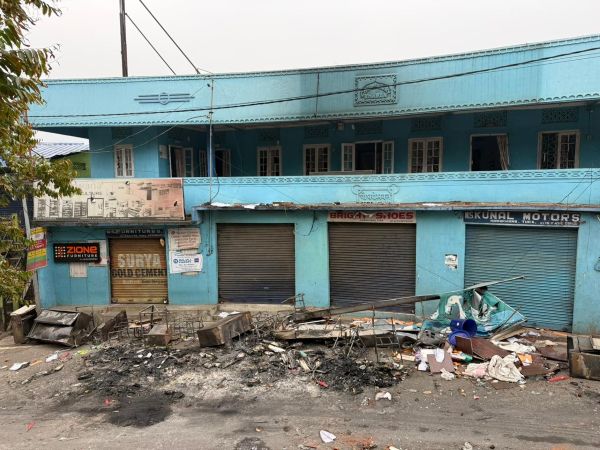
 The trouble over the participation of non-tribals in the election to the Garo Hills Autonomous District Council has snowballed into a major issue. Vandalism, police firing and deaths marked the last few days. There were also reports of an irate mob marching towards the chief minister’s house in Tura. The GHADC election has been postponed without further notice.
Now, the situation is under control. But the issue still lingers, and Chief Minister Conrad Sangma has to tread cautiously before the election. This is because the MDA government had already faced much criticism over the non-payment of salaries to the GHADC staff for over three years. While visiting the damaged NPP office in Tura a day after the vandalism, Conrad said, “Those who burned our party office today may think that by doing so they can end the NPP. But we all know that the NPP lives in the hearts of the people. Therefore, there is no way they can end the NPP.”
Was this a cryptic message to anyone or a group in particular? Considering the timeline of events, it could be read as so. Last month, the NPP released its first list of candidate names for the GHADC election. Surprisingly, it did not have the name of Albinush Marak, the present chief executive member of the GHADC. This created much hue and cry among Marak’s supporters.
Albinush represents the Siju constituency. NPP nominated Calis G Momin from Siju. He is a young candidate and was previously with the BJP.
The NPP candidate list was published on February 16. On February 17, the GHADC passed a resolution requiring all candidates to produce ST certificates, raising the non-tribal issue. Coincidence? Speculations are that Albinush Marak used his influence on his supporters to create a hostile environment over the issue, and in turn, unsettle the MDA government. However, while doing so, the GHADC leadership skipped a few crucial steps, and this has boomeranged on the council.
For any resolution passed by a district council, it has to be discussed in the House of the council members. Then, the resolution has to be sent to the Department of the District Council Affairs. The department will then send the resolution to the governor who has to give his assent. In this case, all these steps were ignored, prompting the High Court of Meghalaya to quash the resolution.
As we mentioned in our last episode, there is no specific rule in the 1951 Assam and Meghalaya Autonomous District Council Rules that bars a non-tribal from contesting. Historically, non-tribals have been contesting the GHADC elections. Of course, such instances are absent in the Khasi and the Jaintia Hills. So, to restrict non-tribals from contesting and voting in the council elections, a specific rule needs to be introduced, and this calls for an amendment of the 1951 rules. However, it is a long process and cannot be done just by randomly passing a resolution.
Keeping in mind that the autonomous councils under the Sixth Schedule are meant to protect the rights of the tribal population, the amendment can always be discussed and introduced, but following the legal method. Instigations and evoking emotions are not the channels to achieve this goal.
While the MDA government can be accused of several drawbacks and failures, in this case, it cannot be blamed solely. The previous governments did not foresee the brewing problem and did not take steps to seek an amendment of the rules. It was despite the fact that the demand for restricting non-tribals was always there.
Opposition leader Mukul Sangma recently lodged a police complaint against Esmatur Mominin for instigating communal disharmony. But when he was in the government, did he take substantial measures to address the issue of non-tribals as council members? No. In fact, the previous governments never took a stand on the existing 1951 rules or made a move to amend those as per the demand of many in the state.
In the end, the controversy over non-tribal participation in the GHADC election highlights a deeper governance gap rather than just a political dispute. Years of inaction by successive governments have allowed the issue to fester, eventually erupting into unrest. If there is genuine concern about protecting tribal rights within the autonomous council framework, the answer lies not in agitation or political manoeuvring but in pursuing a clear legal and constitutional amendment. Until then, attempts to resolve the matter through hurried resolutions or emotional mobilisation will only deepen divisions and further delay a lasting solution.