
Women’s Day Special: Hoping for menstrual justice
In January, the SC declared menstrual health an integral component of individual fundamental rights; but can this judgment address the gaps?

 In a landmark judgment delivered on January 30, the Supreme Court of India declared menstrual health an integral component of individual fundamental rights, making India the only country in the world to guarantee menstrual health constitutionally.
This far-reaching judgment linked menstrual health to the right to life under Article 21 of India’s Constitution, which, the Court emphasised, is not confined to a mere existence but includes the right to live with dignity, health, and self-respect, highlighting the need to dismantle the shame surrounding menstruation.
To ensure this landmark decision is not merely on paper but is implemented in practice, the Supreme Court will hear the matter again in April to assess how well the judgment’s mandates have been implemented across the country.
Lauding the judgment for addressing a long-standing gap between legal guarantees and lived experiences, Debanjana Choudhuri, a gender justice activist, said that “by recognising menstrual health and hygiene as an integral part of life under the Article 21, the Court acknowledged a reality that has been long affecting girls and women particularly, in silence and neglect because it stems from patriarchal mindset, stigma and taboo. The recognition is supported by the constitutional mandate under Article 15, which empowers the state to make special provisions for women by bringing menstruation into constitutional discourse.”
Taboos and gaps in India
In India, approximately one in four adolescent girls drop out of school annually due to challenges in managing their menstruation. Government data shows that approximately 4 million (40 lakhs) girls dropped out of primary education in the last four years. Perhaps this was one of the reasons that prompted the top court to intervene to make menstrual health a fundamental right.
Menstrual justice is a human rights and social justice framework that aims to end the stigma, economic barriers (period poverty), and structural inequalities that prevent individuals who menstruate from managing their periods with dignity.
Coined by legal scholar Margaret Johnson in 2018, it moves beyond “menstrual hygiene” or “equity” to address the deep-seated structural and cultural barriers that treat menstruation as a source of shame or impurity. It aims to bring about systemic changes to root out economic injustice; health injustice; environmental injustice and challenge laws that ignore menstrual needs in workplaces, schools, and prisons, viewing menstrual health as a fundamental human right.
Ruchi Bhattar, a lawyer and journalist, elaborated that the 127 pages long judgment mandates all Indian states and union territories to ensure the provision of functional, accessible, and gender-segregated toilets in every school with usable water and handwashing facilities; free and regular supply of biodegradable sanitary pads in every school, and safe environmentally compliant mechanisms for their disposable; and integration of gender-responsive education on menstruation and related health concerns into school curricula to break the stigma around puberty and menstruation.
“Despite some progress, menstrual hygiene discourse in India has not been discussed vocally as a fundamental right. The onset of menstruation leads to irregular school attendance. Inadequate toilet facilities, lack of privacy, unavailability of sanitary products and fear of embarrassment compel many girl students to remain absent during their menstrual cycle. This has a huge impact on her life choices, economic freedom and her dignity. What begins as a temporary absence frequently develops into an academic difficulty and in several cases results in discontinuation of education. She just simply stops going to school,” said Debanjana.
As per the latest data, over 300 million people menstruate daily. Millions of these girls, women, transgender men and non-binary persons are unable to manage their menstrual cycle in a dignified, healthy way.
Need for safety and sanitation
When girls and women have access to safe and affordable sanitary materials to manage their menstruation, they decrease their risk of infections. Use of sanitary pads leads to a significant reduction in sexually transmitted infections and bacterial vaginosis. Poor menstrual hygiene can pose serious health risks, like reproductive and urinary tract infections. Promoting menstrual health and hygiene is an important means for safeguarding women’s dignity, privacy, bodily integrity, and, consequently, their self-efficacy.
A new report launched by UNICEF and WHO analyses, for the first time, emerging national data on menstrual health and hygiene in schools globally. The report underscores the urgent need for global action to improve menstrual health and hygiene in schools. By addressing these issues, every schoolgirl can manage her menstruation with dignity, safety, and confidence.
Studies show that menstruation-related stigma and discrimination remain widespread. It is often fuelled by harmful social norms and cultural taboos around menstruation. In some parts of the world, even today, menstruating girls and women are seen as dirty or untouchable, restricting their movement and access to spaces. Myths include that menstruating women and girls should not touch certain food, or it would rot, or enter places of worship as they are unclean, and that they should be isolated.
But let us not forget the needs of out-of-school adolescents, many of whom belong to the most marginalised communities in India, or those who drop out of school due to early marriage or some other social reason. They should not be left out but have equal access to menstrual hygiene interventions, as those in formal education. All of us — civil society, communities and policymakers — will have to work together to achieve intersectional menstrual equity and justice.
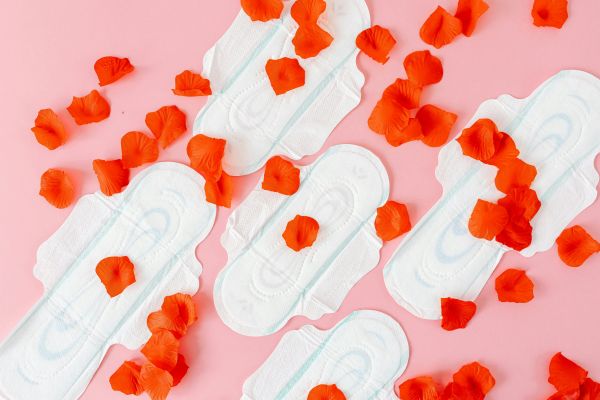
Banner image by www.kaboompics.com: https://www.pexels.com/photo/sanitary-napkins-on-pink-background-7692281/