


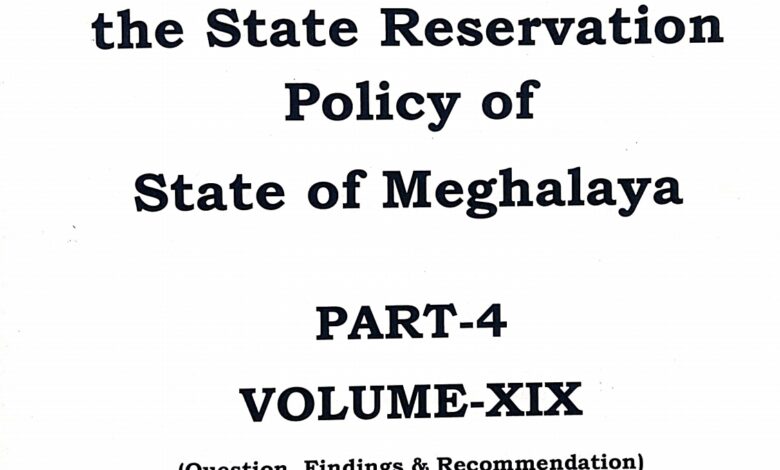
Meghalaya’s existing reservation framework, introduced in 1972, was crafted in a moment when safeguarding indigenous identity was both urgent and necessary. It served as a shield against historical marginalisation and cultural erosion. Yet time has reshaped the social landscape. Economic inequalities have evolved, new forms of disadvantage have emerged, and opportunities have clustered unevenly even within protected communities. The proposed framework recognises this shifting reality and calls not for the abandonment of protection, but for its refinement.
At its core lies a carefully designed structure built on three complementary principles: indigenous protection, socio-economic justice, and open merit—an architecture intended to balance heritage, need, and excellence.
The first pillar reserves 55% of opportunities for indigenous communities, distributed among Khasi–Jaintia, Garo, and other Scheduled Tribes. This provision affirms a fundamental truth: development must not come at the cost of cultural survival. Reservation here functions not merely as a policy tool but as a moral recognition of historical belonging, protecting communities whose identity is inseparable from the land itself.
The second pillar introduces a 20% quota based on socio-economic disadvantage, perhaps the framework’s most transformative feature. Eligibility would be determined by income, educational background, asset ownership, and rural hardship—criteria that transcend identity while remaining attentive to vulnerability. By extending this provision across communities, including economically weaker sections within tribal groups, the policy acknowledges that deprivation is complex and layered. It seeks to prevent the concentration of benefits among relatively privileged segments and to ensure that assistance reaches those most in need. Justice, in this vision, follows reality rather than assumption.
The third pillar reserves 25% of positions for open competition, accessible purely on merit. This component preserves institutional excellence and administrative competence while affirming that equity and capability need not stand in opposition. The framework envisions a system in which opportunity is broadened without compromising quality—where fairness and merit move forward together.
A particularly significant feature of the proposal is the exclusion of the economically advanced within reserved categories—the so-called “creamy layer.” This provision addresses a persistent challenge within reservation systems: the gradual accumulation of benefits among those already advantaged. By directing opportunities toward the genuinely disadvantaged, the framework restores reservation to its original ethical purpose as a mechanism of social mobility rather than permanent privilege.
Equally important is the framework’s emphasis on evidence-based governance. A statewide socio-economic and representation survey every 10 years would guide adjustments in reservation shares, ensuring that policy evolves alongside changing realities. This periodic review introduces flexibility and accountability, replacing rigidity with responsiveness.
Transparency measures further strengthen public confidence. Digital reservation rosters, annual diversity reports, and performance tracking would make the system visible and accountable, reducing suspicion while enhancing trust in public institutions.
Beyond social categories, the framework also addresses the silent injustice of geography. By granting additional consideration to candidates from remote and economically backward districts, it recognises that distance from opportunity can shape life chances as powerfully as social identity. This provision extends the meaning of equity beyond communities to include regions, fostering balanced development across the state.
The proposal wisely acknowledges that reservation alone cannot eliminate structural inequality. It therefore calls for complementary measures—improvements in school education, skill development programs, entrepreneurship promotion, and employment generation. These initiatives strengthen the foundations upon which opportunity rests, ensuring that access is accompanied by capability.
By balancing indigenous rights, socio-economic justice and merit-based access, the framework offers a path toward greater equity, administrative efficiency, and social harmony. It seeks not merely to distribute opportunity but to reduce inequality within communities, improve governance, and strengthen public trust.
The Model Reservation Framework represents a thoughtful and forward-looking reform. It protects heritage while confronting contemporary realities, promotes excellence without abandoning compassion, and introduces transparency where opacity once prevailed. Its vision is neither radical nor reactionary, but measured, balanced, and deeply attentive to the complexities of Meghalaya’s social fabric.
Adopting this framework would not simply revise an administrative system; it would signal a commitment to fairness that evolves with time and to governance guided by evidence rather than assumption. In Meghalaya’s rain-soaked hills, where the past and future continually converse, this proposal offers the promise of a new chapter—one in which justice is not merely proclaimed but lived, and where heritage and progress move forward together.