

‘We want recognition’: Daloiship and Environmental Conservation
Seminar lays bare the environmental challenges in Jaiñtia Hills, which are both ecological and institutional

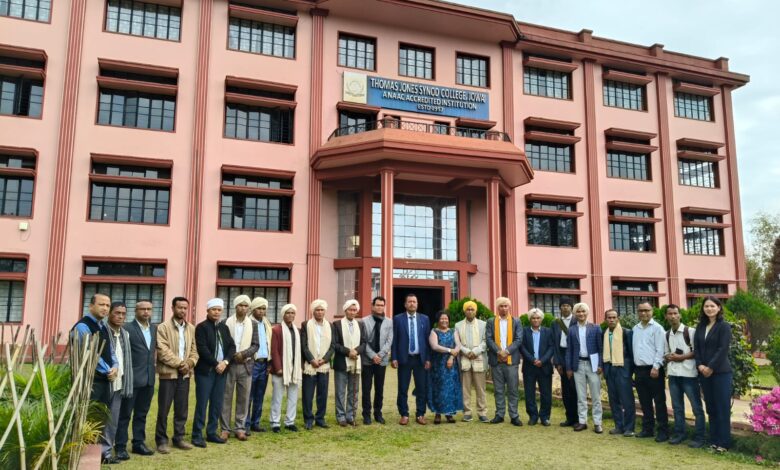
 On April 10, we witnessed a historic moment at Thomas Jones Synod College in Jowai. In collaboration with Jaiñtia Hills Autonomous District Council (JHADC), Earthtree Enviro Ltd (Earthtree) and the college, I initiated an international seminar titled ‘Daloiship and Environmental Conservation’. For this occasion, 14 out of 18 Dalois, along with both Sirdars, gathered in one hall—something that had never happened since the colonial period.
This gathering was not only symbolic. It revealed a pressing issue: While Dalois are formally recognised as key custodians of land and tradition, their authority in environmental governance today is, in actuality, increasingly limited. Despite differences across Elakas, all the Dalois and Sirdars pointed to a shared concern: fragmentation across overlapping institutions, shifting land ownership and unclear lines of responsibility.
Daloiship is a distinctive system of governance in the Jaiñtia Hills. As both administrative and traditional heads of Elakas, Dalois are responsible for their respective territories, while holding formal positions under the JHADC. They, therefore,, link the JHADC, the Dorbar Shnong (village council) and the Raij (religious institution), and their authority is expressed in the maintenance of cultural and political balance within an Elaka.
Yet, despite this central role, the actual roles and duties of Daloi, especially in matters of environmental protection, still remains uncertain to many. This uncertainty was evident among the Dalois themselves. When invitations were circulated, one Daloi responded candidly: ‘What can we, as Dalois, say about environmental conservation?’
This question is increasingly urgent. Across the Jaiñtia Hills, concerns about waste, water pollution and resource extraction are becoming part of everyday conversation. Institutional efforts are visible: afforestation schemes, carbon credit initiatives and externally supported conservation projects. But here, the landscape is governed not only by a single authority but by many such as state departments, district councils, village bodies and customary institutions. Adherence to customary law, in particular, is a fundamental pillar of localised environmental management, determining, for instance, how land is accessed and used.
As Dr H.H. Mohrmen emphasised in his keynote address, systems of land tenure and grassroots governance in Jaiñtia are protected under the Sixth Schedule of the Indian Constitution. Within this framework, the Daloi occupies a formally recognised position as the head. The JHADC Act of 2015 explicitly includes environmental protection within the functions of the Daloi, framing the institution as a custodian of “tribal way of life.” In principle, then, Dalois remain as a key figure in sustaining customary practices and deciding environmental futures.
In practice, however, this authority is far less clear.
This Act is currently subject to amendments, a point also addressed in the opening speech by the chief guest, Mr Hambertus Nongtdu, JHADC Executive Member in charge of Forest. Against this backdrop, the seminar set out to ask a simple yet necessary question: ‘What does tradition say about environmental conservation—and what role can/should Dalois play?’
‘Colourful in the wrong way’
The first session, themed “Daloiship and Conservation,” began with observation. Two students from Thomas Jones Synod College stood before the hall and projected photographs they had taken nearby. Trees appeared draped in plastic—bags, wrappers, even diapers caught in their leafy branches.
‘We are ashamed to say that this is near our College,’ the presenters said. ‘How this waste ended up in these trees is beyond our imagination. So colourful in the wrong way. Diapers and plastic wastes…they are found everywhere.’
The audience were glued to their visual presentation. The student presentation stayed close to the everyday: litter along footpaths, polluted streams, rampant road construction by the river. They described these spaces as how we sacrifice our landscape and water sources for a short-term gain. But what emerged was not a series of isolated problems. There was a sense of accumulation—small acts, repeated across time and space, gradually reshaping the landscape all together. What they call home is becoming, in their words, ‘a critical area.’
Their presentation reminded us all of one issue that lied at the core of our environmental concern—that is, divided responsibilities. What we must attend to is not only environmental degradation, but also how responsibility for the environment is organised, or fragmented. The concern for the future of our environment unites us all, and yet, how we tackle this issue operates in silos.
Once, a JHADC staff instructed me, ‘What exactly are you interested in? If your research concerns forests, consult the Forest Department. But for paddy fields, meet the Land Record and Settlement Officer. For house construction, consult the Revenue Officer. It depends on what you want to know.’
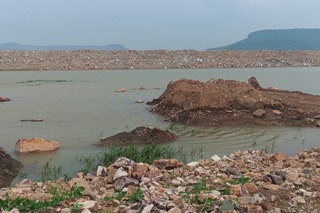
The logic is administrative. Yet the landscape does not follow these divisions. When the Myntdu River turns discoloured alongside road construction and expanding settlements, as the students’ images showed, where should concerns be raised? Which office is responsible? Where do these categories meet?
Even officials recognise this gap. In interviews, an officer from the Forest Department who is involved in tree-planting initiatives spoke with some frustration. Funding for such schemes is increasing, he noted, but implementation often neglects local realities such as appropriate species, soil conditions and land boundaries—many of which are still known through oral agreements or natural markers. ‘Blindly planting any trees does not contribute to anything,’ he claimed. What is needed, he underlined, is cultural understanding.
In this regard, the position of Daloi becomes at once relevant and complicated. As heads of traditional landholding systems, Dalois historically exercised authority over land use. But over the past decades, land in the Jaiñtia Hills has increasingly been privatised or reclassified as village land.
This shift is partly driven by (the need for) development and conservation schemes, which are often implemented on private land under constitutionally protected land rights. The same conditions that allow conservation projects also enable extractive activities such as mining. Once land becomes privately owned, the authority of the Daloi over land is significantly reduced. They cannot easily intervene, whether to prevent environmental damage or to support conservation efforts. In this changing landscape, the Daloi remains symbolically central but practically constrained.
This tension became palpable when Puramon Kynjiñ, Daloi of Elaka Jowai, stood to speak. Looking across the hall, he gave a simple analogy: “If rice is cooked by too many hands, it won’t taste good.” He then went on to describe his own experiences, pointing out that there are simply too many laws and regulations to abide by.
With his gaze focused on the audience, he recounted, ‘I have been planted many trees since 1993. A forest ranger took me to Shillong to get appropriate saplings. But afforestation is not straightforward. If you plant trees in your land, neighbours will start to complain—the leaves will fall into their property.’ Pausing, he added, ‘Why do we have less trees? It is because we lost practices like Sain Khloo (a practice of clan-based afforestation).’ Then, more pointedly, ‘People don’t ask me for the No Objection Certificate (NOC) anymore. They get it from the Dorbar Shnong (village council). Once that is done, there is nothing I can do as Daloi.’
His passionate, personalised speech resonated with many; facing him, other Dalois listened quietly. A range of concerns surfaced: bygone Niamtre practices, neighbourhood relations and the growing number of institutions involved in regulating land. Even forests are divided into categories for the purpose of efficient management and protection, each falling under a different authority. This, in turn, also makes it easier for responsibility to be tossed from one to another.
In this context, the students’ comment: “So colourful in the wrong way” takes on a broader meaning. Meghalaya is celebrated for its diversity: religious, ethnic, linguistic, cultural. At the same time, it is also divided administratively, across institutions that do not always speak to one another.
Just as Manbha Kyndoh, Daloi of Elaka Narpuh, noted, the authority of Daloi is sometimes overshadowed in everyday governance. Recognition exists in law, but not always in practice.
This session ended without a single solution, but with a shared realisation. Environmental challenges in the Jaiñtia Hills cannot be addressed within isolated sectors. They require coordination across institutions, a clearer recognition of the role Daloi can, and cannot, play. Notably, this call for collaboration was voiced across differences, by both Christian and Niamtre Dalois, pointing to a rare moment of convergence.
Empowerment
Following the discussion over the difficulty of balancing statutory law and customary law, the second session, “Custom and Future,” shifted the conversation. Moving beyond degradation, it asked, how might customary shape environmental futures?
Students from Kiang Nangbah Government College presented Daloiship through three interconnected aspects: law, order and sustainable use of resources that lead to forest conservation. Their framing was both simple and pointed, suggesting that conservation is not only an external intervention, but something embedded within existing systems.
As if directly responding to their presentation, Chanky Langbang, Daloi of Elaka Shangpung, spoke of sacred groves, forests that are protected and passed down across generations. These groves are governed through specific responsibilities.
In Shangpung, he explained, different clans are given specific duties and entrusted with their care. The Lamare clan, fore instance, remains most responsible for Khloo Langdoh, one of sacred forests in Shangpung. With its purpose strictly limited to communal and ritual use for the ïung Raij Shnagpung (Sacred house), the Lamare clan guards the forest, prohibiting unnecessary entrance.
Such practices, he implied, are not relics of the past but living systems, which continue to shape environmental stewardship. As Daloi, his role is not only administrative but, crucially, also custodial: to ensure that these practices endure and will be passed down to next generations.
Yet this continuity exists alongside ongoing loss. As Oldwing Shadong, Daloi of Elaka Lakadong, remarked, ‘Man has already started to destroy the richness of our environment a long time ago.’
Environmental degradation, in this sense, is not new, but its pace and scale have intensified. Even when Dalois are acutely aware of and committed to their duty and responsibility for conservation, their authority remains limited by the same forces discussed earlier: privatisation, development pressures and institutional overlap.
Once again, echoing the earlier discussion, the speeches from two Dalois ended with a note: Daloi authority is positioned to constantly navigate between tradition and modern governance, between responsibility and limitation.
This tension became most visible during the open discussion following the speeches. One by one, Dalois and Sirdars stood to speak. The atmosphere shifted. More direct, more urgent. ‘We have no power,’ one Daloi said.
The hall fell silent.
He went on to describe how, at times, prioritising environmental conservation as Daloi had worked against him. Over three decades of service, he had faced suspension, for his actions as a Daloi conflicted with the priorities of other authorities. Another stood and reminded the room: ‘Should I have mentioned before? We are the heads of Elakas.’
The statement was not a claim to authority but a question – what does that authority mean today?
What became clear was this: Dalois are expected to uphold customary law, to represent their communities and to engage with environmental concerns. Yet, at the same time, without recognition and coordination from other institutions, their role risks being reduced to that of a figure head—even when their title, Daloi, carries historical weight.
Threatened Daloi authority equates to the negation of customary law. As Dr H.H. Mohrmen noted, customary law must exist alongside the Constitution. But coexistence alone is not enough. It requires mutual recognition in practice.
The session ended, as one speaker observed, with ‘a political thought.’ There were no definitive, easy solutions, but there was clarity about the problem. Later, one participant reflected, ‘I am not entirely satisfied with the seminar—because we did not get enough answers and solutions to the problems we identified. But I feel that this is a starting point, for paving the way forward.’
Conclusion
What emerged from this historic gathering was not simply a discussion about environmental conservation but a deeper question about governance itself.
Environmental challenges in the Jaiñtia Hills are not only ecological. They are also institutional. Responsibility is spread across too many rules, regulations and authorities, each operating within its own domain, while the landscape remains interconnected. In such a reality, even those formally recognised as custodians, such as the Dalois, at times find themselves unable to act efficiently.
The demand, ‘We want recognition,’ is therefore not symbolic. Recognition must move beyond legislation into practice. This indicates clearer coordination across institutions, greater respect for customary systems and a willingness to rethink how authority is distributed and exercised. The absence of such collaboration may lead to much-needed environmental governance to fragmentation, where the very characteristic of the Jaiñtia Hills—diversity—becomes a source of disconnection. The consequences are already visible across the landscape: colourful in the wrong way.