


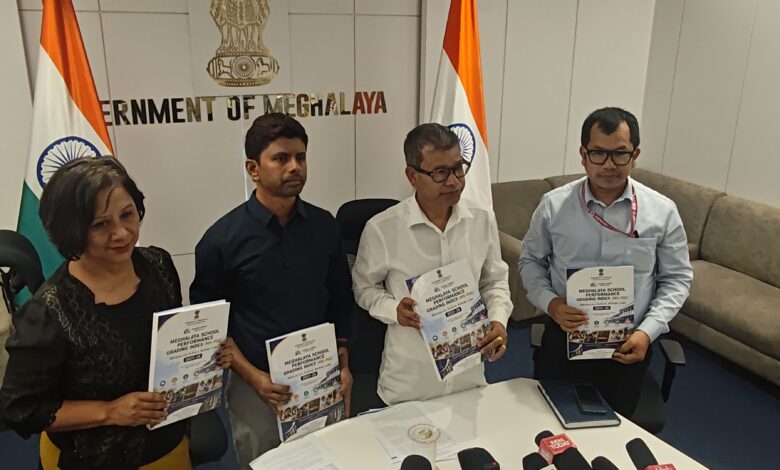
Shillong, July 24: Education Minister Lahkmen Rymbui on Friday (July 24) released the Meghalaya School Performance Grading Index (MSPGI) 2025-26.
Addressing a press conference, Rymbui said prepared by the Education Department on the basis of certified UDISE+ 2025-26 data, the MSPGI is a school-level assessment framework that evaluates all 11,443 recognised schools across the state’s 12 districts against 43 indicators spread over five domains — Accessibility, Digital Education, Infrastructure Facilities, NEP Activities and Quality Parameters — with a maximum composite score of 1,000 points. Each school assessed under the framework receives an individual School Report Card indicating its score, performance grade and ranking position.
Purpose and intent: Speaking on the occasion, the minister said the MSPGI has been designed not as a ranking exercise but as a diagnostic and planning tool to help schools understand their institutional strengths and the areas that require attention. The index is intended to create a common, transparent language that school heads, teachers, school management committees, block and district authorities and state-level planners can use to hold constructive discussions on school readiness and to direct support where it is most needed.
Methodology: Scores are generated from UDISE+ 2025-26 data filled, finalised and certified by schools themselves, ensuring that the assessment rests on authenticated, verifiable information rather than subjective evaluation. Binary indicators are scored as full weightage for compliance and zero otherwise, while percentage-based indicators are scored proportionately; where an indicator does not apply to a particular school category, its weight is redistributed proportionately among the applicable indicators to keep the assessment fair across school types. Schools are placed into one of 17 performance grades, ranging from Utkarsh (Outstanding) at the highest level to Akanshi-10 (Intensive Support) at the level requiring the most intensive support, allowing schools to be assessed against absolute standards rather than only against one another.
Link to the national PGI: The MSPGI has been modelled on the Performance Grading Index (PGI) administered by the Ministry of Education, Government of India, which assesses States and Union Territories on similar dimensions of access, infrastructure, equity, governance and teacher-related parameters. While the national PGI presents a state-level picture, the MSPGI extends the same principle down to the level of the individual school, translating State priorities into indicators that schools can act upon directly. Improvements recorded at the school level under the MSPGI — in areas such as infrastructure, digital readiness, NEP-aligned activities and quality-related enabling conditions — feed directly into the parameters on which the State’s own PGI performance is assessed. The Department noted that Meghalaya’s PGI score has already improved from 401.62 in 2022-23 to 525.71 in 2025-26, moving the State from the Akanshi-3 category to Akanshi-1 — the first time it has moved out of the lowest performance band under PGI 2.0 — and that the MSPGI is expected to sustain and accelerate this trajectory by embedding the same priorities at the school level.
What schools are expected to do: The separtment has urged all schools to treat their individual report cards as the starting point of a simple improvement cycle: review the results, discuss them with teachers and the School Management Committee, identify priority gaps, plan feasible actions, seek support from Block and District authorities where required, and track progress in the next assessment cycle. Schools recording higher grades are encouraged to serve as reference institutions for peer learning, while District and Block authorities have been asked to use the consolidated results to identify schools and areas requiring facilitation, convergence or administrative support. The Department clarified that the MSPGI complements, and does not replace, academic inspections, classroom observation and other ongoing assessments, and that the score should not be read as a stand-alone measure of children’s learning achievement.
The minister reiterated the Government’s commitment to evidence-based planning and continuous improvement in school education, and expressed confidence that the MSPGI, used alongside existing academic and administrative processes, will help schools across the state progressively meet approved institutional standards and further strengthen Meghalaya’s performance under the national PGI in the years ahead.