

Meghalaya-Sikkim journalists visit CMFRI Kochi to experience India’s marine research

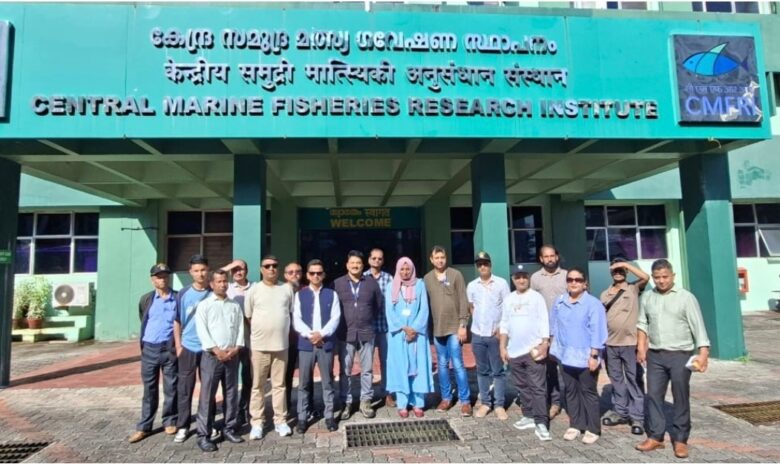
Shillong, Sept 8: Journalists from Meghalaya and Sikkim got a first-hand look at India’s marine biodiversity, fisheries and fish farming during their visit to the Central Marine Fisheries Research Institute (CMFRI), Kochi, the country’s largest marine fisheries research institute. The programme, part of the Press Information Bureau’s (PIB) Press Tour to Kerala, included interactions with scientists and visits to the Institute’s museums, aquarium and other facilities.
A major attraction was the 14-metre-long skeleton of a Bryde’s whale at the Marine Megafauna Museum. The whale had beached at Kozhikode in October 2023 and, after obtaining the necessary permission, was buried on the beach. About a year later, CMFRI scientists excavated the site and recovered the skeleton, which was dried, cleaned and assembled with the assistance of an artist before being put on display.
The journalists were also introduced to recordings of marine mammal sounds used for navigation and communication. They learnt that dolphins use clicks for echolocation while hunting and whistles for social interaction.
At the Marine Biodiversity Museum, scientists explained the Institute’s collection of 2,856 marine specimens, covering fishes, echinoderms, molluscs, crustaceans, corals and seaweeds. The museum also displays a range of marine organisms and exhibits related to biodiversity, conservation and sustainable fisheries.
The aquarium provided an insight into CMFRI’s work in fish breeding and farming, including the breeding and culture of ornamental species and commercially important fish varieties. The journalists learnt how fish are bred, young fish are produced and raised, and how these methods are shared through training programmes for farmers, entrepreneurs and Self-Help Groups (SHGs), supporting livelihood opportunities and sustainable fish production.
During the interaction, Dr. Vipin Kumar V. P., Principal Scientist (Agricultural Extension) and ATIC Manager, briefed the journalists on CMFRI’s mandate and its efforts to share scientific knowledge and improved fish-farming methods with communities. He also outlined the Institute’s work in monitoring marine resources and supporting sustainable fisheries.
The interaction covered sustainable fishing, marine fish farming, seaweed cultivation, breeding and seed production, along with measures to help fishing and fish-farming communities adapt to changing weather and environmental conditions.
The programme provided the journalists with an overview of the links between marine biodiversity, fisheries, fish farming, livelihoods and the Blue Economy, through direct interaction with scientists and exposure to CMFRI’s research and facilities.