

Why diverting maize for ethanol is affecting poultry farmers
India’s poultry farmers have watched their input costs rising in the last four years, as maize-based ethanol went from 0% in 2021-22 to around 37% in 2025-26

Despite a record maize production last year, India’s poultry farmers are contending with higher retail prices of the poultry staple due to its increasing demand for ethanol blending. With a decline in sowing and deficient rainfall this year, experts say this is likely to get worse.
Maize was available to poultry farmers for Rs 12-14 per kg around the year 2019 but it now sells for Rs 27-28 per kg in the retail market. Since maize is the primary, starch-heavy food for all poultry and soymeal is the secondary food, farmers maintaining egg-layer and broiler poultry are both facing a crisis. They have to buy feed at these high prices and either pass on the cost to the consumer or bear the losses.
The contribution of maize towards ethanol blending increased from 0% in 2021-22 to around 37% in 2025-26. India’s move to blend 20% ethanol in petrol has been a subject of much discussion this past year after vehicle owners alleged damage due to the biofuel. Besides, when sugar prices surged recently, it led to debate on whether it was due to the Ethanol Blended Petrol programme.
Poultry farmers from Maharashtra spoke to ISignal of their losses, especially when a weak monsoon might mean lower maize and soybean production this year, and said that unless maize cultivation increases, it should not be diverted for ethanol. Eggs are a cheap source of protein, important to improve the nutritional status of Indians.
The E20 programme is targeted at reducing India’s import bill from fossil fuels such as petrol and diesel. But if the area under maize cultivation goes up at the expense of pulses and oilseeds and we have to import them, would that not cancel the E20 gains and therefore miss the point, asked agriculture expert R. Ramakumar, a faculty member at the Tata Institute of Social Sciences, currently on sabbatical.
ISignal wrote to the Ministry of Fisheries, Animal Husbandry and Dairy for comment on how the government plans to protect the interests of poultry farmers in this context. We will update this report when we receive a response.
Maize 0 to 37
Ethanol can be blended into petrol to reduce the quantity of petrol required to run a vehicle, thus reducing dependency on imported, costly and polluting petroleum, as ISignal explained in May 2022. Ethanol is a principal biofuel naturally produced by the fermentation of sugars by yeasts or via petrochemical processes.
In India, it was initially primarily produced from sugarcane-based raw materials or certain types of heavy molasses, sugarcane juice/sugar/sugar syrup, followed by surplus rice available with the Food Corporation of India and maize. These are known as first generation biofuels.
Since the beginning of the EBP programme in 2003, average blending remained in the 0.1% to 1.5% range up to 2013-14, according to a roadmap for ethanol blending released by NITI Aayog in 2021.
A number of interventions by the government, including eased tender conditions, an interest subvention scheme—a financial support scheme for distilleries—for augmentation of production capacity and more, led to 5% blending by 2019-20.
India achieved the E20 target in 2025-26 and, the government said, saved Rs 1.9 lakh crore in foreign exchange spent on importing fossil fuels since 2014-15.
Currently, nearly three-fourths of the ethanol produced in the country comes from grains, particularly maize. The contribution of maize towards ethanol blending has increased from 0% in Ethanol Supply Year (ESY) 2021-22 to around 37% in ESY 2025-26 (ESY runs from November to October, unlike the financial year which is April to March). This amounts to around 4.8 billion litres of maize-based ethanol in the same year, requiring about 12.6 million tonnes of maize. The share of sugar diverted for ethanol declined from around 12% in 2022-23 to around 9% in 2025-26.
“Restrictions on sugar diversion following consecutive monsoon disruptions limited the availability of cane juice and molasses,” the All India Distilleries’ Association noted. “To maintain blending targets, policy incentives were extended to grain-based ethanol, including higher procurement prices.”
The price of maize-based ethanol is actually higher—Rs 71.86 per litre in 2025-26—than other feedstock, rising from Rs 52.92 in 2021-22. During the same period, the price of ethanol from C-heavy molasses increased from Rs 46 to Rs 57.97.
In 2025-26, India achieved record production of maize, at 55 million tonne, which is 11 million tonne higher than the previous year. Yet, India’s maize production finds itself under strain from the competing demands for human consumption, poultry and livestock feed, and the rising demand from the ethanol industry.
Poultry lower in the pecking order
In the five years between 2021 and 2026, poultry farmers found themselves scrambling for cheap maize for their birds.
Sujit Patil, a poultry farmer from Sangli, used to buy maize for about Rs 12 per kg in 2019. Now in the off season, the price goes up to even Rs 32 per kg. “Back when maize was Rs 12 and soya was around Rs 25-26, the cost to produce a single egg was Rs 2.50-2.60. Now, it costs the farmer Rs 4-4.50. So the egg which you used to get in the market for Rs 5 now goes for Rs 8-10,” said Patil.
“Because maize got diverted for ethanol, its availability for poultry reduced and rate increased,” Anil Phadke, a poultry farmer from Nashik, said. “Maize prices five years ago used to be Rs 14–15 per kg. Now they are Rs 25 to Rs 28 per kg. This inflation rate is much higher compared to other commodities.”
If the use of maize in ethanol production continues to rise and if the vital feedstock becomes unavailable for poultry, Phadke estimates that the price of chicken will rise from Rs 200 per kg to Rs 400-500. “Eggs that are Rs 10 per piece will become Rs 20 or 25. If India wants to feed its large population, our cultivable land has to increase but it is decreasing,” said Phadke.
But poultry farmers’ profit margins are still the same, Patil said.
“Either maize production must be increased to meet the demands of both the poultry sector and ethanol or for now, you must stop supplying it for ethanol. Food should be a priority,” said Patil.
In December 2025, the Ministry of Consumer Affairs, Food and Public Distribution told parliament that “the quantity of maize is sufficient to cater the demand of ethanol production, poultry and other purposes. To maintain feed availability, the poultry feed industry is also adopting other domestically available ingredients such as Rice bran, Broken Rice, Bajra and Wheat offal”.
But Patil said that de-oiled rice bran as mentioned by the Ministry above has also become costlier—from Rs 7-8 per kg in 2019 to Rs 22-23 now.
This year’s deficient monsoon means India has sown less rice, soybean and maize this Kharif season.
Sanjay Nalgirkar of the Maharashtra Poultry Farmers and Breeders Association and a poultry farmer himself is worried about poor rainfall this year and believes it will yield only 30% to 40% of the usual maize harvest. The international body Food and Agriculture Organization had also warned in June how the El Niño could lead to a weak monsoon over India and particularly impact rice and maize.
“If ethanol continues taking maize from the market, maize prices can go up to Rs 30 next year, the highest ever,” said Nalgirkar. “The cost of eggs has increased around 40% because maize and soymeal prices increased. The third input is imported vitamins and minerals and even there, prices have increased. We are facing around 20% losses. Traders can choose to wait to sell (eggs) but we cannot. We have to sell at whatever the price.”
Ranpal Dhanda, president of the Poultry Federation of India and himself a poultry and maize farmer from Panipat, Haryana, agreed that poultry farmers’ cost of production is increasing but corresponding prices are not.
“The moment the price increases even slightly, there is uproar. So, we cannot increase prices. Then what should we do?” asked Dhanda.
He believes production of maize needs to increase per hectare, for which high quality seeds need to be made available for maize farmers.
“Right now, if maize farmers are getting better prices, poultry is suffering. There needs to be balance. India produces only 3 to 4 tonnes of maize per hectare but with high quality seeds, that can go up to 11 tonnes,” said Dhanda.
Even distilleries are afraid of a looming shortage.
“Industry estimates for 2025–26 indicate a potential maize shortfall of 17 million tonnes, prompting calls for duty-free imports and alternative feed options. India has already shifted from being a net exporter of maize to a net importer to manage this gap,” AIDA noted.
India cultivates non-genetically modified maize and allows only up to 0.5 million tonnes of corn imports annually at 15% import duty. Beyond that, maize imports have a 50% import duty.
A corn job
Domestically, despite increasing demand, increasing the area under foodgrain production is also not easy and experts argue that investing in renewable energy to reduce fossil fuel-dependence is a better option.
For example, you need 187 hectares worth of maize-derived ethanol to match the annual travel distance of an EV recharged from one hectare of solar energy—even accounting for losses from electricity transmission, battery charging and grid storage—according to a 2022 report by the Institute for Energy Economics and Financial Analysis, as we explained that year.
Ramakumar said the increase in maize demand has reduced the area under other crops. “India has limited land. So where will maize grow? It has to substitute something else,” he said. “Incentives to convert from rice to maize are limited but incentives to convert from oilseeds or pulses to maize are much higher.”
He explained that across the board, cropping patterns have shifted from pulses, oilseeds, etc. to maize, “which creates a larger question at the national level, because India has a target to reduce its dependence on oilseed imports”. He cited the example of soybean, another feedstock for cattle, for which sowing area has gone down in Madhya Pradesh due to maize.
India spends more than $20 billion a year importing edible oil, and that bill is rising, we explained in June 2026. The government launched a mission two years ago to boost domestic oilseed production by nearly 80% by 2031, but experts say the numbers don’t add up without solving deeper problems: India farms 15-20% of the world’s oilseed acreage yet produces only 6-7% of global vegetable oil.
Ramakumar called the entire E20 exercise unplanned.
“Maize supply simply could not catch up with the increasing demand which means that we have a maize shortage now and it is affecting everybody,” he said. “If you had planned for an increase in the demand for ethanol, did you plan for the increase in supply also? What happens to your overall food security concerns including pulses, oilseeds, etc.? Have you done a cost-benefit analysis? No. If the import bill from fossil fuels is falling and the import bill from oilseeds is rising, what is the net gain? Ultimately, distilleries are benefiting more than even maize farmers. They are the winners here.”
(Uday Narayanan and Sanket Dagade, interns with ISignal, contributed to this report)
(The article was first published in ISignal. ISignal is an award-winning initiative that uses data and evidence to tell stories)
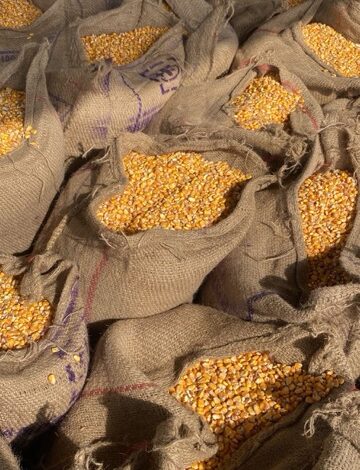
Banner image by Dptc India: https://www.pexels.com/photo/harvested-maize-in-burlap-sacks-32506154/