

Siang Upper Multipurpose Project and search for public consent
If independent evidence shows unacceptable risk, national interests require a different course

D. Jeevan Kumar
The ongoing conflict over the Siang Upper Multipurpose Project (SUMP) raises a fundamental policy question: How should India protect its water and energy interests when the proposed means threaten its citizens’ homes, livelihoods and cultural landscape?
The proposed 11,200 MW project in Arunachal Pradesh’s Siang Valley combines longstanding hydropower ambitions with strategic concerns about China’s upstream development of the Yarlung Tsangpo.
Organisations opposing the dam fear the submergence of 27 villages, displacement of 1.5 lakh people and loss of fertile paddy fields. These are reported concerns, rather than a settled assessment of the current configuration. For indigenous communities, ancestral land sustains cultural heritage, livelihoods and food security.
Resistance cannot simply be dismissed as hostility to development.
The State Cabinet’s September 2026 decision to establish an Empowered Committee for preliminary surveys has intensified demands for transparency. Reports of efforts to manufacture consent, coercive deployments and the branding of opponents as anti-national have deepened mistrust.
October’s confrontation in Pasighat, involving alleged arson and subsequent arrests and restrictions, and current calls for a prolonged bandh across Arunachal Pradesh underscore the urgency of dialogue.
The government identifies electricity, water security, flood moderation, employment and regional development as benefits.
Storage might buffer abrupt upstream releases and sustain flows during scarcity. Yet China’s hydropower development does not itself establish diversion or hostile intent. Different scenarios require separate evidence and modelling. Storage is finite: Water retained for generation reduces the space available to absorb floods.
Installed capacity is no guarantee of dependable annual supply. Government must disclose expected generation, seasonal constraints, transmission costs, tariffs and rehabilitation expenditure. Employment projections should distinguish temporary construction work from permanent local jobs. Flood protection must be quantified: A Siang reservoir cannot prevent floods originating in downstream tributaries. Assam’s erosion, sediment and fisheries concerns also require assessment.
Earlier expert appraisal records and a cumulative Siang basin study identify concerns about cascading dams, environmental flows and ecological impacts. They do not establish the environmental acceptability or safety of today’s larger configuration. Civil society critiques and a defence studies policy brief likewise underline ecological disruption, displacement and seismic vulnerability.
A current independent assessment must examine earthquakes, landslides, extreme floods, upstream failures, sedimentation, emergency evacuation and cumulative impacts.
Independent review must be free to reject an unsafe location or design. Appraisal becomes justification if rejection is excluded. Preliminary surveys, earlier basin studies and political endorsement should not be confused with environmental clearance for the present proposal. Government should publish the project’s actual approval status and relevant documents, enabling communities to distinguish investigation from authorisation for construction.
Arunachal Pradesh’s history of project agreements and upfront payments raises questions about revenue priorities and corporate influence. The Central Electricity Authority’s proposed Brahmaputra basin transmission network signals the enormous scale of planned development. National security and electricity demand cannot substitute for scrutiny of who benefits and who bears the costs.
Large dams have delivered services, as Bhakra illustrates; Sardar Sarovar exposes failures in assessment and rehabilitation. The 2023 Sikkim disaster demonstrates the need to assess connected mountain hazards. The World Commission on Dams emphasised public acceptance and alternatives. Klamath dam removals show that ecological and tribal interests can reshape infrastructure choices.
Alternatives must match objectives: Renewables, grids, batteries, efficiency and suitable storage for electricity; forecasting, floodplain planning, wetlands and resilient settlements for flood protection; diplomacy, data sharing and alternative reservoir configurations for water security. Smaller projects are not automatically harmless. Compare equivalent services, cumulative impacts, modified designs and the no-project option.
A negotiated way forward
A solution cannot guarantee that every party obtains everything it wants. It can ensure that avoidable conflict is reduced and that the eventual choice rests on public evidence. Khandu’s 2 November 2026 promise of consultation and consent offers a political starting point. It should be translated into a published agreement on how decisions will be made.
First, establish conditions for dialogue. Government should review restrictions and cases affecting peaceful protest, while community representatives commit to non-violent participation. Essential services and livelihood assistance should be available without requiring support for a dam. Trust will remain fragile if ordinary development is perceived as a reward for acquiescence.
Second, agree on the questions before undertaking intrusive investigation. An independent panel acceptable to government and affected communities should include expertise in geology, hydrology, dam safety, ecology, economics, anthropology and rehabilitation. Representatives from Assam should participate in downstream assessment. Communities should have funded access to independent technical advice and explanations in locally understood languages.
Third, distinguish consent for temporary survey access from consent to acquisition or construction. Any access agreement should define its limited purpose, duration, restoration duties and compensation for damage. It should explicitly preserve the right to oppose the project after the results are known.
Fourth, commission and publish a comparison of alternatives, including flood routing and upstream release scenarios. The panel’s findings and the government’s responses should be open to independent scrutiny. Decision criteria should identify unacceptable displacement, ecological damage and safety risks in advance.
Fifth, if the project survives that assessment, negotiate enforceable arrangements for land, livelihood restoration, community continuity, local benefits, downstream safeguards and independent monitoring before irreversible work begins. A one-time payment cannot stand in for long-term recovery. Equally, benefit sharing cannot make an unsafe design acceptable.
Sixth, legal language must remain precise. The land acquisition law’s familiar 70% and 80% consent provisions concern specified PPP and private company acquisitions; they are not a universal threshold for every government project. Tribal safeguards, forest rights and the applicability of particular provisions require examination in the actual legal setting. Public consultation and consent should not be treated as interchangeable. Government can nevertheless honour a clear commitment to an agreed process for obtaining community acceptance.
Finally, rejection must remain a real outcome. If independent evidence shows unacceptable risk or communities cannot be assured of a just settlement, national interests require a different course. The security of the Siang valley includes the security of the people who live there. A sound decision will protect that relationship while meeting demonstrable public needs.
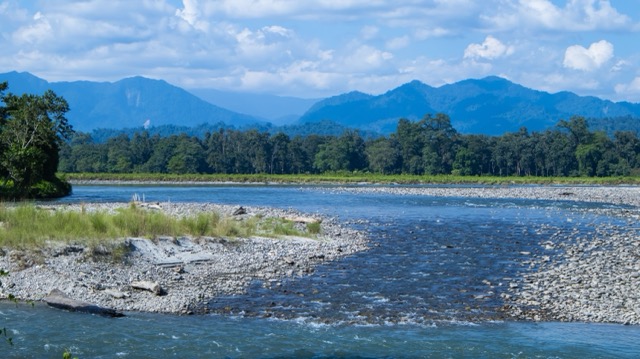
Banner image by Animesh Paul: https://www.pexels.com/photo/scenic-river-and-mountain-landscape-in-summer-34515837/