

 Every year, as Diwali celebrations light up the country, another familiar sight returns – thick smoke, rising pollution levels and people struggling to breathe.
In Delhi, the debate over firecrackers has once again brought the Supreme Court’s restrictions into focus. Despite regulations on when and which firecrackers can be used, violations continue to raise questions about enforcement.
But is banning firecrackers enough to tackle India’s pollution crisis? And why does clean air continue to remain a challenge for some of the country’s biggest cities?
This week on Meghalaya Monitor Insight, we go beyond the smoke screen – looking at the impact of firecrackers on people and animals, the government’s response, and what states like Mizoram and Sikkim can teach the rest of the country about environmental responsibility.
Let’s begin with Delhi, the worst affected place in the country.
The Supreme Court has repeatedly intervened in the firecracker debate, introducing restrictions on the sale and use of firecrackers, including allowing only certified green crackers during specified hours.
But what happens when these restrictions are not followed?
Orders on paper cannot automatically translate into cleaner air. Their success depends on enforcement, public cooperation and accountability. So, the court had also rightly observed that a firecracker-free Diwali should be people’s movement.
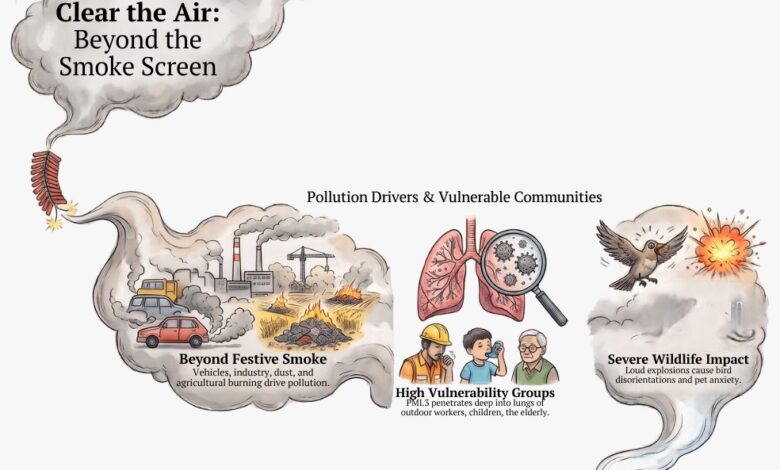
There is also a larger debate about whether limited permissions for firecrackers are sufficient when pollution levels are already a serious public health concern. Delhi and other parts of the country face other sources of pollution, such as vehicle emissions, industrial activity, construction dust, waste burning and agricultural residue burning. Firecrackers add to the woes.
When pollution levels rise, children, senior citizens and people with respiratory conditions are among the most vulnerable.
Fine particulate matter, particularly PM2.5, can travel deep into the lungs and even enter the bloodstream.
For people working outdoors – such as traffic personnel, street vendors, delivery workers and sanitation staff – avoiding polluted air is hardly an option.
And humans are not the only ones affected.
For animals, the loud explosions of firecrackers can trigger panic, anxiety and disorientation. Birds can become confused by sudden bursts of light and sound, while smoke and particulate pollution add another environmental burden.
So, how do we understand the air we breathe?
This is where the Air Quality Index, or AQI, becomes important.
India’s AQI ranges from zero to 500.
A reading between zero and 50 is considered good. Between 51 and 100 is satisfactory. From 101 to 200, it is moderate. Between 201 and 300, it is poor. From 301 to 400, it is very poor. And anything above 400 falls under the severe category.
But AQI is more than just a number on a screen.
It tells us about the quality of the air we are breathing and the potential health risks associated with it.
And this is why regular monitoring, transparent reporting and timely intervention are essential.
Now, let’s bring the focus closer home.
While several Indian cities continue to struggle with deteriorating air quality, parts of the North East offer interesting examples worth examining.
Mizoram’s capital, Aizawl, has featured among India’s cities with the lowest PM2.5 concentrations. Sikkim, meanwhile, has built a reputation for environmental initiatives, including restrictions on certain single-use plastics and efforts towards responsible waste management.
But it is important to understand that geography, population density, traffic and industrial activity also influence air quality. These states are not pollution-free, but their environmental practices offer lessons worth studying.
The question for Meghalaya is equally important. Shillong has often enjoyed comparatively cleaner air, but increasing traffic, construction activity and waste-related concerns make it important to protect that advantage. Can Meghalaya learn from its neighbouring states before pollution becomes a bigger urban challenge?
The government has introduced several programmes to tackle air pollution. The National Clean Air Programme focuses on reducing pollution in identified cities through city-specific action plans.
The Graded Response Action Plan in Delhi-NCR introduces emergency measures when pollution reaches specified levels. There are also efforts towards cleaner vehicles, improved public transport, dust control, industrial emission monitoring and better waste management. Some cities have demonstrated improvements through mechanised road sweeping, electric waste-collection vehicles and scientific waste disposal.
But policies and programmes need consistent implementation, monitoring and public participation to deliver lasting results.
Also, awareness among citizens is a crucial thing. We have to not only teach our children to avoid loud firecrackers but also tell them to clean the public spaces they use for celebrations. Remnants of firecrackers on the roads are adding to waste management problem. To talk about firecracker-free celebrations is not targeting religious rituals because no religion has any traditional ritual of bursting firecrackers.
Also, cases of fire-related accidents each year during Diwali should also be a lesson for all to have safe celebrations.
And finally, clean air cannot be achieved by government action alone.
We can begin with simple changes. We need to understand that air pollution is not someone else’s problem. It affects the air we breathe, the food we grow, the animals around us and the health of future generations.
The debate around firecrackers returns every year, but the fight for clean air cannot be limited to a few days of the festive season. From Delhi’s pollution crisis to the environmental initiatives in Mizoram and Sikkim, there are lessons India can learn. The real challenge is to move beyond temporary restrictions and build a culture where clean air becomes a shared responsibility. Ultimately, celebrating a festival should never come at the cost of someone’s right to breathe.
WATCH MORE VIDEOS