



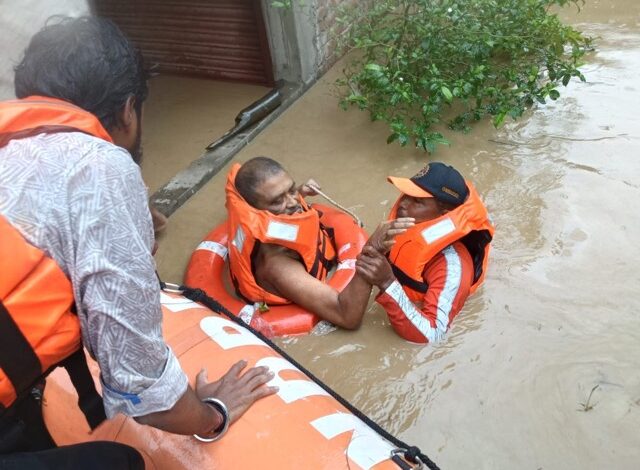
 Assam is once again struggling with one of its worst flood situations, with the death toll rising to 78 and over three lakh people affected across hundreds of villages. With torrential rainfall, a political debate has also emerged over who is responsible for the worsening floods?
For the devastation in Sivasagar, Charaideo and Jorhat, the incessant rain in neighbouring Nagaland has been the culprit. Experts have blamed mining, deforestation and vanishing wetlands as reasons behind the unprecedented flooding in Assam.
The floods are the result of multiple factors. Intense rainfall in the upper catchments rapidly increases river discharge, while deforestation, hill cutting, mining and excessive siltation reduce the rivers’ carrying capacity. The loss of forests and wetlands further accelerates surface runoff, turning heavy rain into devastating floods.
Climate change is making the situation even more challenging. Warmer temperatures are increasing the intensity of rainfall events, making flash floods more frequent across the region.
It is not just Assam, but other parts of the North East too have been reeling from heavy rainfall and landslides. Last year, Manipur witnessed major flooding. In all this, the role of humans is crucial. Now, these floods are beyond natural calamities but are more man-made. As hills lose their green cover, lose soil are easily washed away during heavy rain, leading to more landslides and devastation downstream.
The record-breaking water levels in the Disang, Dikhow, and Jhanji river basins this year should make policymakers think about the ecological degradation being carried out in the states.
Assam Chief Minister Himanta Biswa Sarma has repeatedly alleged that construction activities and hill development in neighbouring Meghalaya, particularly around the Ri Bhoi region, have contributed to severe waterlogging in parts of Guwahati, including Jorabat, Khanapara and the airport road.
Meghalaya has strongly rejected the allegation.
Deputy Chief Minister Prestone Tynsong responded by saying that Meghalaya is naturally located at a higher elevation, while Assam lies in the downstream floodplains. Water flowing from higher to lower ground is a natural hydrological process, he said, and cannot be prevented simply because it crosses a state boundary.
Tynsong rightly argued that instead of blaming Meghalaya, attention should be given to improving Guwahati’s own drainage infrastructure. He pointed out that clogged drains, encroached natural water channels, shrinking wetlands and inadequate cross-drainage structures have significantly reduced the city’s ability to handle heavy rainfall.
The Assam chief minister had also blamed USTM in Meghalaya for demolishing hills, which had led to large-scale flooding in Guwahati. He had said USTM was a danger to Assam as the university was engaging in “flood jihad”. While seeing a jihad in everything is not a new thing for a BJP leader, in this case, it has become an exaggeration on one hand and downplaying of the state’s own responsibility on the other.
The debate over responsibility highlights a larger issue. Floods in the Brahmaputra basin are not confined by state boundaries. Managing them requires coordinated action between Assam, Meghalaya, Arunachal Pradesh and Nagaland through scientific watershed management, better drainage planning, forest conservation and restoration of wetlands. The current problem of flooding and landslides should not be seen through the prism of political boundaries but a problem caused in the contiguous ecology of the region.
A climate-focused urban planning is necessary to cope with these floods in towns and cities. The proper maintenance of embankments is another important thing to be considered in the planning. It is also high time that wetlands are revived. The flood planning must include this as wetlands act as sponges and can absorb a huge amount of water flowing down the hills.
Like the northeastern states coming together for border talks, there should be CM-level talks with all contiguous states pre- monsoon and post monsoon.
As Assam struggles to recover from another devastating flood, the focus may ultimately need to shift from assigning blame to finding regional solutions. Because rivers do not recognise state borders, and neither do the impacts of climate change.
WATCH OTHER VIDEOS