


Noise pollution is health risk that’s hard to measure and monitor
In some cities, citizen groups have been demanding action against noise pollution, building political pressure

Disha Shetty/Mongabay India
A recent debate over using DJs and high-powered sound systems during Pune’s Ganesh festival brought noise pollution and its health impacts into focus.
In August and September, residents and citizen groups in Pune called for stricter enforcement of noise limit rules, prompting a parliamentary committee review of noise and light pollution. The National Human Rights Commission also sought a report from Maharashtra’s pollution control board on action taken on noise limit violations during the festival.
The impact of urban noise extends beyond festivals. Prolonged exposure to environmental noise is linked to sleep disturbance, hearing impairment and cardiovascular risks, making noise pollution a public health concern in India’s increasingly noisy cities.
Gaps in noise pollution data from Indian cities and the challenges of monitoring sound levels at scale are compounding the problem, say researchers. Meanwhile, citizens have been pushing for better policy and better implementation of guidelines, with incremental changes being observed over the years, say noise pollution activists.
Under-researched “silent killer”
“It’s been known for a long time that noise is more than just a nuisance or an annoyance, but that it’s a serious cardiovascular disease concern,” said Danielle Vienneau, Associate Professor at the UMC Utrecht in The Netherlands, an expert on environmental pollution and its impact on human health.
Regular exposure to high levels of noise pollution is linked to hearing loss, poor cardiovascular health, high blood pressure, diabetes, stress and even adverse reproductive outcomes, according to a 2023 review of existing evidence.
“When we’re exposed constantly to noise, it triggers a stress response in our body… We could think of it as a silent killer,” Vienneau added.
Despite its risks, noise pollution is still a relatively under-researched subject, especially in low- and middle-income countries.
Noisy Indian cities
Since 2003, Mumbai-based environmentalist Sumaira Abdulali has been measuring noise levels in the city. On average, she says, noise levels outdoors are around 65-85 decibels and motorcycle horns can create noise up to 110 decibels, both significantly over the World Health Organization (WHO) recommendation that noise levels be 54 decibels or less for road and traffic sounds. On festivals, the noise has been even higher, going up to 145 decibels in Mumbai, from the sound of fireworks.
A yearly average of 70 decibels from all sources combined is acceptable as is an occasional exposure to noise levels of up to 100 decibels. India’s Central Pollution Control Board too recommends implementing WHO standards.
But noise levels in Indian cities are well over these levels on any regular day. Continuous exposure in such a situation can also cause sleep disturbances, lead to poorer work and school performance, hearing impairment, and mental health issues like anxiety and depression, according to the WHO.
Advocacy has yielded some progress though.
The Indian government recognises noise pollution as an issue and bans loud noise such as from music systems, fire crackers and industrial activities in public spaces between 10 pm and 6 am unless special exemptions have been sought.
“The police, politicians and officials, through all these years, and through the court orders which have specifically come about, have become aware of the noise rules, and they know the rules. They know they have to act,” Abdulali, who also founded the Awaaz Foundation, said.
Many pollution control bodies like the Maharashtra Pollution Control Board (MPCB) have taken over measuring noise levels in a systemic way, creating a database of official data.
But this data is very limited for high quality research.
Why researching noise pollution is difficult
Currently, most of the existing research on health impacts of noise pollution comes from Europe. But the landscape is not as barren anymore with improved research in the past decade, said Dr. Angel Dzhambov, Associate Professor at Research Institute at Medical University of Plovdiv, Bulgaria.
He said the relatively less research on health impacts of noise pollution is linked to the history of environmental health research, and also to the difficulty in measuring noise exposure through the day as people move through different spaces and micro-environments.
“We have to make the assumption that they’re [people] mostly exposed in their home, which is plausible but reflects only part of their exposure because they’re mobile and spend time at work, other places commuting and so forth. So one thing would be exposure assessment,” Dzhambov said.
Then, the acoustic models researchers need are expensive and are not always readily available for all parts of the world. The way noise moves around is driven by many local small-scale factors (sources, surrounding barriers, etc.) and global noise models covering entire countries and continents are not available in a way that global air pollution models are.
Vienneau explained that the way sound moves through the environment changes over very short distances. To study noise pollution and its impact well requires many noise monitors or good quality noise models to capture this variation.
Then there is the more individual impact. “Different people exposed to the same objective acoustic environment may respond differently. So their bodies may react with different stress responses,” Dzhambov added.
What is also clear is that noise doesn’t necessarily have to be loud. Low frequency sounds from windmills are known to give people headaches. When those who live near an airport hear a plane fly overhead, it raises their blood pressure even if they don’t wake up, according to research.
Attempts to find a solution
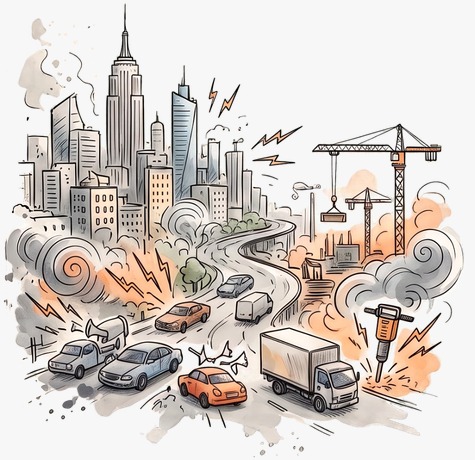
Researchers from the Indian Institute of Technology, Madras (IIT-M) conducted a city-wide 2026 study in Chennai and found that the mix of traffic and construction sounds were almost always the primary contributors to the high levels of noise pollution.
Traffic noise has been strongly linked to poor heart health, including increased risk of heart failure and stroke.
“We are currently doing some engineering controls and trying to understand whether we can use locally available materials and come out with some kind of a barrier, so this noise can be reduced. We are doing this as an experiment now,” said S.M. Shiva Nagendra, professor at the institute’s Department of Civil Engineering.
These barriers would be designed to either absorb or deflect sound around noise-sensitive places like hospitals, educational institutions and places of worship.
But Nagendra accepts that there are limits to how effective engineering solutions can be. “No engineering solution can be 100% complete. Source control is always better. How do we control source? It’s actually a policy intervention,” he said.
Dzhambov said green belts and barriers between buildings and roads help reducing residents’ exposure to noise. Using smart architecture and design is another way to reduce noise pollution like using building facades to reduce noise levels or placing bedrooms away from the road. Quieter types of vehicles like electric vehicles also help reduce noise pollution.
“It should be an integrated, smart redesigning of our cities and in a way that people don’t feel robbed out of something,” Dzhambov said.
Many of these solutions help reduce both air and noise pollution while creating more communal, quieter spots within cities.
Growing awareness and citizen activism
In some cities, citizen groups have been demanding action against noise pollution, building political pressure.
“I think now in Pune, for example, when people are becoming more vocal and have started coming to the streets and asking for these noise rules to be implemented, that’s a huge step forward,” Abdulali said.
There have been other areas of progress too. Fire crackers have become less noisy with rising awareness and education on noise pollution. They are now often creating noise of 125 decibels or less. While it’s still high, Abdulali pointed that it shows progress is possible when you work with various stakeholders, but enforcement is key.
Dzhambov also said that individual behaviour to reduce exposure to noise pollution when possible also goes a long way.
Another interesting conundrum researchers are grappling with now is how air pollution intersects with noise pollution, given that sources like traffic and construction are responsible for both.
“One of the big questions that we’re always asking is whether it’s the air pollution effects or the noise effects that we see, for example, in relation to cardiovascular disease, and this can be quite tricky to untangle,” said Vienneau.
(The article was first published in Mongabay)