


Shillong, July 7: A united indigenous movement encompassing all three regions of Meghalaya will be formed in defence of traditional institutions, customary governance, indigenous land rights, and the matrilineal system.
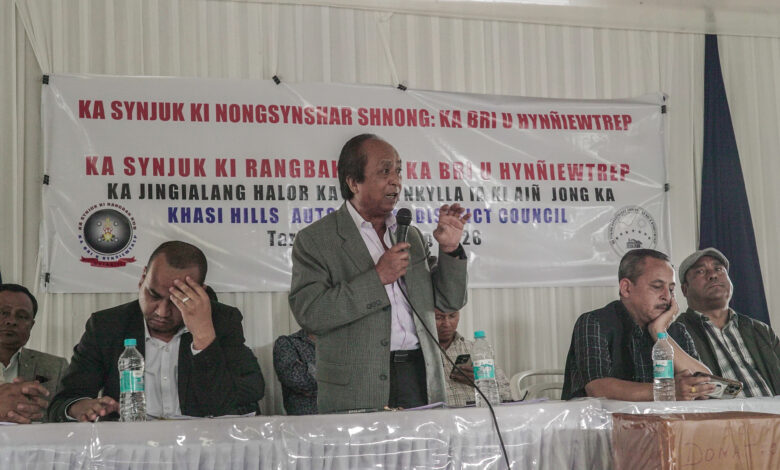
A joint meeting of the traditional locality councils of the Shillong city conglomerate, represented by the Synjuk Ki Nongsynshar Shnong, and the traditional clan organisation, Synjuk Ki Rangbah Kur, convened on Tuesday (July 7) in Shillong to deliberate on issues concerning the preservation of indigenous traditional institutions, customary governance, and the Khasi matrilineal system.
After extensive deliberations, the gathering expressed grave concern over the reported attempts by the Khasi Hills Autonomous District Council (KHADC) to undermine the constitutional and customary authority of the Dorbar Shnong and its allied traditional institutions, while also failing to adequately safeguard the Khasi matrilineal system of clan lineage.
The meeting, attended by a large number of headmen, clan elders, and representatives from various localities, unanimously resolved to demand the immediate withdrawal of the notification relating to the proposed Land Bank initiative. It further called upon the KHADC to withdraw and comprehensively review the proposed KHAD (Land Administration) Amendment Bill, 2026, particularly objecting to the omission of clause 16, which had originally mandated compulsory consultation with the traditional institutions—namely the Dorbar Shnong, Dorbar Raij, and Dorbar Hima—before the formulation or implementation of any regulation affecting land administration and customary governance. The participants observed that the deletion of this provision significantly weakens the traditional decision-making process and diminishes the authority of institutions that have historically served as the custodians of indigenous land, customary laws, and community welfare.
On the issue of the Khasi matrilineal system, the meeting unanimously reaffirmed its commitment to preserving and strengthening the traditional clan lineage system through the coordinated efforts of both the local administrative institutions and the traditional clan organisations. It emphasized that the preservation of matriliny is inseparable from the protection of Khasi identity, customary laws, and the social fabric that has sustained the indigenous community for generations.
The meeting further resolved to intensify public awareness and organisational mobilisation throughout all localities and villages under the jurisdiction of the Khasi Hills Autonomous District Council. It was also informed that similar support has already been extended by traditional organisations within the jurisdiction of the Jaintia Hills Autonomous District Council (JHADC), with encouraging responses emerging from Garo Hills as well. Accordingly, the participants resolved to build a united indigenous movement encompassing all three regions of Meghalaya in defence of traditional institutions, customary governance, indigenous land rights, and the matrilineal system.
During the deliberations, legal practitioner Robert June Kharjahrin presented a comprehensive analysis of the proposed legislation, highlighting several legal inconsistencies, constitutional concerns, and procedural loopholes that, if enacted in its present form, could prove detrimental to the customary rights and interests of the indigenous inhabitants of the State. He urged the traditional institutions and the public to remain vigilant and united in safeguarding the constitutional protections accorded to the sixth schedule areas.
Among those who addressed the gathering were R. L. Blah, General Secretary of the Synjuk Ki Nongsynshar Shnong; Bantylli Battry, Headman of Nongrim Hills; and R. L. Kharpran, President of the Synjuk Ki Rangbah Kur, alongside numerous headmen, clan elders, and representatives from different localities across Shillong City. The meeting concluded with a unanimous pledge to remain steadfast in defending the authority of the traditional institutions, protecting indigenous land and customary governance, and preserving the Khasi matrilineal heritage for future generations.