


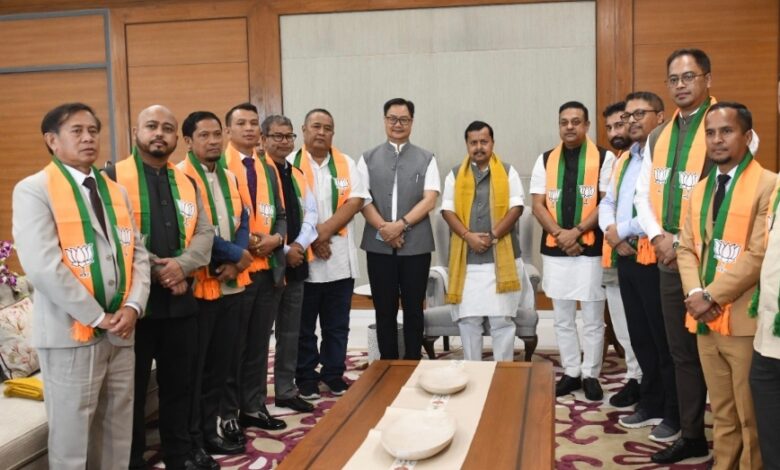
 Meghalaya has witnessed one of its biggest political shifts ahead of the 2028 Assembly elections. Eight sitting United Democratic Party MLAs have formally joined BJP, changing the political arithmetic in the state almost overnight.
With this, BJP’s strength in the 60-member Assembly has increased from two to 10, while UDP has been reduced from 12 MLAs to four.
On the face of it, this gives BJP something it has not had before in Meghalaya: a sizeable group of sitting MLAs with established constituencies and political networks. The eight legislators are not newcomers. They have already fought elections, built local organisations and developed relationships with voters in their respective constituencies. Two of the turncoats, Lahkmen Rymbui and Kyrmen Shylla, have also served as ministers.
But the political significance of the move goes beyond numbers.
The MLAs have explained their decision largely through Meghalaya-specific issues. These include the demand for Khasi to be included in the Eighth Schedule of the Constitution, changes to the Meghalaya Residents Safety and Security Act, issues surrounding coal mining and the relocation of the Harijan Colony. Lahkmen Rymbui has said the group received assurances from the BJP leadership on these issues and that access to the BJP-led government at the Centre could help push them forward.
This gives the switch a clear political argument from the MLAs’ side.
However, there is an important distinction between an MLA’s personal political support and the support enjoyed by a political party.
The eight MLAs won their present seats as UDP candidates. Their constituencies, therefore, carry an electoral history associated with the UDP symbol as well as with the individual legislators. The next election will provide the first major test of how much of that support is attached to the individual leader and how much is attached to the regional party identity.
This becomes particularly relevant in Meghalaya because regional parties have historically played an important role in the state’s politics. From the All Party Hill Leaders’ Conference, which was closely associated with the movement for Meghalaya’s statehood, to the UDP and HSPDP, regional political formations have provided voters with platforms focused specifically on local and indigenous issues.
The UDP itself emerged in 1997 as an offshoot of that regional political tradition. It won 20 seats in the 1998 Assembly election and has remained an important player in coalition governments and post-election political arrangements. In the 2023 election, it won 11 seats, making it the second-largest party at that time.
For many voters, regional politics represents more than simply a party label. It can represent political attention to issues such as land, language, indigenous rights, traditional institutions, employment and the state’s relationship with the Centre.
That is also where BJP’s expansion presents a different political equation.
BJP has been part of Meghalaya’s coalition politics, but its independent Assembly presence has remained comparatively small.
The eight MLAs consequently bring three major assets to the BJP: sitting legislators, constituency-level networks and experience in Meghalaya’s regional political environment. What they do not automatically bring is a transferable BJP vote base. That distinction will become important as the party attempts to expand beyond the individual constituencies represented by these leaders.
The shift also changes the internal balance of the Meghalaya Democratic Alliance. The eight legislators have moved from one MDA constituent party to another, so the overall coalition numbers are not fundamentally altered. However, UDP’s reduced strength and BJP’s enlarged presence change the relative weight of the two parties within the alliance.
For the NPP-led MDA, this means managing a coalition in which BJP now has a much larger legislative presence. The immediate political impact is less about government stability and more about the changing dynamics between the alliance partners ahead of the 2028 state polls.
The move also gives BJP greater political visibility inside Meghalaya’s government and coalition structure without automatically translating into additional Cabinet positions or a separate mandate. BJP has so far remained part of the existing MDA arrangement.
The impact is already visible in the Khasi Hills Autonomous District Council.
Two of the eight MLAs, Synshar Kupar Roy Lyngdoh Thabah and Pius Marwein, are also sitting MDCs. Their switch has brought BJP back into the KHADC after an eight-year absence. The council has 29 elected members and is currently led by the Voice of the People Party. UDP’s strength has fallen to three MDCs following the two defections.
This creates a new political configuration inside the district council. BJP will now have representation in an institution dealing directly with matters linked to tribal administration, customary practices and local governance.
The larger political picture is not simply about eight MLAs changing parties. It is about BJP gaining established political faces. It is also about a national party attempting to deepen its organisational presence in a state where regional political identity has historically mattered greatly.
Ultimately, the 2028 election will provide the clearest electoral evidence of how voters respond to this shift and whether or not BJP’s majoritarian politics and Hindutva ideology win ground. Christian groups in the state have already termed the move as betrayal of the electorate.
Until then, the present numbers demonstrate a major change in political arithmetic, but they do not by themselves establish that the eight former UDP MLAs will retain the same level of electoral support under the BJP banner.
WATCH OTHER VIDEOS