

Beyond the margins: Decolonising public policy through NE lens
The region offers a rich body of institutional experience, community knowledge & governance practices


 The North East India is frequently discussed through the familiar lenses of security, development, ethnic identity and geographical remoteness. These are important concerns, but they tell only part of the story. The region also offers a rich body of institutional experience, community knowledge and governance practices that can inform public policy across India.
Colonial administration often sought to classify, regulate and govern communities through categories and systems that reflected the priorities of the colonial state. Indigenous institutions and customary practices were frequently interpreted through external administrative frameworks rather than understood on their own terms.
For a country as diverse as India, this required moving beyond a one-size-fits-all approach. Policies designed in distant administrative centres may overlook local relationships, customary arrangements, ecological realities and community priorities. Consultation conducted after a policy has been formulated is not the same as involving communities in defining the problem in the first place.
The North East offers valuable opportunities to rethink this relationship between the state, institutions and citizens.
Meghalaya: A Living Governance Conversation
Meghalaya provides an instructive starting point. Its Khasi, Jaintia and Garo communities have distinctive social and customary traditions. The state also has three Autonomous District Councils established within the constitutional framework of the Sixth Schedule. These councils exercise specified legislative, executive and judicial functions, including powers relating to land, forests and customary matters. This clearly illustrates that constitutional governance need not always depend on uniform administrative structures. It can accommodate institutional diversity while operating within the broader framework of the Indian Constitution.
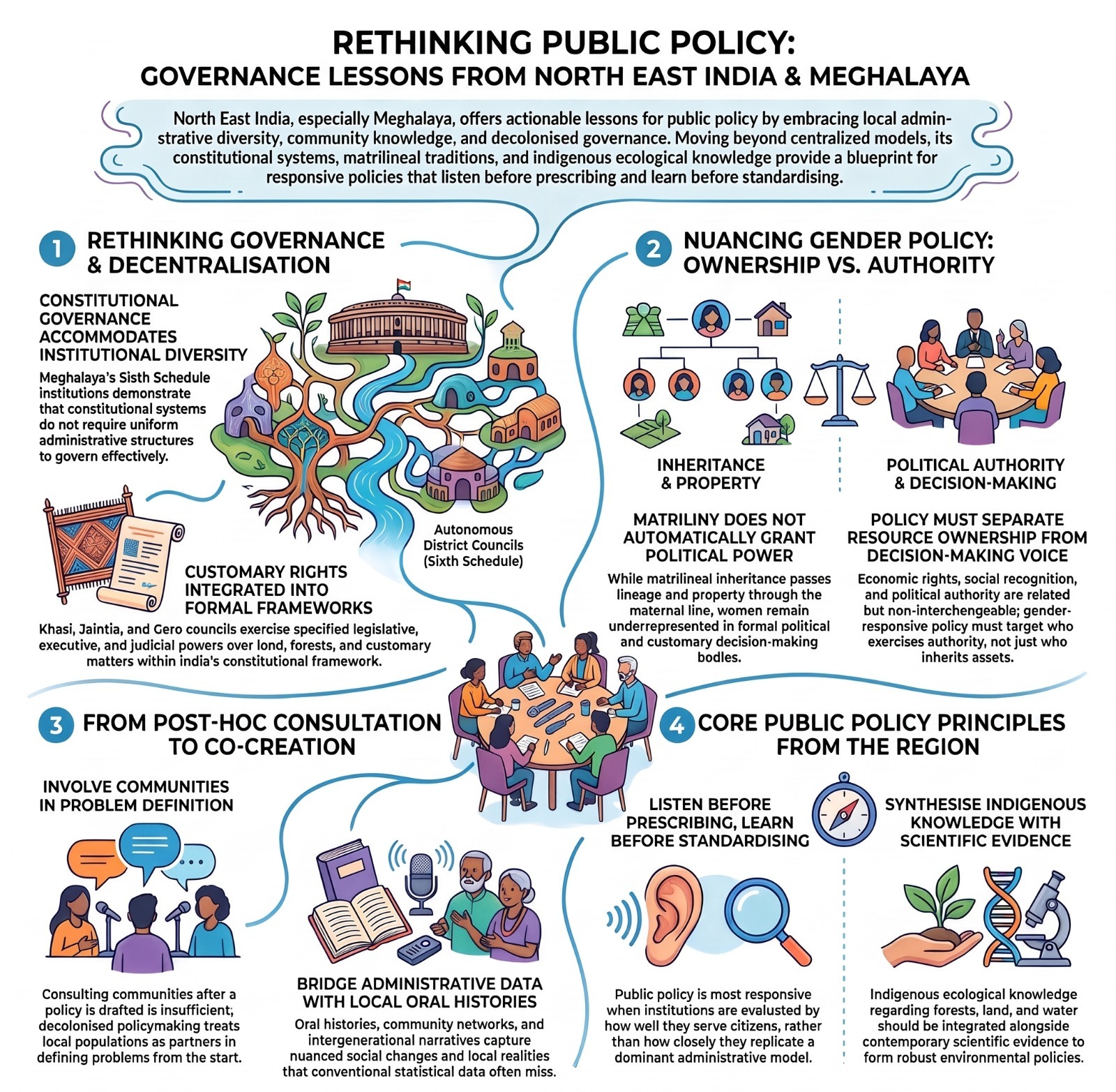
Meghalaya’s matrilineal traditions offer a particularly important lesson. In Khasi and other matrilineal communities, lineage and inheritance follow the maternal line, although practices vary. However, matriliny does not automatically ensure women’s participation in political decision-making. Research has documented women’s limited representation in formal political and customary decision-making institutions.
The distinction matters for public policy economic rights, social recognition and political voice are related, but they are not interchangeable. Policies seeking gender equality must, therefore, examine not only who owns or inherits resources, but also who makes decisions, sets priorities and exercises authority.
From Consultation to Co-creation
A decolonised approach to policymaking begins by treating communities as partners in producing knowledge, rather than merely as beneficiaries or respondents. Oral histories, customary practices, community networks and indigenous ecological knowledge can help administrators understand local needs that conventional data may fail to capture. This calls for dialogue between different forms of knowledge, with transparent processes for examining evidence, resolving disagreements and protecting individual rights.
The constitutional recognition of autonomous institutions in the North East provides a starting point for examining how decentralisation can be made meaningful. The next step is to ask whether government departments, researchers and local institutions share information, coordinate responsibilities and learn from one another. They are not templates to be transplanted into India, but reminders that the relationship between indigenous peoples and the state can be reconsidered through institutional dialogue, recognition and accountability.
An Alternative Direction for Public Policy
Public policy becomes more responsive when it listens before prescribing, learns before standardising, and evaluates institutions by how well they serve people rather than by how closely they resemble a dominant administrative model. The North East should not be seen only as a region to which policies are delivered. It should also be recognised as a region from which India can learn.
Policy Lessons from Meghalaya
Meghalaya’s social institutions offer lessons for policymakers, but these must be understood in context rather than treated as universal solutions.
- Customary arrangements and community networks can help governments understand local priorities, relationships and decision-making practices. They should be engaged as living institutions, not merely preserved as cultural heritage. Hence, indigenous institutions are sources of policy insights.
- Matrilineal inheritance can give women important rights within families, but it does not automatically translate into equal participation in customary councils or formal politics. Gender-responsive policy must examine both resource ownership and decision-making power.
- Community histories, narratives and intergenerational knowledge complement administrative data, particularly in understanding local experiences, social change and environmental practices. Their use should respect community consent and ownership.
- Meghalaya’s Sixth Schedule institutions demonstrate a constitutional approach to recognising regional and customary governance. Effective decentralisation also depends on clear responsibilities, coordination, public accountability and protection of rights.
- Indigenous ecological knowledge can contribute to understanding forests, land, water and changing environmental conditions. It should be considered alongside scientific research and contemporary environmental evidence.
The larger lesson is that public policy need not choose between indigenous knowledge and constitutional governance. It can create accountable spaces in which community experience, evidence, equality and justice inform one another.