




 In development work, reporting is much more than paperwork because it is the story of work done, its progress and impact.
Every activity conducted leaves behind lessons, results and evidence and reporting ideally helps to capture those moments clearly. Whether it is an activity report after a workshop, a training report showing participants’ learning, a progress report tracking milestones or a donor report sharing outcomes with partners.
Good reporting builds accountability, strengthens transparency and supports better decision-making. It tells what worked, what did not and what needs to improve. For example stakeholders are able to understand what has happened.
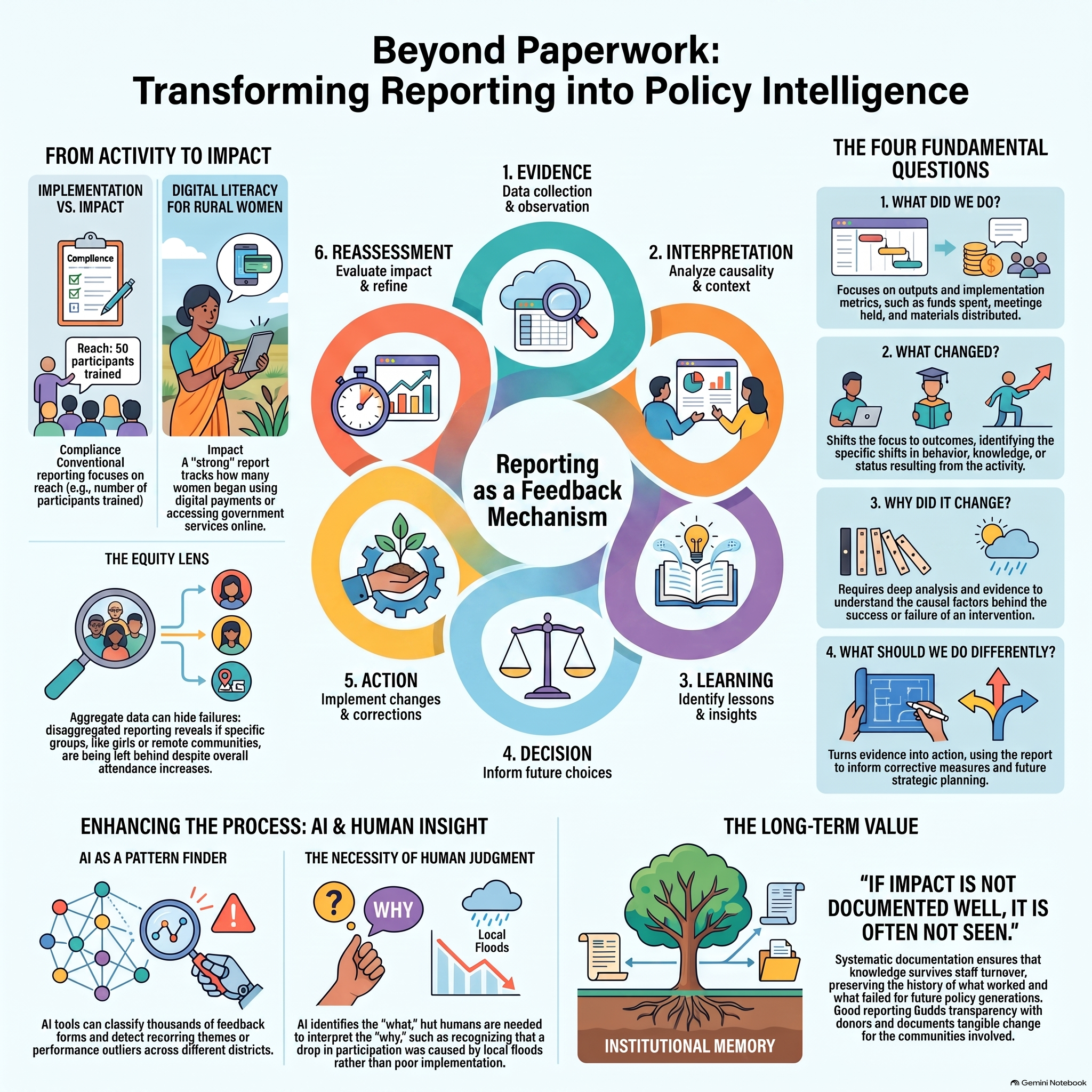
For donors, it shows value for resources invested. For communities, it documents change. For organisations, it becomes institutional memory. Reporting is, therefore, not simply about recording what was done. It is about showing what was achieved, what was learned and what difference the intervention made. If information/impact is not documented well, it is often not seen.
Context
One often thinks of reporting as an administrative tail-end of a programme: collect numbers, complete templates and submit the document. In government departments, NGOs and development organisations, reporting can easily become synonymous with compliance. But reporting is much more than that.
 Reporting is part of the infrastructure that makes accountable governance possible. It creates the evidence that allows institutions to understand what they are doing, assess whether it is working and make better decisions about what should happen next.
In public policy, this becomes particularly important especially when governments implement hundreds of schemes and programmes every year. For example, consider the information generated through health programmes, education initiatives, livelihood schemes, social protection programmes or rural development interventions. If this information is merely collected and filed away, a significant opportunity is lost.
If it is analysed, interpreted and fed back into decision-making, reporting becomes a powerful instrument for policy learning. It is important to distinguish between activity and outcome.
For example, an education department may report that 500 teachers participated in a training programme. That tells us something about the programme’s reach. But a policy-oriented report should go further: Did teachers acquire new skills? Did they use those skills in their classrooms? Did student learning improve? Which elements of the training were most effective? Did the results differ between rural and urban schools?
The first set of questions measures implementation. The second begins to measure impact and learning.
The same principle applies to development programmes. Imagine an NGO implementing a digital literacy programme for rural women. A conventional report might highlight the number of training sessions conducted and participants enrolled.
A stronger report could show how many women subsequently began using digital payments, accessing government services online or helping others in their communities. The latter provides information that can inform decisions about whether, and how, the programme should be expanded.
Reporting should, therefore, be treated as a feedback mechanism within the policy cycle, not as paperwork that follows it.
From reporting to policy learning
Good reporting enables institutions to ask four fundamental questions:
What did we do? What changed? Why did it change? What should we do differently?
The first question relates to outputs, the second to outcomes, the third requires analysis and evidence and the fourth turns evidence into action.
Sadly, many reports remain concentrated on the first question because outputs are easier to count. Meetings held, people trained, funds spent, materials distributed and beneficiaries reached are important indicators. But they tell only part of the story. This is why reporting should be regarded as part of the policy cycle.
For example, a programme that appears successful in aggregate may produce very different results across districts, communities or demographic groups. Disaggregated reporting can reveal who is benefiting and who may be getting left behind.
In other words, an overall increase in school attendance may appear encouraging. But if attendance among girls, children with disabilities or students in remote villages has not improved, the aggregate figure can conceal an important policy problem. Thus reporting can also be considered as an instrument of equity.
Reporting and accountability
Accountability in reporting matters since public institutions are entrusted with resources and responsibilities. Citizens have a legitimate interest in knowing what those resources have achieved. Transparent reporting helps create a chain of accountability between public investment, implementation and results.
But accountability should not mean producing increasingly elaborate reports simply to satisfy bureaucratic requirements. It should mean producing information that is relevant, accessible and usable.
For example, a 100-page report that nobody reads may be less useful than a concise document that clearly explains what happened, what changed, where problems occurred and what corrective action is proposed.
Reporting should therefore be designed with the decision-maker and citizen in mind.
Can AI make reporting better?
Artificial Intelligence offers new possibilities for improving reporting. Its greatest contribution may not be writing reports but helping organisations make sense of the enormous amount of information they already possess.
For example, take a public health programme with thousands of beneficiary feedback forms, field reports and survey responses. AI-assisted tools can help classify responses, identify recurring themes, detect patterns and flag unusual findings. Human analysts can then verify and interpret these findings.
AI also helps compare information across years or locations. It helps to identify that one district consistently performs better than others, or that a particular intervention appears to be associated with improved outcomes. Such findings can prompt policymakers to investigate what that district is doing differently.
AI should assist reporting, not determine its conclusions.
For example, a sudden fall in programme participation may be interpreted as poor implementation when the real explanation is a flood, migration, conflict or another local circumstance. Human judgement therefore remains indispensable.
From reports to decision intelligence
One often think of reporting. This requires organisations to redesign what they report and why they report it.
For example, a good reporting framework can include: Evidence → Interpretation → Learning → Decision → Action → Reassessment.
Reporting should create feedback loops. For example, if a government department identifies through its reports that a programme is not reaching a particular community, that information should lead to a change in implementation. The next reporting cycle should then examine whether the change worked.
In other words, reporting should become iterative rather than terminal. A report should not be the final destination of information. It should be the beginning of the next decision.
Reporting as institutional memory
Without systematic documentation, valuable knowledge can disappear when individuals leave. This can happen when officials are transferred, project teams change or organisations evolve. Good reports preserve not only data but also experience: what worked, what failed, what was learned and what should be avoided in future. In public policy, this is important where many programmes operate over years and sometimes decades. Today’s reporting can become tomorrow’s evidence base.
Reporting matters because governance depends on the ability to learn. Hence, one should stop asking whether a report has been submitted and start asking a more important question: What decision will this report help us make better? That is when reporting moves beyond paperwork and becomes policy intelligence.
And when reporting informs learning, accountability and action, it does something even more valuable, it helps institutions turn experience into better governance.