


 September seems to be becoming a politically interesting month for the United Democratic Party. One year ago, in September 2025, two senior UDP ministers — Paul Lyngdoh and Kyrmen Shylla — were dropped from the Meghalaya cabinet.
They were replaced by UDP president Metbah Lyngdoh and Lahkmen Rymbui. And that cabinet reshuffle wasn’t just a change of faces. It reportedly marked the beginning of differences between Paul Lyngdoh and Metbah Lyngdoh.
Now, exactly a year later, the UDP is once again at the centre of political speculation. But this time, the question is much bigger. Could the UDP be heading towards a political realignment with BJP?
Recently, a delegation of UDP MLAs met Union Home Minister Amit Shah and BJP leaders in Delhi. The stated issue was FCRA. But soon after, reports emerged that as many as eight — and in some reports, nine — UDP legislators could be in talks with BJP.
UDP president Metbah Lyngdoh has rejected these reports and maintained that the party is united. However, Lahkmen Rymbui, who was part of the Delhi delegation, has himself acknowledged that political possibilities cannot simply be ruled out. So, what exactly is happening behind the scenes?
If the meeting was purely about FCRA, why did it immediately trigger speculation about a possible political shift? And if there is no political discussion at all, why are reports of multiple meetings between UDP MLAs and BJP continuing to emerge?
These are questions the UDP will have to answer.
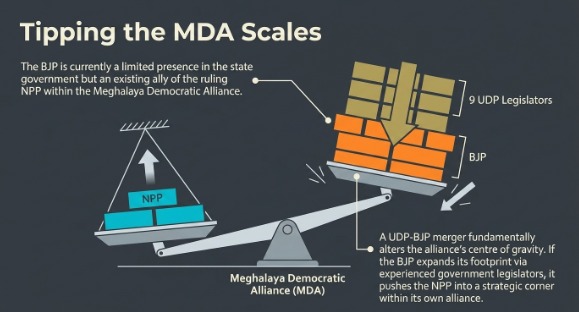
But let’s look beyond the UDP. Because this is not just an internal matter for a regional party. This could potentially change the balance within the Meghalaya Democratic Alliance. And that brings us to BJP.
BJP may have only a limited presence in the state government today. But politically, its ambition is much larger. The 2028 Assembly election is roughly 16 months away. And BJP has openly been working to expand its footprint in the North East. So, if BJP is trying to increase its numbers in Meghalaya, why wouldn’t it look towards legislators who already have experience in government?
But here’s the interesting part. BJP is also an ally of NPP. So, what happens if BJP expands?
Will NPP be a mute spectator? Or does it try to intervene and work out a political arrangement — perhaps even accommodate one or two more UDP MLAs in the cabinet — to keep the regional party within the existing alliance?
Now, if eight or nine UDP MLAs were to move towards BJP, then one wonders what would happen to the popular regional party. UDP isn’t just another political party. It represents Meghalaya’s regional political space. Its strength comes from the argument that Meghalaya needs strong regional voices negotiating with national parties. So, if its own legislators begin moving towards a national party, it will only weaken the regional force.
Not only that, the ideological differences between a regional party and BJP may not resonate well with supporters.
In all this, VPP may win an edge over both NPP and UDP. Known for its strong tribalism, VPP may gain popularity for holding on to the regional roots and keeping the national biggies at bay, unlike NPP and UDP.
UDP now has 12 MLAs. If nine of them join BJP, then there could be a possible merger. With over 18% of MLAs with BJP, the party will have a strong say in the government, which it already has to a great extent. And if BJP manages to increase its footprints in Meghalaya, it will only push NPP to the corner. Will NPP allow this to happen?
September last year changed the equation inside UDP. And September this year may tell us whether that change was just the beginning or the first move in a much bigger political realignment in Meghalaya.
WATCH MORE VIDEOS