
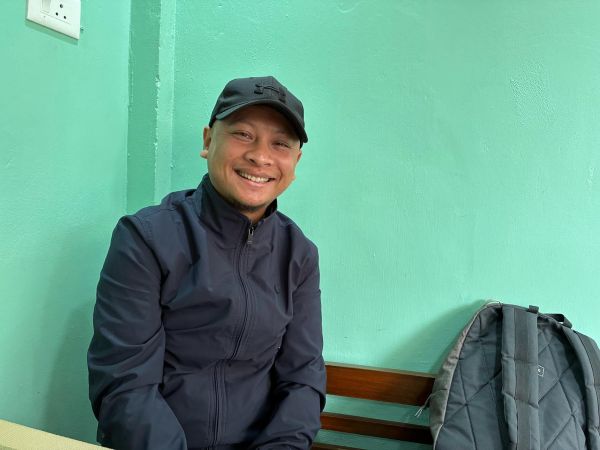
Young teacher shows way to holistic education in Meghalaya
Batskhem Thabah's Living Library, if nurtured well, can bloom into a system that will complement curricular education

 Talat Bulut, the teacher in the Turkish film The Miracle (Mucize), changed the life of an autistic man in a remote village and several children who never knew what a school looked like.
Back in Meghalaya, the character of Talat Bulut inspired a young teacher who was determined to make a difference in the lives of the villagers of Raibah in East Khasi Hills. And, his resilience paid. Batskhem Thabah not only changed the lives of the children there but also encouraged their parents to share their traditional knowledge with their wards, so that the latter have a holistic education.
At 33, Thabah is known for his model of teaching and community building, which has earned him the Shikshagraha Award 2026.
He started his teaching career in 2017 at Kiddies’ Corner, his alma mater. According to Thabah, “Sir Brian Wallang’s method of teaching” inspired him in many ways as a teacher.
“In 2019, I quit teaching to become a tour guide. I have always loved to explore new places, especially the rural pockets of the state. So, the work as a tour guide was exhilarating for me. Then the pandemic hit, and I engaged in social work in collaboration with Milaap, a non-profit organisation,” recollected Thabah.
One teacher making an impact
During that period, Thabah realised that while children in the urban pockets were privileged to continue their education even amid adversity, those in remote villages were completely missing out on the opportunity. This prompted him to take up teaching once again.
When Thabah joined Raibah LP School in 2021, he was the only teacher. What the villagers called a school was only a carcass. “There were no teachers in the village for two years. The number of students had also reduced to about 30. I realised that I had a lot of work to do,” said the young teacher.
Thabah’s approach was not just to provide curricular education, but teach the children life skills. So, involving the parents was an important step, but not an easy one. Farming was the source of sustenance for most of the villagers, and they always preferred their children to help them in the fields. It was a challenging task to convince the parents to support education and the school in the village.
The new village teacher immediately realised that he had to be a Roman in Rome. He had to live their life to understand their problems and constraints. Thabah would go to the fields with the villagers, go fishing with them, live with them and sleep on the floor. He even helped in renovating the school alongside the villagers. In no time, he earned the villagers’ respect and trust.
On the one hand, the infrastructure was improved, and on the other, discipline was installed in the children. There were frequent meetings with parents, and Thabah ensured that the children attended school every day.
“The attendance increased to 40. A friend, Ibarihun Majaw, helped me raise Rs 1.5 lakh through crowdfunding. The money was used to renovate the school in 2023. The year before that, I took up cleanliness drives and awareness on self-hygiene. We planted saplings around the school. I also encouraged community engagement,” said Thabah.
These changes made an impact. Students came to school on time, and they would keep the premises clean. Thabah introduced extra-curricular activities and nature walks for the holistic growth of his students.
“I also introduced local edible plants, which were easily available in the village, in the midday meals. We started using areca leaves for serving lunch. I encouraged parents to make pencil cases out of bamboos, and the idea worked,” Thabah said.
Two persons who also helped Thabah achieve the feat were Dr Randolph Langstieh, professor of social work at Williamson Sangma University, and David Nongrum of the Directorate of Educational Research and Training.
Living Library
Thabah’s association with the village and his method of educating the children there continued even after he left the school in 2024. Now a teacher at Mawlaideng Government UP School, Thabah has been promoting Living Library at Raibah.
The whole idea of the library is to keep alive the tradition and culture, and make children aware of their roots and history.
“Ibarihun Majaw, Badapbiang Dkhar and I are working on this project to reach other parts of the state. We plan to have the pilot in 12 villages across the state. This is designed in the lines of the National Education Policy,” said Thabah.
The Raibah Living Library is a unique idea that, if adopted properly, will complement the curricular education and help enrich the state’s education system. The idea is growing, like a living organism, and if nurtured well, will bloom in other parts of Meghalaya and beyond.