


Could wildfires in Canada have affected India’s monsoon?
New research suggests the scale of Canada’s 2023 wildfires was so large it may have affected weather far beyond North America

Simrin Sirur/Mongabay India
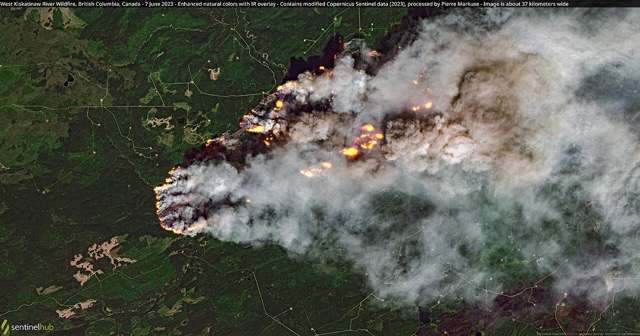
When the worst recorded wildfires ripped through Canada in 2023, scientists didn’t expect to see its effects take shape in far corners of the world. Yet, the magnitude of the disaster was so large that it may have interfered with atmospheric circulation systems thousands of kilometers away – in India.
“When we started this research, we didn’t set out to see what the impacts would be on the Indian monsoon. It just happened during our simulations,” said Iulian-Alin Roşu, a post doctoral researcher at the Laboratory of Atmospheric Environment and Climate Change, Technical University of Crete, who simulated the global impacts of the wildfire emissions using a climate model.
The wildfires in Canada raged from May to July, engulfing 15 million hectares of land and emitting almost almost 480 megatons of carbon and 10,700 kilotons of particulate matter (PM2.5). These smoke particles and aerosols were transported across continents and oceans, causing a direct impact on air quality in Canada, the United States, and parts of Europe.
Roşu and his co-authors found that the aerosols from the wildfires could have contributed to atmospheric cooling over the northern hemisphere, by blocking the sun’s radiation into Earth. This same cooling effect, extending to the northern Arabian Sea, could have contributed to a “pronounced low-level pressure anomaly over the Asian continent” which weakened monsoonal winds over India in August 2023.
The study was published in the Natural Hazards journal in February.
What caused dryness in August 2023?
As the wildfires abated in Canada, India faced record lows in rainfall in August 2023. The country received 36% less rainfall than normal that month, making it the lowest in over a century. The India Meteorological Department attributed the unusually dry August to an unfavourable Madden Julian Oscillation (MJO), an eastward moving disturbance of clouds, rainfall, and winds which travels along the equator and can moderate the timings of the monsoon and control the formation of tropical cyclones.
According to the IMD, the MJO was locked over the western hemisphere and Africa in August 2023, which “was quite unfavorable for rainfall over the Indian monsoon region.” In the suppressed convective phase of the MJO, winds converge at the top of the atmosphere and are pushed down to the surface, causing warmth and dryness, and suppressing rainfall.
But the MJO is just one probable theory for what caused the unusual dryness in August. “We now have stronger evidence that dry air moving in from arid regions to the west and northwest of India was a key factor,” said Akshay Deoras, a senior research scientist at the National Centre for Atmospheric Science and Department of Meteorology, University of Reading. “These dry air intrusions reduce cloud formation and suppress rainfall in India, which lead to breaks in the monsoon.”
The wildfire hypothesis, on the other hand, posits that aerosols from the wildfires reached Eurasia and the northern Arabian Sea, causing atmospheric cooling. “Where there is atmospheric cooling, there is also atmospheric pressure, because cool air moves down and warm air comes up,” said Roşu, “This higher pressure creates a cyclonic pattern, which leads to winds that were pushing against the monsoon of that period. These opposing winds are what could have weakened the monsoon,” he explained.
How the study was done
The researchers were able to estimate the impacts of the wildfires on India’s monsoon by running multiple simulations through the EC-Earth3 Earth system model, including and excluding wildfire smoke.
Simulations including the wildfire smoke resulted in “a very good match in the location, shape and magnitude” of the modelled and measured precipitation anomalies, the study says. Both modelled and observed reductions in daily rainfall across India were around 5 mm a day, with some pockets having reductions of up to 16-20 mm a day. The modelled simulations could also accurately capture reduced cloud cover and align with recorded hotter surface temperatures.
“Our argument is that the MJO makes sense as an explanation, but perhaps there is a simpler explanation for the monsoon anomaly in August 2023, which is that wildfire emissions played a role,” said Roşu.
However, while the simulations captured the extent of precipitation deficits accurately, it projected them for July instead of August, suggesting a mismatch in timelines. Deoras, who was not involved with the study, said the heavy reliance on a single model to simulate the impacts of the wildfires was a serious limitation. “The model simulations were based on background conditions from 2015 rather than the actual climate conditions of 2023, which limits how realistic the results are,” he told Mongabay India over email.
“There is growing evidence that air pollution from one region can affect weather elsewhere. For example, we are fairly confident that high levels of air pollution over Europe before 1975 contributed to a weakening of the Indian monsoon. Such long distance links can be useful if they are clearly established, but if the evidence is weak they can lead to misleading conclusions,” Deoras added.
The article was first published in Mongabay