


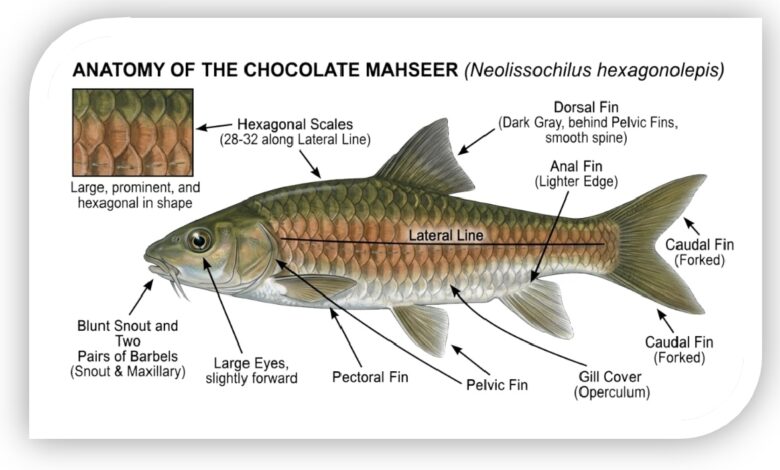
Shillong, May 5: Meghalaya will be the third state in the North East to declare Chocolate Masheer (Neolissochilus hexagonolepis) as the state fish.
The state cabinet on May 5 took the decision.
In 2007, Chocolate Masheer was declared as state fish by Nagaland government and Sikkim also adopted it as state fish in 2021.
This means that three states are claiming the fish to be their own thereby diluting the uniqueness of the species.
According to Meghalaya cabinet, the Khasi name for the fish is Khasaw and the Garo name is Na-rang.
“At present, our state does not have an officially designated state fish, unlike many other parts of the country. We have therefore decided to declare the Chocolate Mahseer, locally known in Khasi as Khasaw and in Garo as Na-rang as the state fish. This fish is native to the state of Meghalaya, and the decision has also been taken with a strong focus on conservation, to protect and promote this indigenous species”, Chief Minister Conrad Sangma posted on X..
Later, a statement from the Governor’s House said it was a significant step towards conservation and promotion of indigenous aquatic biodiversity.
With this Meghalaya has become 23rd state in the country to declare its State Fish.
The proposal, initiated by the Department of Fisheries, was recommended by the Meghalaya State Aquaculture Mission and subsequently endorsed by fish farmers and key stakeholders during consultations. The proposal also received technical validation from the ICAR-National Bureau of Fish Genetic Resources, further strengthening its scientific basis.
The Chocolate Mahseer is an indigenous fish species widely distributed across the hill streams and rivers of the state. It thrives in cool, clear, fast-flowing, oxygen-rich waters with rocky or gravelly substrates, making it an integral part of Meghalaya’s aquatic ecosystem, the statement said.
The species, known for its distinctive brown to dark chocolate coloration, can grow up to approximately 120 cm in length and weigh up to 11 kilograms. It is currently listed as “Threatened” under the IUCN Red List and categorized as “Endangered” by Indian Council of Agricultural research – National Bureau of Fish Genetic Resources (ICAR-NBFGR), highlighting the urgent need for its conservation.
The declaration aims to promote conservation, culture, and sustainable production of this high-value indigenous species. It will help in ensuring protection, restoration, and improvement of its natural habitat. It will also encourage documentation and preservation of associated cultural beliefs, indigenous practices, and traditional knowledge systems.
“This landmark decision reflects the Government’s commitment to biodiversity conservation, sustainable fisheries development, and the preservation of the state’s rich ecological and cultural heritage”, the statement added.