

Reintroduced rhinos in Assam breed, but recovery remains fragile
A decade-long study tracking reintroduced rhinos in Manas National Park, Assam, shows encouraging signs of reproduction and adaptation

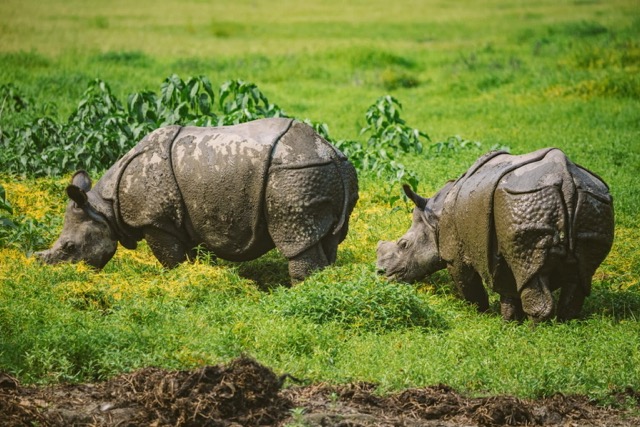
Sneha Mahale/Mongabay India
The greater one-horned rhinoceros was once wiped out from Assam’s Manas National Park (MNP), marking a major conservation setback. The rhino population, however, was re-established through the wild-to-wild translocation under the Indian Rhino Vision 2020 (IRV2020) and rhino rehabilitation programmes.
A recent study on the re-established population, introduced through two routes — translocation from other protected areas, and rehabilitation and release — between 2012 and 2021 offers encouraging signs of adaptation in their restored habitat. The study also followed the first generation (F1) of rhinos born in Manas.
Manas National Park lies in Assam’s Chirang and Baksa districts in northeast India and borders the Royal Manas National Park in Bhutan to the north. Between 2008 and 2021, 22 greater one-horned rhinos were translocated from Kaziranga National Park and Pobitora Wildlife Sanctuary as a part of efforts to restore the park’s rhino population.
In addition, 20 rehabilitated rhinos from the Centre for Wildlife Rehabilitation and Conservation were released in the park between 2006 and 2021, as Manas was considered a more suitable natural habitat than keeping them in rehabilitation facilities.
Breeding and calving pattern
Researchers recorded 35 rhino births in Manas during the study period. Nineteen calves were born to translocated females and nine to rehabilitated rhinos. Five calves were born to the F1 generation, while two calves were recorded without identified mothers. In total, eight translocated females, four rehabilitated females, five F1 females and two unidentified adults produced calves.
“Breeding and calving are among the most important indicators that reintroduced rhinoceroses have adapted well to their new environment,” says the corresponding author of the study, Deba Kumar Dutta, a wildlife biologist and member of the IUCN/SSC Asian Rhino Specialist Group.
In two cases, calves were born less than 480 days after release (roughly the gestation period for the species), suggesting they had conceived before translocation and that the move did not disrupt their pregnancies.
During the study period, the animals were tracked using radio telemetry systems that included VHF collars, directional antennae and receivers, along with camera traps and field observations.
Translocated rhinos were identified through ear notches made during capture, while rehabilitated rhinos were recognised through distinctive body features recorded in a master identification file.
By tracking females and recording when calves were first seen, researchers estimated birth dates and calculated key reproductive indicators such as age at first calving and inter-calving intervals (ICI). “Greater one-horned rhinos reproduce relatively slowly. Females reach sexual maturity at about five to seven years and carry a calf for 15-16 months. They give birth to a single calf and generally produce another every two to three years,” says Dutta.
The study found F1 females had their first calf at an average of 5.65 years, while rehabilitated rhinos calved later, at about 9.2 years. Inter-calving intervals ranged from 2.12–4.41 years for rehabilitated rhinos and 1.99–6.30 years for translocated individuals. Birth rates fluctuated widely: nine calves were recorded in 2013, followed by a sharp decline, with none in 2016. Numbers recovered after 2017, reaching five calves in 2020 and seven in 2021.
Monitoring rhino movements
The study also revealed differences in how rhinos used space within the park depending on their origin. Translocated rhinos occupied significantly larger areas, with an average home range of about 339 sq km, often using remote or less disturbed parts of the park. Rehabilitated rhinos, by contrast, had much smaller home ranges averaging around 52 sq km and were mostly concentrated in central areas of the park.
“Rehabilitated rhinos are often human-imprinted and tend to remain close to human-inhabited areas within protected areas. At times they may even move towards nearby villages, mingling with cattle during the night and returning to the park in the morning. Translocated rhinos, captured from the wild and released into natural habitats, generally retain their natural behaviour,” says Dutta.
The first generation of rhinos born in Manas displayed intermediate movement patterns. Their home ranges averaged about 79 sq km and often overlapped with the core areas used by rehabilitated rhinos. Some of these females were even observed using calving sites similar to those used by their mothers, suggesting possible continuity in habitat use.
The study also revealed clear seasonal patterns in rhino reproduction. Most births (14) occurred during the monsoon, between May and September. “In Manas, flooding is not a big issue compared to other rhino areas such as Kaziranga, Orang or Pobitora. However, during the monsoon period food and water availability are at their peak, which may influence rhino movement and habitat use,” says Dutta.
Challenges for recovering population
Despite these encouraging signs of reproduction, the researchers note that the population has not yet reached its full reproductive potential. Several factors may have influenced birth rates during the study period. In the early years of the reintroduction programme, poaching incidents killed several adult male rhinos in the park, disrupting breeding opportunities and affecting the population’s sex ratio.
Protection measures were later strengthened, helping stabilise the population. However, researchers warn that a small recovering population may still face risks such as inbreeding if closely related individuals breed with each other.
Rhinos have slow life history traits, and recovery is extremely slow and highly dependent on active and continued conservation efforts, says Yadvendradev Jhala, senior scientist of INSA at NCBS, Sr Professor & Dean (Retd.), Wildlife Institute of India, adding: “The reintroduction has been remarkably successful but should not be viewed with complacency since it can easily be reversed.” He said that the Manas rhinos should always be managed as a metapopulation with Kaziranga, Pobitara and other populations in West Bengal. So all these populations benefit from occasional immigrants bringing in genetic diversity and population vigorously as they won’t sustain themselves without continued management in these landscapes.
Dutta says the population would need to be strengthened further, possibly through additional introductions from donor sites such as Kaziranga and Pobitora. He also emphasises the importance of continued monitoring and habitat management, including the removal of invasive plant species from grasslands and maintaining perennial water sources.