



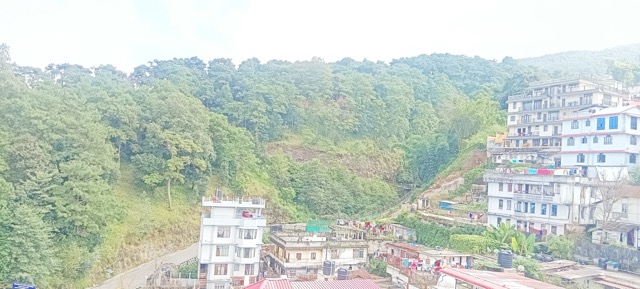
 The Cabinet’s recent amendment to the Meghalaya Building Bye Laws, 2021, under the ‘Special Projects Category’, may have opened the doors for rapid urban growth in Meghalaya — but it has also opened a floodgate of fear, anxiety, and serious questions over public safety in one of India’s most earthquake-prone states.
By reducing the minimum plot size from 50,000 sq. ft. to 37,500 sq. ft. and lowering the required built-up area from 20,000 sq. ft. to 15,000 sq. ft., the government has effectively made it easier for more developers and landowners to enter the race for large-scale commercial and institutional projects.
Hotels, hospitals, educational institutions, shopping malls, multiplexes, ICT/BPO centres, and high-rise commercial structures are now expected to mushroom across urban Meghalaya.
But with this promise of development comes an alarming reality.
Across several localities, traditional Assam-type houses — structures long considered more adaptable to the region’s terrain and seismic sensitivity — are rapidly disappearing. Assam-type buildings have their own charm and aesthetic beauty and have long been part of the region’s architectural identity. Yet, one after another, old homes are either being dismantled or, in some disturbing incidents, even gutted by fire before new concrete structures emerge in their place.
The lure of rental income and commercial profits is pushing many landowners toward vertical construction, with entire neighbourhoods slowly transforming into an urban jungle.
Many heritage structures in the city have also slowly vanished under the wave of aggressive expansion. Even iconic buildings, including Tara Ghar, were brought down. The disappearance of these structures show how fast the city’s history, character and identity are disappearing.
This an alarming situation as Meghalaya may now be entering a dangerous phase of uncontrolled urbanisation, where profit could begin overshadowing public safety.
The biggest concern remains impossible to ignore — Meghalaya lies in Seismic Zone V, one of the highest earthquake risk zone in the country. In a state where tremors are not uncommon, the reckless vertical expansion without uncompromising safety enforcement could eventually lead to catastrophic consequences.
Questions now arise over whether the state is truly prepared for the risks that come with buildings beyond Ground +3. Later, the government moved toward allowing Ground +5 structures, this decision raises fears that could amplify the danger in an already vulnerable hill state.
Serious concerns also arise regarding the safety of children if more multi-storey schools and educational institutions are constructed under the amended rules. In the event of an earthquake or fire emergency, are schools equipped with proper evacuation plans, emergency staircases, open safety zones and trained disaster-response systems? Many fear that without strict enforcement of safety protocols, thousands of students could be placed at risk inside densely packed concrete structures.
Concerns are also intensifying over the growing pressure on already strained civic infrastructure. More buildings mean more traffic congestion, parking chaos, water stress, drainage overload and increased pressure on emergency services. Yet many fear that Meghalaya’s urban planning system is expanding far slower than the pace of construction approval.
The issue becomes even more sensitive in light of earlier controversies involving a few proposed high-rise commercial projects in the state that reportedly escalated to the Supreme Court over building permissions and height regulations. Those disputes had already exposed deep public unease over whether urban development in Meghalaya is moving faster than regulatory oversight.
Now, fears are growing that the latest amendment may trigger a fresh wave of unprecedented real-estate expansion unless strict safeguards are immediately enforced. It is argued that strict action should be taken against any violation of safety norms, illegal construction, or misuse of permissions. Concerned government bodies must ensure that no multi-storey project is approved without strict seismic audits, structural clearances, fire safety certification, and continuous monitoring.
If the government is aggressively promoting the development of the New Shillong Township as the city’s future expansion hub, then why push for even denser construction inside the already congested core city? instead of preserving Shillong’s fragile ecology and existing urban character, the amended building rules may end up choking the city even further with unchecked vertical growth, worsening congestion, pressure on resources, and safety risks.
Because in a fragile hill state like Meghalaya, the danger is not just about taller buildings — it is about what happens when the ground beneath them begins to shake.
For some the amendment represents economic opportunity and a modern urban future. But for many others, it raises a chilling possibility that Meghalaya could be racing toward a concrete future without fully understanding the human cost.
WATCH MORE VIDEOS: