



Editor,
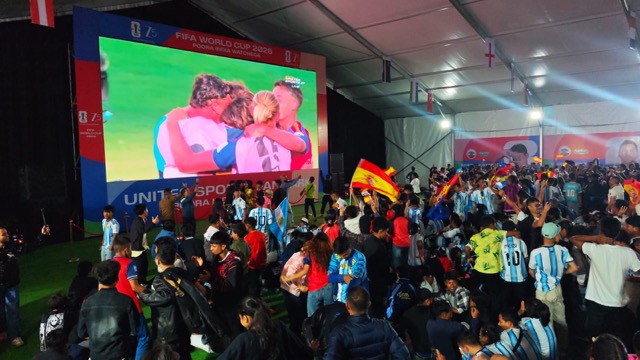
Meghalaya may be a football-loving state, but football cannot become an excuse for the government to treat education as an afterthought. Chief Minister Conrad K. Sangma’s decision to declare Monday, July 20, a holiday for all educational institutions so that students could watch the FIFA World Cup final between Spain and Argentina may have delighted football fans, but it raises a deeply uncomfortable question: what exactly are the priorities of a government presiding over a state whose school education system has recently been ranked at the bottom nationally?
The final began at 12:30 a.m. IST, and the government’s argument was apparently that students would stay awake late, and therefore, need a day off. That may sound considerate, but governance is not supposed to be reduced to granting holidays every time a popular sporting event happens at an inconvenient hour.
A government that is genuinely serious about education should be worrying about learning outcomes, attendance, teacher quality, infrastructure, examinations and the dismal national assessment of the state’s education system — not enthusiastically converting an international football final into an official educational holiday.
The irony is particularly glaring. Meghalaya has just endured the embarrassment of being placed at the bottom of the Performance Grading Index for school education, with the government subsequently defending itself against the findings. At such a moment, the political leadership should have been sending an entirely different message to students: education matters, discipline matters and a football match—even a World Cup final—cannot be placed above the classroom. Instead, the message appears to be that if a football match is sufficiently popular, the education system can simply be shut down for the day.
Meghalaya is undoubtedly football-mad. Its passion for the sport is genuine, deep-rooted and culturally significant. The massive response to football screenings in Shillong and elsewhere is proof of that. The Chief Minister is perfectly entitled to celebrate the state’s football culture and encourage sporting excellence. But there is a difference between celebrating football and allowing football to dictate the functioning of the education system.
The absurdity becomes even more apparent when one considers that the final involved Spain and Argentina—two countries with immense football traditions. Yet the educational systems of the countries whose teams were actually playing the final did not need to be shut down merely because a match was scheduled at an inconvenient hour. The fact that football is a passion in Meghalaya is no justification for institutionalising the idea that academic obligations should yield to television viewing.
This is not an argument against football. It is an argument against priorities.
The government could have left the decision to individual schools, colleges, students and parents. Educational institutions could have made their own arrangements, adjusted schedules where necessary, or allowed students to take leave according to their circumstances. Instead, the State itself stepped in and declared a blanket holiday for every educational institution.
And that is precisely where the decision becomes unbecoming. A Chief Minister is expected to elevate the aspirations of a state, not merely echo its popular enthusiasms. When education is already biting the dust, when Meghalaya continues to face serious challenges in school education, and when the state needs to catch up with the rest of the country, the government should be encouraging students to spend more time in classrooms—not officially rewarding them for staying up through the night to watch football.
The message from the Chief Minister should have been: watch the match if you wish, but do not allow entertainment to take precedence over education. Instead, the government effectively announced that the classroom could wait.
There is also something deeply revealing about the political instinct behind such gestures. A government may find it easy to win applause by announcing a holiday for a popular event. It is far more difficult to win applause by undertaking the painstaking, unglamorous work of reforming schools, improving learning outcomes, enforcing teacher accountability and confronting the structural weaknesses that have dragged Meghalaya’s education system to the bottom of national rankings.
Football produces instant applause. Education reform produces results only after years of hard work.
If the Chief Minister truly believes that football is “a passion and a way of life” in Meghalaya, then the state should be producing world-class footballers through better schools, academies, coaching and sports infrastructure—not merely giving students a day off to watch professionals on television.
A state whose education system is in crisis cannot afford to confuse popularity with governance. Meghalaya needs more classrooms, better teaching and stronger educational outcomes—not a government that appears to have found a holiday solution every time football comes calling. The World Cup final lasted a few hours. The consequences of educational neglect last generations.
And if the government’s priorities are indeed reflected in its decisions, then this particular decision sends an unfortunate message: football has become a passion for the government; education, apparently, remains a problem for another day.
Yours etc.,
Rajiv Roy
A citizen