


 What began as a dispute over an under-construction temple inside the CBI office premises at Mawdiangdiang has now opened up a wider debate in Meghalaya — over the use of government land, institutional neutrality and the meaning of secularism in a constitutional democracy.
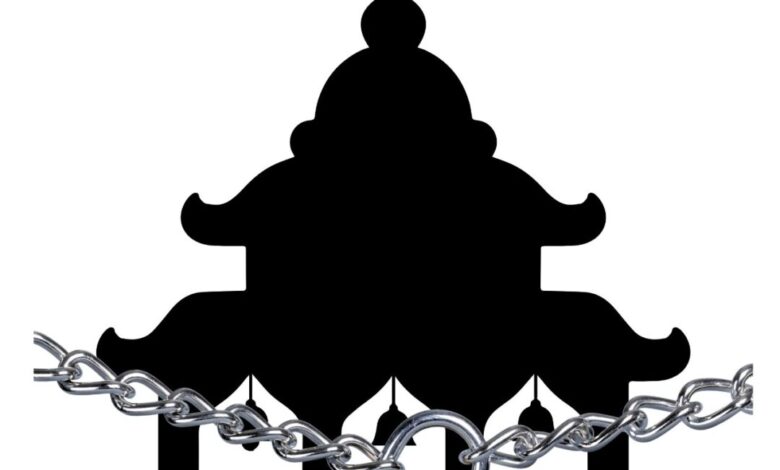
The Khasi Students’ Union (KSU) of the Shillong Mihngi Circle has objected to the construction, arguing that the land was allotted for official purposes and that a religious structure has no place within a government office complex. The organisation had earlier locked the under-construction structure and demanded its removal.
But the immediate question is not simply whether a temple should exist inside a government office. The more fundamental question is: Was the structure authorised in the first place?
According to the Department of Urban Affairs and the New Shillong Township Development Agency, the land was leased to CBI on November 14, 2018, for an office-cum-residential complex. The reported lease conditions require prior permission for construction or alteration of structures. The state authorities have sought clarification from CBI regarding the religious structure.
This makes the lease agreement central to the controversy.
If permission was obtained, the next questions are: Who granted it, under what authority, and was the religious structure included in the approved plan? If no permission was obtained, the issue becomes one of compliance with the terms under which government land was leased.
That distinction is important because calling the construction “illegal” before the relevant documents and permissions are established would risk reducing a serious governance question to a political or religious argument.
At the same time, the KSU’s own actions deserve scrutiny. While the union has raised questions about the use of government land, its decision to lock the structure raises another question: Who has the legal authority to seal or lock a government property? If there is a violation, should the matter be decided through the competent administrative authority or the courts rather than through direct action?
Beyond the immediate dispute lies an even larger constitutional question.
India is a secular republic. The Supreme Court describes the Constitution as establishing a secular state that recognises freedom of conscience and religion, while also guaranteeing equality before law.
A CBI employee is free to practise his or her religion. But the CBI itself is a constitutional government institution and not a religious organisation. While citizens are free to follow their respective faith, from the perspective of the State, a person’s religion is immaterial and all are entitled to equal treatment.
Therefore, the issue is not whether Hindu employees can pray. They can. Nor is the issue whether temples, churches, mosques or other places of worship can exist in Meghalaya. They can, subject to applicable laws.
The question is whether a permanent religious structure should be established within a government institution, or for that matter, any constitutional institutions, using land allotted for a secular public purpose.
And if such structures are permitted, the same standard must apply to every religion.
That is where the wider public debate about Meghalaya’s religious landscape must be handled carefully. There is a perception in some sections that churches are mushrooming across the state. But the existence of churches or other religious institutions on private, community or institutional land is not automatically comparable to a religious structure allegedly being constructed on government-leased land meant for a government office.
The real test should, therefore, be simple: one law and one standard, irrespective of religion.
If an unauthorised church were constructed inside a government office, would the authorities act in the same manner? If a mosque or gurdwara was built without permission on government land, would the response be identical?
That is the test of institutional neutrality.
The issue also has implications for educational institutions. Article 28 places specific constitutional restrictions on religious instruction in educational institutions wholly maintained out of state funds, while also making distinctions for other categories of institutions. The principle is not that religion must disappear from society or that students cannot learn about religion. Rather, publicly supported institutions must ensure that education does not become a vehicle for coercion or religious discrimination.
For Meghalaya, this debate is particularly significant because religious identity is deeply woven into society. The answer, however, cannot be to pit one faith against another.
Secularism does not mean hostility towards religion. It means that the State does not favour one religion over another.
In this context, the CBI temple controversy could become bigger than the structure itself. It raises questions about government land, lease conditions, administrative authority and the responsibility of constitutional institutions to remain neutral.
Ultimately, this should not become a contest of religious strength or institutional ego — between CBI, the state government, KSU or different communities.
The central question should remain:
When public land is given to a public institution for a defined purpose, can that purpose be changed without permission — and should the same rule apply regardless of which religion is involved?
The answer to that question will determine whether the controversy remains a religious confrontation or becomes an important conversation about the rule of law and secular governance in Meghalaya.
WATCH OTHER VIDEOS