

Kodaikanal: Nine stops, a thousand moods
A sudden veil of mist, a shaft of sunlight through the trees or the distant call of a bird can turn an ordinary stop into a memorable moment

 Recently, my husband and I visited Kodaikanal for a short stay of two days with some friends and tried to cover some places.
According to history, Kodaikanal was an important and integral part of the British rule in India. It was in the 10th century that British officers and American missionaries were trying to identify a place with cool environment. Credit goes to Rev. J.F Laidlaw and European and Rev WH Allen, an American missionary, who discovered Kodaikanal in 1850.
The name Kodailkanal has multiple interpretations and they include “Kodai” meaning summer and “Kanal” meaning forest. Another interpretation says the word “Kodai” is derived from the Tamil word gift or shade and hence gift of the forest-Kodai Kanal. In the two days that we were there, we managed to cover some of the interesting and important tourist spots.
Coaker’s Walk
The Coaker’s Walk was named after Lieutenant Coaker in 1872. It is not just a colonial era pathway but depicts a front-row seat to the theatre of mist, mountains and the plains in the steep southern ridge. Its identity today spans to a path which is embedded into the hillside and is visited by tourists from all over the world.
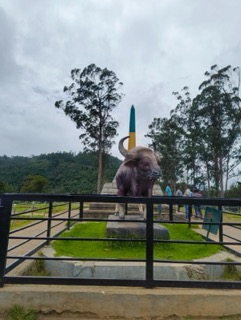
On a clear day, the landscape seems to stretch endlessly; on misty mornings, the mountains appear and disappear behind drifting clouds. There is something wonderfully unhurried about walking here—the cool air, the occasional glimpse of the valley and the simple pleasure of walking without having to reach anywhere in particular.
The Upper Lake view does not have any significant historically attached to it. It is an elevated point from where one can get a full view of the landscape and the distinctive star-shaped Kodaikanal Lake and the green hills surrounding it. It was created by Sir Vere Henry Levinge in 1863 where he transformed a marshy depression into an artificial lake which is now centrepiece of the hill station.
There is something particularly satisfying about seeing the familiar lake in its entirety: the water, the encircling greenery and the town tucked into the hills. On a clear day the geometry of the lake is unmistakable when mist descends, the view becomes more elusive, with the landscape appearing and disappearing in fragments. It serves as a spot to stop briefly and enjoy the panoramic view.
The history of Kodaikanal at Moir Point is written not only in the landscape, but also in the road that first opened a passage through it. History narrates that in 1929 Sir Thomas Eyebron Moir a senior British civil servant in the Madras Presidency began this construction and came to be known as Goschen Road. Sir Thomas turned the first sod and the road was completed in 1932. Today, the engineering history has almost disappeared beneath the mist and greenery. We stopped here to take some photographs and saw the expanse overseeing the Palani Hills.
The Pine Forest in Kodaikanal is a fascinating example of how landscapes acquire new meanings. What
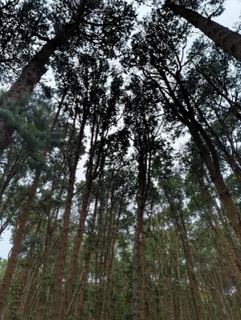
was planted more than a century ago for timber has become a tourist destination—but its story also reminds us that not every beautiful landscape is a natural one. The pie planting was initiated in 1906 under the British Forest Department. Forest Officer H.D. Bryant began this operation by experimenting with different types of coniferous trees. Over decades, what began as an experiment in forestry acquired an entirely different identity. The tall, straight trees, shafts of light filtering through the canopy and thick carpet of fallen pine needles created an atmospheric landscape that has become one of Kodaikanal’s best-known tourist attractions. Today it has become an important ecological project beneath its beauty.
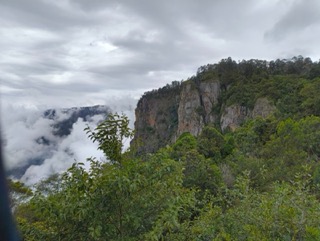
The Pillar Rocks are three enormous granite formations rising about 122 metres. It has no historical significance but its sheer beauty of the three pillars forms an excellent visit for tourists. They stand majestically and tower the hills and stand sharply silhouetted against the sky and sometimes disappear into the mist.
The Bryant Park was named after H. D. Bryant as an experimental horticultural initiative. It has a remarkable collection of flowers, shrubs, trees which are neatly potted and some exhibited in a glass house. There are some airy cages where birds are kept. They fly in the large cage and chirp loudly. Today it is maintained by the Tamil Nadu Horticulture Department and has evolved as a popular public garden from a mere horticultural experiments.
Suicide Point or Green Valley (the name was changed to disillusion people with the original name) overlooks the Vaigai dam. The change of name is significant as it shifts the emphasis from the site’s tragic associations to its extraordinary landscape. The valley is extremely deep and visitors are asked to be cautious. For a photographer it is a delight to capture the expansive panorama—the green folds of the Palani Hills, the distant plains and the Vaigai Dam on a clear day.
The Lake is a beautiful place where one goes boating either with one of the staff or can use the pedal boat.
Kodaikanal’s greatest attraction may be what cannot be planned. A sudden veil of mist, a shaft of sunlight through the trees, the distant call of a bird or the unexpected opening of a valley can turn an ordinary stop into a memorable moment. Nine stops but a thousand moods and somewhere between the mist and the mountains, Kodaikanal leaves you with something that no itinerary can quite capture: the desire to return.
Travelling from Bengaluru
One can go by Vande Bharat to Madurai and stay overnight. Then, travel to Kodaikanal by road (3 hours travel). There are also direct buses from Bengaluru and Chennai.