

Beyond blame, towards dialogue between Meghalaya, Assam
Choosing talks is not weakness, but the beginning of restoring peace

Balakmen Suting
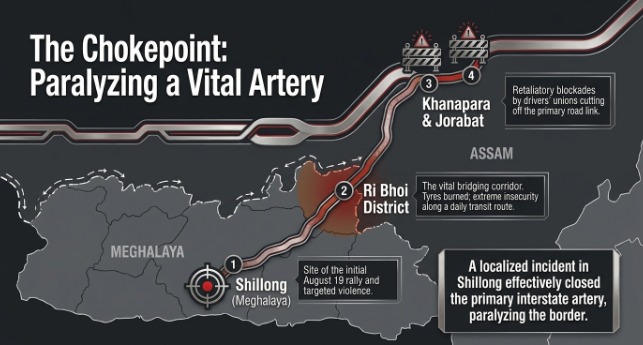
On August 19, a black-flag motorcycle rally organised by the Khasi Students’ Union (KSU) in Shillong turned violent, straining relations between Meghalaya and Assam and disrupting the lives of ordinary people on both sides of the border.
What began as a protest over a legitimate charter of demands has, within days, become a border standoff, one that is being paid for not by those who caused it, but by commuters, traders and daily-wage families who had no part in it. This is call to separate the guilty from the innocent, to pursue dialogue over retaliation, and to remember that vast majority of people in both states want nothing more than to travel, trade and live in peace with their neighbours.
The KSU’s black-flag rally was organised to press the Meghalaya government on a five-point charter. Among its demands, action on a contested public hearing for a cement project in East Jaintia Hills, full implementation of the Meghalaya Residents Safety and Security Act, and reforms to migrant-worker regulation. These are legitimate grievances, raised through a process the state itself had approved.
What followed was not protest but disorder. East Khasi Hills Police confirmed that 31 vehicles were vandalised, a government vehicle was set ablaze, and civilians including passengers on a bus carrying children were assaulted without provocation. Vehicles bearing Assam registration plates were reportedly singled out. Statues of Swami Vivekananda and Netaji Subhas Chandra Bose were desecrated. Three KSU leaders have since been arrested.
The fallout crossed state lines within hours. Angered by the targeting of Assam-registered vehicles, drivers’ unions in Assam blockaded the Khanapara and Jorabat entry points, cutting off the primary road link between Guwahati and Shillong.
In Ri Bhoi district – the very corridor that bridges the two states – the effect has been immediate: roadside traders who depend on passing traffic to sell perishable goods such as bananas and fruit have watched days of unsold stock spoil, with no buyers and no relief in sight. Tyres were set ablaze at multiple points in Ri-Bhoi, deepening the sense of insecurity along a route that thousands rely on daily. Chief Ministers Conrad Sangma and Himanta Biswa Sarma have since spoken and agreed to a ministerial-level mechanism to restore normalcy, but on the ground, the road remains effectively closed and the losses continue to mount.
Beyond collective blame
One of the most dangerous consequences of the present situation is the temptation to treat an entire organisation, community or state as responsible for the actions of individuals. That would be a mistake. The violence that occurred during the rally must be investigated. Those who vandalised vehicles, assaulted civilians, damaged public property or committed arson should face the law if the evidence establishes their responsibility.
But accountability must be individual and evidence-based. It would be equally wrong to assume that every person who participated in the rally was responsible for every act of violence, just as it would be wrong to hold every Khasi person responsible for the actions of those accused of committing crimes.
The same principle applies on the other side of the border. A person from Meghalaya travelling through Assam is not responsible for what happened in Shillong. An Assamese trader, driver, tourist, or student should not be made to pay for the actions of someone else. The distinction is not semantic. It is the foundation of justice.
Why retaliation fails
Assam’s blockade is a response to a real grievance – the deliberate targeting of Assam-registered vehicles is a serious matter and deserves acknowledgement, investigation and redress. But a blockade, by its nature, cannot distinguish between the guilty and innocent. It does not reach the people who threw the stones or lit the fires. It reaches the commuter stranded at the border, the trader whose perishable stock is rotting unsold, the student unable to reach class. Retaliation of this kind punishes proximity, not culpability, and in doing so widens the circle of harm rather than closing it.
Meghalaya has lived through this cycle before where an isolated incident spiralled into curfews, shutdowns and days of stranded travel and shuttered business. In every instance, the resolution came the same way: through arrests of those actually responsible, and through political leaders choosing to talk rather than escalate. There is no precedent here in which escalation resolved a grievance faster than negotiation did.
The innocent majority
There is an account in the Book of Genesis that speaks directly to this moment. When the Lord told Abraham that Sodom and Gomorrah faced judgement for their wrongdoing, Abraham did not accept that the whole city should be destroyed for the sins of some within it. He asked whether it was right for the righteous to be swept away with the wicked, and he interceded. First for 50 righteous people, then 45, then 30, then 20, then 10, pleading each time that the cities be spared for their sake. Each time, he received the same assurance: for the sake of the righteous, the place would be spared.
Meghalaya or Khasi people are not Sodom or Gomorrah, and the comparison should not be overstated. But the principle Abraham modelled refusing to let the wrongdoing of a few determine the fate of the many, and interceding on behalf of the community rather than writing it off is precisely the posture this moment calls for. The overwhelming majority of people in whole state or whole community or organisation are not guilty of anything. They deserve to be treated as such.
What should happen now
First, identify those responsible. The violence of August 19 should be investigated thoroughly, and those found responsible for vandalism, assault, arson or other offences should be prosecuted according to law.
Second, restore free movement. the blockades at Khanapara, Jorabat and elsewhere should be brought to an end as quickly as possible, with adequate security arrangements for travellers and transport workers.
Third, protect those who have suffered losses. People whose vehicles or property were damaged should have access to appropriate legal remedies and compensation where warranted. Small traders and transport workers who have suffered losses because of the disruption should not be forgotten.
Fourth, make the Sangma-Sarma dialogue meaningful. The proposed ministerial mechanism should have clear responsibilities regular communication and time-bound measures to restore confidence and normal movement.
Fifth, address legitimate grievances through democratic institutions. The issues raised in the KSU’s charter should be considered through the appropriate governmental and constitutional processes. Peaceful protest has a place in democracy; so, does negotiation.
It is 2026, Meghalaya and Assam are neighbours connected by roads, trade, education, tourism, employment and generations of human relationships. A single episode of violence must not be allowed to define the relationship between two neighbouring states.
The people bearing the cost today are often the people who had no role in the confrontation such as the shopkeeper or vendors waiting for customers, the driver trying to earn a living, the student trying to cross the border, and the traders whose goods depend on an open road.
- They did not throw the stones.
- They did not set the vehicles on fire.
- They did not create the blockade.
- They should not be the ones who pay for it.
Let the law identify those responsible. Let government protect those who are innocent. Let grievances be addressed through dialogue. And let the roads between Meghalaya and Assam remain what they should be: links between neighbours, not frontlines between adversaries.
Find the responsible. Protect the innocent. Reopen the roads. Choose dialogue. That is not weakness. It is the beginning of restoring peace.