


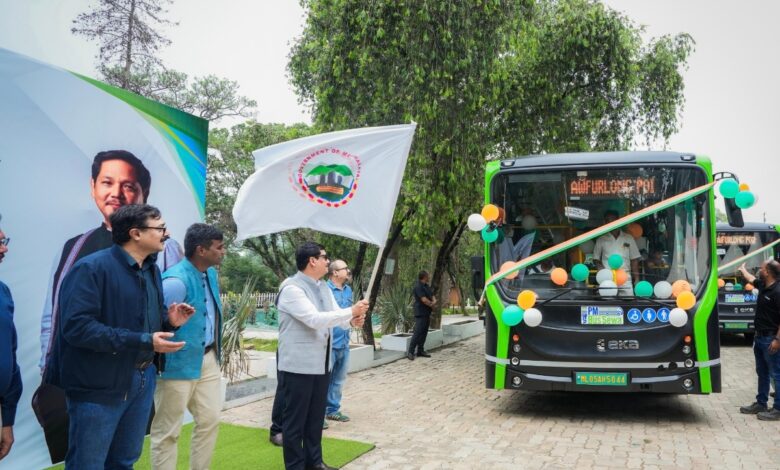
Shillong, June 9: Chief Minister Conrad Sangma on Tuesday flagged off five electric buses under PM eBus Sewa Scheme.
The event was held at Taraghar–State Guest House, here.
This is the first phase of the initiative aimed at providing citizens with cleaner, greener, and more efficient public transportation services.
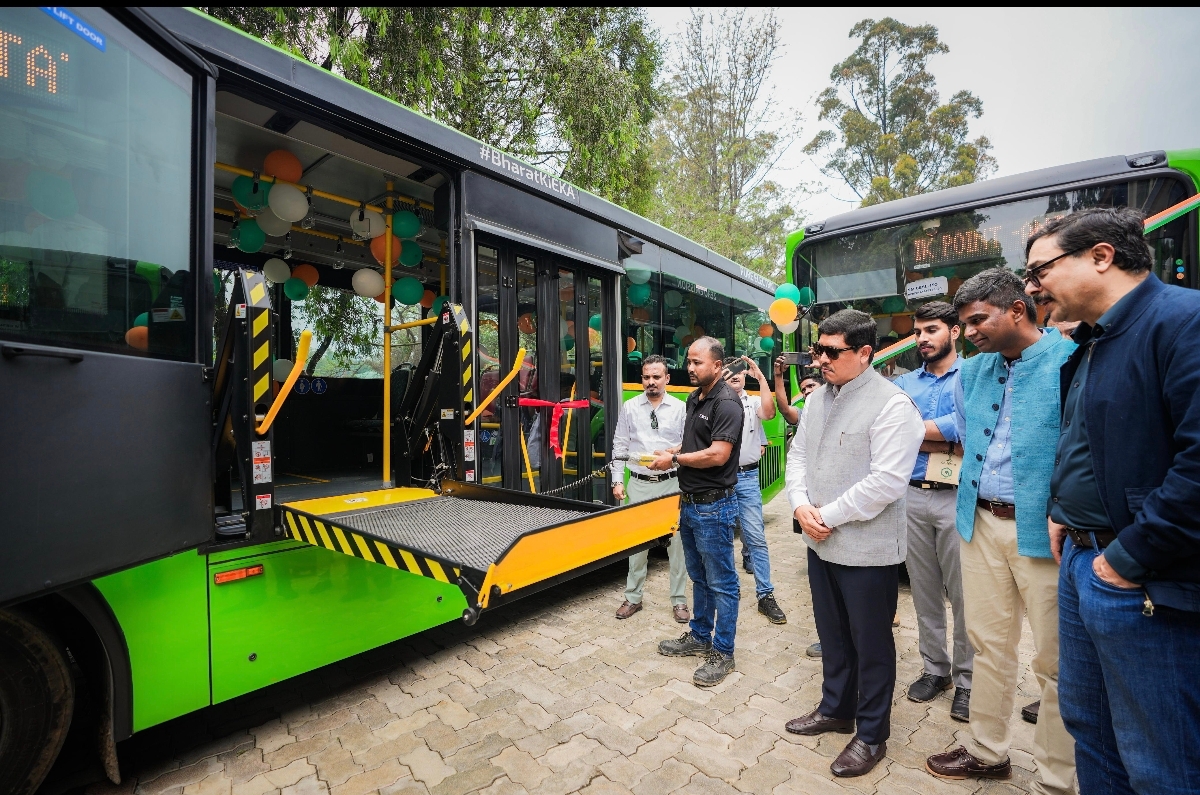
The newly launched buses are fully air-conditioned, with zero-emission vehicles built on a safe stainless-steel chassis and are capable of covering around 180 to 200 kilometres on a single charge. Each bus can accommodate up to 25 passengers in addition to the driver and features a comfortable 2×2 seating layout with overhead storage facilities. Designed to be inclusive and commuter-friendly, the buses are equipped with designated wheelchair spaces and foldable ramps to ensure accessibility for persons with disabilities. They also feature a modern e-ticketing system aimed at providing passengers with a seamless and convenient travel experience.
Addressing the gathering, Conrad congratulated the Urban Affairs Department and thanked the Government of India for supporting Meghalaya’s efforts to transform urban mobility through the PM eBus Sewa Scheme.
The chief minister noted that public transportation has long been one of Shillong’s biggest challenges and said the government has been experimenting with different mobility solutions over the years. He described the launch of the electric buses as another important step towards creating a transport system that is better suited to the needs of the city.
“Slowly but steadily, we are arriving at a model that is more adaptable and tailor-made for the needs of our city,” he said. “The ultimate objective of this entire exercise is to determine how we can decongest Shillong and encourage people to use public transportation instead of relying on private vehicles”, he said.
The electric bus initiative forms part of a broader strategy to reduce congestion and improve mobility in Shillong through a combination of public transportation, parking infrastructure, and urban planning interventions, he said.
He said the government is developing multiple connectivity options between Shillong and the new administrative city, including a proposed four-lane road, to facilitate the gradual relocation of administrative functions and reduce vehicle movement within the city centre.
“This is the broader roadmap that we have envisioned,” he said. “What we are doing today is part of a larger vision and a long-term strategy for Shillong. Every initiative—whether it is the introduction of electric buses, the development of parking infrastructure, or the creation of the new administrative city—is connected to that larger objective.”
The chief minister also reiterated the state government’s commitment to promoting electric mobility and informed that the policy providing exemptions on registration fees and road taxes for electric vehicles is being renewed following the completion of its initial three-year term.
Clarifying recent concerns regarding registration charges for electric vehicles, he explained that the earlier exemption had automatically expired and would continue once the renewed policy receives cabinet approval.
“I sincerely hope that more and more citizens begin using electric vehicles because it is the right direction for us to move towards,” he said.
Sharing his own experience as an electric vehicle user, the Chief Minister sought to dispel misconceptions surrounding EV adoption and charging infrastructure. He noted that electric vehicles can be conveniently charged at home and are particularly well-suited to Meghalaya’s terrain due to regenerative braking technology.
“The answer is absolutely yes,” he said when discussing the suitability of electric vehicles in hilly regions. “Electric vehicles are not only viable in Meghalaya but can actually perform very effectively in our terrain.”
He further informed that senior government officials and Cabinet Ministers would increasingly be encouraged to use electric vehicles, adding that the government intends to lead by example in promoting cleaner modes of transportation.
The chief minister also highlighted opportunities for communities and private landowners to participate in the development of charging infrastructure and parking facilities through government-supported initiatives, generating both revenue and employment opportunities.
Referring to the new public transport model being adopted in Shillong, he stressed that the government’s focus is no longer solely on operating bus services but on building a reliable and efficient public transportation system.
“The objective is no longer simply about whether a bus service generates profit,” he said. “The objective is to create a system that is safe, reliable, predictable and accessible for citizens.”
He added that people should have confidence that buses will arrive according to schedule and that accountability mechanisms would be built into the system to ensure reliable service delivery.
“For us as a government, and for institutions such as the Municipal Board, the larger goal is to encourage people to shift from private vehicles to public transportation. That is the bigger picture. That is the objective we are pursuing,” he said.
Calling for greater public participation and community support, the Chief Minister emphasised the importance of partnerships between government and citizens in achieving Shillong’s long-term development goals.
Earlier, Dr. Vijay Kumar D, Commissioner & Secretary, Urban Affairs Department, said the launch marked an important milestone in Shillong’s transition towards a modern and reliable public transport system.
He informed that Shillong has been sanctioned a total of 50 electric buses under the scheme and explained that the city is moving towards a Gross Cost Contract (GCC) model of operation, under which operators are paid based on adherence to service standards rather than fare collection.
“This is a major shift, and it reflects global best practices in urban public transport,” he said. “Whether there is one passenger or twenty, the bus arrives and departs on time. That is the transition we are introducing in Shillong.”
He said the new model incentivises operators to provide reliable public transport as a service rather than focus solely on fare collection. The buses are GPS-enabled and operate on fixed schedules, with service quality monitored in real time.
Highlighting the success of the recently introduced diesel bus fleet operating under the same model, he informed that 15 of the 30 procured diesel buses have already been operational for the past three to four months, creating employment opportunities for nearly 50 local youth. Daily ridership on the service has grown from approximately 300 passengers at launch to nearly 3,000 passengers per day.
Vijay Kumar D further informed that four major routes have been identified for the electric buses and expressed confidence that within the next six months, Shillong would have a combined fleet of around 150 diesel and electric buses operating on regular schedules.
“We expect this network to serve at least 60,000 commuters every day, enabling a large proportion of the city’s residents to access reliable public transport,” he said.