


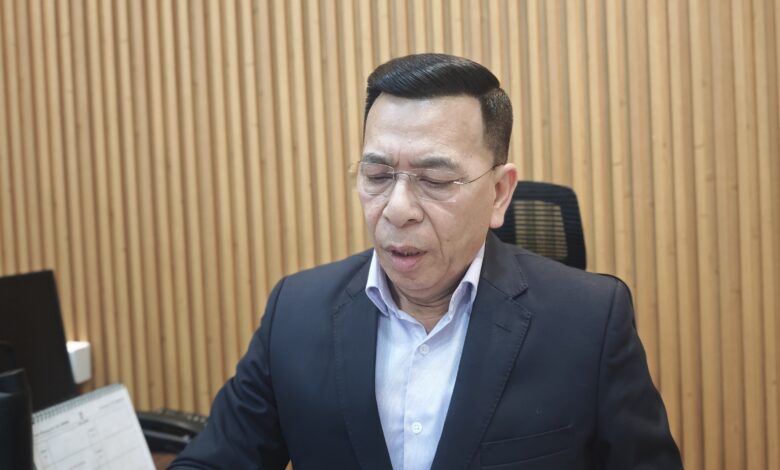
Shillong, May 26: The state’s poor ranking in the Performance Grading Index is due to structural problems in the school education system, said Advisor to the Education Department HM Shangpliang
Speaking to reporters on Tuesday (May 26), Shangpliang said”,We have seen the low Performance Grading Index, or PGI, of Meghalaya. That mainly reflects structural problems in the school education system, not the lack of talent among students. We have to be very clear about it”.
The PGI gives a lot of weight to actual student learning levels in reading, maths, and science. Meghalaya has been struggling in these areas, particularly in foundational literacy and numeracy and in board exam consistency, he said.
Many rural schools face shortages of subject teachers and limited academic monitoring.
“Several schools still have deficiencies — lack of science labs and libraries, poor internet facilities, digital access in rural areas, inadequate classrooms and toilets, and difficult transport connectivity in remote areas. All contribute to this low grade,” he said.
High dropout rates further impact the index, especially after upper primary and secondary levels. In remote tribal areas and economically weaker areas, parents generally discourage children from continuing studies. They push their children into menial work to earn some livelihood for the family, Shangpliang said.
Teacher-related issues
He pointed out teacher-related issues including shortages in rural schools, uneven deployment, absenteeism and allegations of proxy teaching. Gaps in governance and monitoring, such as evaluation, data management and school inspections, also weigh on the score, he said.
Geography compounds the problem. “Our terrain gives a lot of administrative difficulties. We have remote villages and poor road connectivity, particularly during monsoons. Our children cannot reach school on time, and teachers cannot reach schools. There are hard-to-reach schools where children and teachers have to walk. Sometimes teachers are reluctant to go to such distant schools, he said.
According to him. the government is addressing these gaps under Chief Minister Conrad bSangma. “We from the government side have tried our best to provide as much as we can under the leadership of Conrad K Sangma. You have witnessed the amount of money the government is spending to develop and improve education in the state,” he said.
“It is a continuous process. We will continue to do it, but again the society, the environment, and everybody has to be conducive enough to encourage children to be at school.” He said teacher rationalization has begun on the Chief Minister’s direction to reduce schools with low enrolment and address uneven staffing.
“Schools with more children will be merged with schools that have fewer teachers, so those teachers can perform in bigger schools,” he said.
Shangpliang said strengthening foundational learning is critical. “Most education experts agree that the biggest challenge is weak foundational literacy and numeracy, particularly in Classes I to V. We have to go on mission mode with reading and maths programmes in every primary school,” he said.
He stressed daily reading assessments, remedial classes for weak students, and mother-tongue based early learning with a gradual transition to English. Another point is to improve teacher quality and accountability, and to upgrade infrastructure on priority.
“We have to immediately look into providing functional toilets for boys and girls, drinking water, electricity, internet, smart classrooms, libraries and science labs,” he said.
To curb dropouts, he proposed more residential schools and hostels, transport support for rural students, scholarships for economically weaker sections, vocational education from secondary level, and career counselling.
He wanted merging non-functional schools and creating well-equipped cluster schools with transport facilities.
“Schools that have zero enrolment or more teachers than students have to be merged with another school that is closer with better facilities,” he said.
He said technology must be leveraged through hybrid learning systems, recorded lessons in Khasi, Garo, Jaintia and English, and teacher support apps.
PGI measures growth in governance. The government has to be very strict to conduct regular learning outcome surveys, strengthen district education officers, and use real-time school data systems, he said.
Shangpliang wanted partnerships with churches, communities and NGOs. “In Meghalaya, community institutions are very powerful. Schools improve faster when village education committees become active, when churches support anti-dropout campaigns, when parents track attendance and learning, and when NGOs help with remedial teaching,” he said.