


 In our last episode of Insights, we highlighted how the central government had chosen to remain silent on activist Sonam Wangchuk’s weeks-long hunger strike. The hunger strike was in demand for the resignation of Union Education Minister Dharmendra Pradhan. It is a demand raised by young protesters under the banner of the Cockroach Janta Party.
The protests by the members and supporters of the Cockroach Janta Party have refused to die down. Rather, these protests have spread to other towns and cities in the country from the epicentre of Jantar Mantar in New Delhi. The ripple effect of the protest in the Capital is despite the recent police atrocity. On July 20, hundreds of CJP supporters started their peaceful march towards Parliament, which was supposed to sit on its monsoon session on the same day. However, Delhi police used excesses to stop the peaceful march and used lathi-charge, water canons and tear gas to disperse the crowd. Several protesters were injured and one young woman is in critical condition.
And yet, the central government has refused to enforce accountability and had remained adamant on not paying heed to the demands of the protesters. What was projected by the government as an olive branch to the protesters turned out to be a farce. Instead of assuring the CJP representatives of corrective action, the government asked them to cooperate and end the protest. It seemed more like a threat in the garb of a friendly gesture.
Is the government testing the patience of its citizens? Or, is it that it absolutely does not care about the grievances of the citizens? Either way, it is definitely not doing its job and creating an atmosphere of violence and fear. Had the honourable prime minister ended his silence and spoken on the issue instead of waiting for the monsoon session of Parliament to begin, and had the government reached out to the protesters and assured accountability, the violence could have been averted. Instead, the government did nothing.
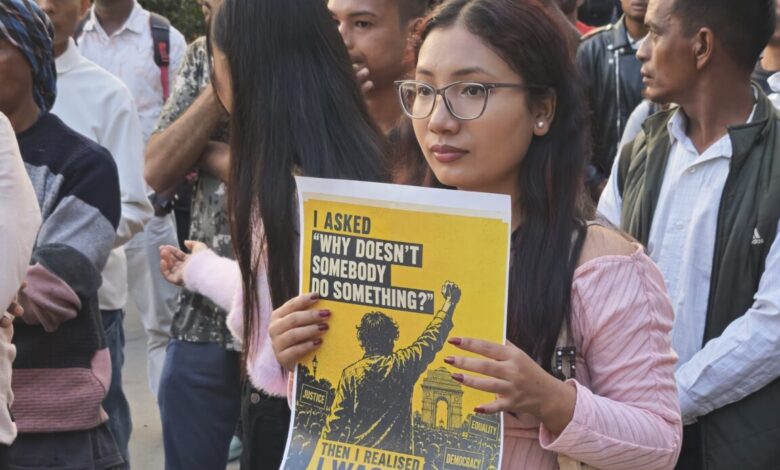
Probably, that was part of a bigger plan — push young protesters to the brink of despair and frustration and then use law enforcement to create fear among them and silence them forever. However, the government probably did not foresee the retaliation and resilience of the youth and did not expect the widespread support that the CJP movement would get. While the Cockroach Janta Party started as a satirical take on a remark by none other than the Chief Justice of India, the protests spread like wildfire soon after Wangchuk started his hunger strike. On July 20, many cities in different states saw impromptu gatherings of young protesters who showed solidarity with those in Delhi. Even shillong saw such overwhelming support. Other northeastern states also experienced similar youth gatherings.
It is heartening to see how the GenZ of India is reacting to the government’s high-handedness and refusing to give in to the system’s pressure.
Amid all these, the judiciary’s role also remains questionable. The Supreme Court on July 22 declined to entertain an urgent listing of a petition about police atrocity against protesters. It bluntly told the lawyer not to waste the court’s time. It also refused to watch the videos showing the police attacking the protesters. In shillong, an advocate, who is also a prominent BJP member, blatantly says that these protesters should be shot, and there is no action against him for insinuating violence.
Now, if the judiciary refuses to listen to citizens’ problems and refuses to be compassionate towards the youths who were, all throughout, were protesting peacefully, then what can the citizens of the country expect? Who should the common man fall back on in times of injustice and systemic failure?
In such a circumstance, the opposition political parties, including the Congress, have already entered the scene. The strength of the opposition political parties, whether national or regional, would definitely add steam to the students’ protest. But the problem is the opposition bloc is divided and there is no united front so far. The Congress being the most prominent political entity in the opposition bloc is trying to create its own space in this protest against the NDA government. Having said that, it is the right time for the opposition parties to come together and corner the BJP-led NDA government, and they must make the best of the opportunity. In doing so, they should not forget that the future of lakhs of students and youths is at stake, and they must respect the sentiments of the protesters.
As seven states prepare for Assembly elections in 2027, and as the country wait for the crucial Lok Sabha elections in 2029, this GenZ movement becomes a decisive factor in electoral politics and a crucial weapon for the opposition. But how much can this translate into results will only be revealed with time. For now, the fight for justice is on.
WATCH MORE VIDEOS