


Govt vows fast-track courts for paper leaks; existing ones have 249,000 pending cases
Researchers say paper-leak cases need immense human and technical intelligence, but police and forensic agencies face a resource crunch

Karthik Madhavapeddi, ISignal
Nothing is more important than the welfare and future of our youth!” Prime Minister Narendra Modi said on the social media platform X (formerly Twitter) on July 23, adding that the government has “decided to set up fast-track courts to ensure swift and stringent punishment for those involved in paper leaks”.
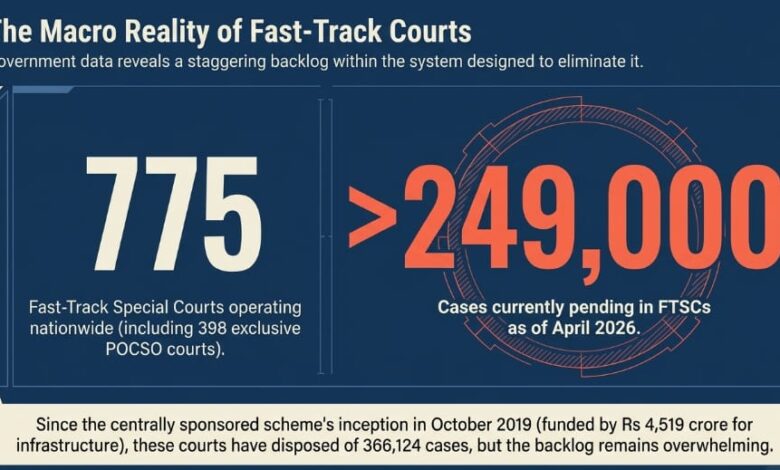
That same day, the Union government told the Rajya Sabha that by April 2026, 775 fast-track special courts—including 398 exclusive courts set up to deal with cases under the Protection of Children from Sexual Offences (POCSO) Act—had more than 249,000 pending cases.
The Prime Minister’s statement came three days after students took out a march from the protest site at Delhi’s Jantar Mantar to the Parliament demanding accountability for paper leaks. Police and Rapid Action Forces baton-charged the protestors and fired tear-gas shells, and reports suggest tens of protestors sustained injuries. Some of the injured allege the use of pellet guns by personnel, while the police have denied this claim, stating that “Delhi Police neither possess pellet guns nor do they use them in the ongoing protest”.
Fast track courts were first recommended by the Eleventh Finance Commission in 2000 “to substantially bring down, if not eliminate, pendency in the district and subordinate courts over the next five years”, as ISignal explained in December 2020.
Following recommendations of the 14th Finance Commission and a 2019 order from the Supreme Court in a writ petition, the Union government introduced a centrally sponsored scheme for the establishment of FTSCs in October 2019. Since inception of the scheme in 2019 until March 2026, these FTSCs have disposed of 366,124 cases, a snapshot of the Department of Justice dashboard for FTSCs—which remains inaccessible at the time of publishing—shows.
ISignal reached out to the Union law ministry for comment on the learnings from the existing FTSCs, and how fast-track courts for paper leaks can be designed to make them more efficient. We will update this story when we receive a response.
‘Fast-track courts do not address the concern’
“How does this mechanism partially, marginally or even peripherally address the concern which has brought the youth of this country out on the streets,” asked Vrinda Grover, lawyer and human rights activist. “This is about trying to distract public discourse, which is asking difficult questions, but questions which impact the future of our youth.”
“The future and success of the country is interlinked to the future and success of the youth. What we will be as a country 50 years later depends on how highly professionally educated are youth,” she added.
Grover described the move as a gimmick, a quick fix to distract the conversation and show that the government is taking some action. “We have tried this, and the dismal result is that there is nothing fast about a fast-track court,” she added.
Grover cited the example of FTSCs in cases of rape and sexual violence to illustrate this. India’s criminal procedure code, the Bharatiya Nagarik Suraksha Sanhita, 2023, stipulates that a trial should be completed within two months of a chargesheet being filed in such cases. On July 24, 2026, Grover made submissions in the case of the Manipur sectarian violence that occurred in May 2023. The Chief Justice of India noted that this is of concern, and proposed special courts to fast-track the hearings. “This is the fate of things that the country takes very seriously,” she added.
Further, despite stringent laws to deal with sexual violence and rape, crime is not abating or even diminishing, she noted. “If the law is not a deterrence, will it deter the next paper leak?”
“Merely having a faster judicial track is not enough to expedite the resolution of cases. What is equally important is the presence of a dedicated unit of investigative agencies—be it the police or others—to serve these FTSCs,” said Valay Singh, lead at India Justice Report.
“In the case of a paper leak, the evidence by its very nature will be highly complex,” Grover explained, adding that it will require rigorous and meticulous investigation involving digital, physical evidence. “The conversation we don’t have is, how competent, skilled, relevant is the investigation that is done.”
But these departments are resource-strained. “Cyber crime prevention capacity is limited to a few police departments and central agencies,” said Singh. Cyber crimes have doubled from approximately 50,000 cases in 2020 to just over 100,000 in 2024, he noted, adding that, “Currently the existing cyber capacity in state police forces is simply inadequate.”
Delays and constraints
In a March 2026 response to the Lok Sabha, the government cited third-party evaluations conducted at the time of extending the scheme and said the reports “underscored the positive impact of the Scheme and recommended its continuation”.
But, that same month, it attributed delays to “availability of physical infrastructure, complexity of facts involved, nature of evidence, co-operation of stake holders viz. bar, investigation agencies, witnesses and litigants and proper application of rules and procedures. Other factors that lead to delay in disposal of cases include frequent adjournments.”
“The primary responsibility for the development of infrastructure facilities for District and Subordinate Courts in the States/UTs, rests with the State/UT Governments,” the government told the Rajya Sabha on July 23, adding that under the centrally sponsored scheme for “Development of Infrastructure Facilities for District and Subordinate Courts”, it has provided an amount of Rs 4,519 crore to states during the 15th finance commission cycle. It listed five components of the scheme: court halls, residential units, lawyers’ halls, toilet complexes and digital computer rooms.
A November 2022 study, by the Vidhi Centre for Legal Policy, which studied cases disposed of by 486 POCSO courts, found that on average, the courts took about 510 days—or about 17 months—to dispose of a case. In 2020, Delhi had the highest average case length at 1,284 days or about 42 months. This is six months shy of the time taken to complete a graduate degree.
The study found that POCSO courts were not able to meet the mandated timelines. This could be explained by special public prosecutors not being appointed or, in cases where they were appointed, they were handling other cases, leading to a resource crunch, said Jyotika Randhawa, senior resident fellow at Justice, Access, and Lowering Delays (JALDI) team at the Vidhi Centre for Legal Policy.
Forensic departments take time to process evidence, and the police take time to file chargesheets, she explained, adding that these ancillary departments are also under-resourced.
“Too often, specialisations—fast-track courts, human rights courts, juvenile justice, consumer redressal systems, commercial courts—though recognised as aids to efficiency, fall short of desired outcomes for the same reasons that everyday courts fail: under-resourcing and overburden,” the 2025 India Justice Report noted.
As of July 23, 35% of the 13.9 million criminal cases pending across India’s district courts were delayed due to the unavailability of counsel, while in another 24% cases, the accused was absconding, according to the National Judicial Data Grid. Further, 17% were marked as delayed due to “witness”, and 11% were “stayed for reason”.
Scheme guidelines say each FTSC will have one judicial officer and seven support staff members, and that “additional charge of the FTSCs will not be given to any existing Judicial Officer or court staff”. In addition, they provide for engaging retired judicial officers to dispose of cases in the FTSCs.
In many instances, Randhawa said, other courts were redesignated as FTSCs and were handling other cases as well, leading to additional delays.
Grover agreed. “I have done cases in fast track courts, where the same court is then redesignated as fast track,” she said. “Then it carries the burden of two courts.”
The analysis of FTSCs’ working shows that they lack dedicated judges, and face a resource crunch in the form of infrastructure and IT services, as well as secretarial staff, said Singh.
“The Scheme initially envisaged targeted disposal of 1,66,882 cases of Rape and POCSO Act which included 1,60,989 cases of POCSO Act (as per the data collected from the High Courts as on 30.6.2019), within one year,” a 2023 statement from the ministry said during the extension of the scheme period. Any cases pending at the end of the scheme period will be transferred back to regular courts or other special courts as decided by the states/UTs, it said.
The way forward
The state needs to provide the judiciary with the resources and the capacity to fulfil the mandate of fast-track courts, said Randhawa. The government needs to make a realistic assessment of the budgets, the courtrooms and number of judges needed, based on the likely inflow of cases in order for them to be functional and effective, she added.
“Inter-state coordination, well-trained investigative officers, technical knowhow and procedural knowledge are the prerequisites for a subject like paper leaks,” said Singh. “Given that paper leaks happened through multiple middlemen and transactions were made through hard-to-trace modes, establishing a common link and unravelling the ‘mastermind’ will require immense human as well as technical intelligence.”
Singh cited the 2025 report to point out that there is a nearly 50% vacancy in posts of scientific officers in forensic labs, nationally. “In police, separation on investigative and law and order wings remains to be implemented on the ground, therefore, investigations remain poor and slow,” he explained.
(The article was first published ISignal. ISignal is an award-winning initiative that uses data and evidence to tell stories)