

Genetic blueprint of four Asian hornbills offers new tool for research

Nikhil Sreekandan/Mongabay India
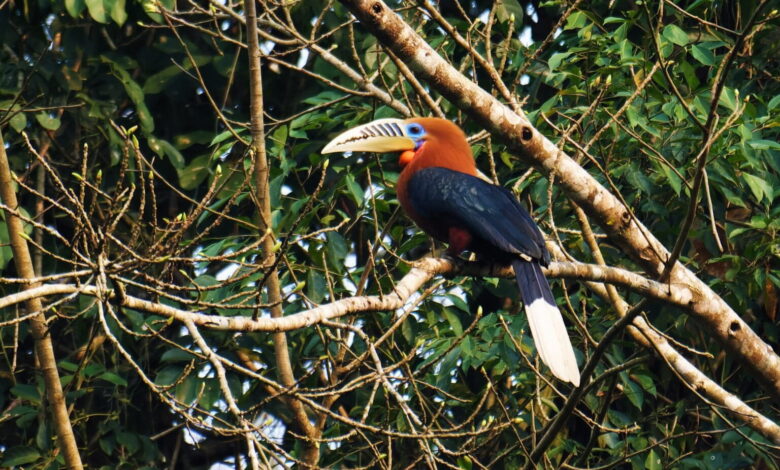
Scientists have generated a reference genome, a genetic structure model, for four threatened Asian hornbill species. The high-quality genome assemblies were generated for the great hornbill, rufous-necked hornbill, Malabar-pied hornbill and wreathed hornbill by researchers from the Nature Conservation Foundation, Mysore and CSIR-Centre for Cellular and Molecular Biology (CCMB), Hyderabad.
“My research interest is [in] understanding how wildlife responds to their changing environment,” says corresponding author of the research paper Pooja Pawar, who has studied great hornbills (Buceros bicornis) in both protected areas and in coffee plantations. For her master’s dissertation, Pawar compared the behaviour and breeding biology of these large, majestic birds in protected areas in the Anamalai Hills and the human-modified landscape of Valparai, Tamil Nadu. Then, for her Ph.D. at the Nature Conservation Foundation and Manipal Academy of Higher Education, Pawar expanded the scope of her research to investigate how climatic, geographic, and anthropogenic factors have influenced hornbill populations across regions and geological epochs.
To help answer these questions, the behavioural biologist turned to genomics, the study of an organism’s complete genetic structure. “Genomics allowed me to ask these questions at much larger temporal and geographic scales,” Pawar says. “I could go back in time, to when the species originated or diverged from its sister species, and not restrict [my research] to the Western Ghats or northeast India.”
But before she could do that, Pawar first had to create baseline genomic data for Asian hornbill species, which was largely missing despite their flagship conservation status. Whole-genome information was available for only two of the 32 Asian hornbill species: great hornbill and rhinoceros hornbill.
The new research paper by Pawar and team, published in BMC Ecology and Evolution, aims to serve as a resource to understand the genetic makeup of hornbills and will be “valuable for future evolutionary and population genomics research on hornbills throughout Asia and Africa.”
Reference genome is a critical resource
So what is a reference genome? “A genome is the complete genetic structure of an organism,” Pawar says. “[And] a reference genome is a baseline genome for a particular species.” It provides an overview of the entire genetic structure of a species, including genome length, chromosome number, chromosome length, and their arrangement.
But how does one reconstruct an organism’s genome? First, a tissue sample is taken from the organism, and its DNA is extracted and prepared for sequencing. The sequencing platform then reads these DNA fragments, which are then bioinformatically pieced together into a complete genome.
Whole-genome sequencing can be done using different sequencing technologies, according to Pawar. Illumina is a short-read sequencing platform that generates DNA sequences, or reads, of 150 base pairs. Oxford Nanopore Technology (ONT) is another platform, which decodes longer stretches of DNA, ranging from a few hundred to more than 50,000 base pairs.
Pawar and team used a combination of long-read and short-read sequencing to assemble and annotate hybrid genomes of the four hornbill species at the Next Generation Sequencing facility in CCMB, Hyderabad. This hybrid approach complements both datasets and minimises errors, says Pawar. Before this, genomic data was available for the great hornbill and rhinoceros hornbill, but both were short-read-only assembly genomes generated with the Illumina platform. “[ONT] technology has been around for some time, but it was just not done until now for the Asian Hornbills,” Pawar says. The biologist noted that Illumina sequencing costs less than ONT.
Beyond Illumina and ONT, there is a third sequencing technology called PacBio, which gives even longer reads and generates chromosome-level assembly. “In my assembly, I cannot tell what the size of the first chromosome is or locate a particular chromosome. That is a limitation of my study,” Pawar says. The southern ground-hornbill (Bucorvus leadbeateri) from Africa has the best-quality genome produced to date for a hornbill species.
The N50 value of a genome is a good measure of its quality, notes Pawar. “If the entire genome, [that is] all the scaffolds (pieced genome sequences), are arranged in descending order, with the longest scaffold at the beginning and the shortest at the end, the length of the middle scaffold is its N50 value,” she says.
The N50 value of the genomes assembled by Pawar and team is much higher than previous Asian hornbill genomes but is lower than that of the southern ground-hornbill. But Pawar stressed that the availability of a high-quality reference genome saves the cost of generating the same resource again for that species. “This is a critical resource that is now available to researchers to be used as a reference going forward,” she says.
Meghana Natesh, who works in conservation genetics with WWF India, hailed the research team for this “very useful resource”, whilst calling attention to the poor representation of Asian species in global genomic databases. “High-quality genome assemblies are critical for facilitating genomic research,” Natesh, who was not associated with the study, says. “[From] understanding population-level variation, movement and connectivity, adaptive variation, population history and much more.”
Genomic data can contribute to conservation decisions
Genomics is the basis for our understanding of evolution, says Pawar. She takes the example of Asian and African hornbills: while some species are arboreal (tree-living), others are ground-dwelling. “When you look at a suite of species, some are adapted to certain conditions or environmental stressors whereas some are not,” Pawar says. “By comparing their genomes, we can attribute differences in their characteristics to the structural and functional variations within their genomes.”
Genomics also adds a different aspect to population monitoring, notes Natesh, aiding in measuring genetic variation in populations. “Genetic variation or diversity is crucial to the adaptive potential and long-term resilience of populations,” she says. Genome data can therefore help identify at-risk populations with low genetic variation and elevated levels of harmful mutations, thereby contributing to conservation management decisions.
There are also novel methods being developed in population genetics to make use of these genome datasets, says Pawar. One such process is the Pairwise Sequentially Markovian Coalescent (PSMC) method, which traces back the demographic history of a species and examines its population trajectories to identify common ancestors.
When the team performed PSMC on the Asian hornbill genomes, it found that changing climates, particularly during the Pleistocene (2.5 million years to 11 thousand years ago), impacted all four species. It resulted in an overall decline in their effective population size (number of individuals that contribute to genetic diversity) to varying degrees. Furthermore, it was found that the more abundant and widely distributed wreathed hornbill showed a higher effective population size than the other three hornbill species.
These new findings have led to many more questions, says Pawar, and now that the foundation has been laid with high-quality reference genomes available for four Asian hornbill species, she aims to dedicate her doctoral thesis to answering them all.
(The article was first published in Mongabay)