


Meghalaya: The politician, the plaque and the missing brain cell
Democracy gave them the microphone; it is up to us to decide whether they deserve to keep it

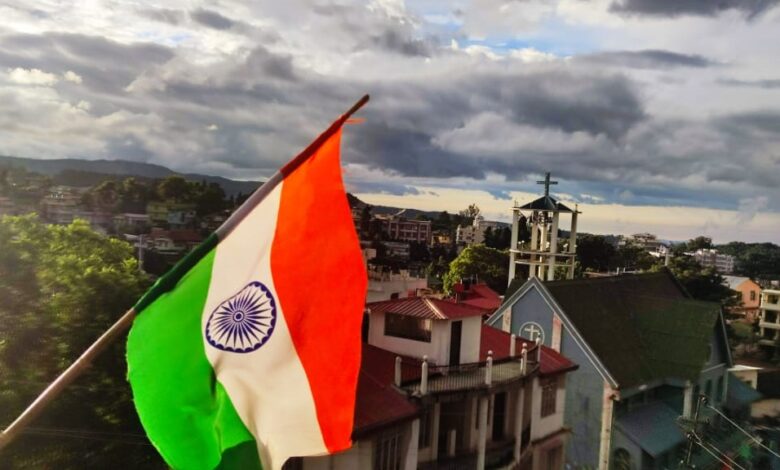
Today is Independence Day. Flags will fly, the anthem will play, children will stand in the sun, and politicians will deliver speeches about sacrifice, democracy and freedom. Everyone will go home feeling patriotic until somebody says or does something so confusing that even history quietly asks for a transfer. This is the strange beauty of Meghalaya politics: some can speak for an hour without saying anything, while others can say something in ten seconds that takes three days to understand.
Who can forget the episode of a road being named after Sanbor Shullai while he was still alive and serving as a legislator? Reports said the local dorbar decided the name as a mark of appreciation, so technically the politician did not simply name the road himself. Still, there is something wonderfully efficient about a living man inaugurating a road that already carries his name. Most people wait until they are dead to discover whether history thinks they deserve a memorial. Meghalaya apparently decided there was no reason to waste time. Why wait for posterity when you can have the photograph, ribbon and newspaper report by Tuesday?
The possibilities are endless. We could have Sanbor Shullai Road, Traffic Signal, Parking Area and Roundabout. The roundabout would be particularly appropriate because it represents politics beautifully: everybody keeps moving, but nobody is quite sure where they are going. We could even unveil a statue while the politician is alive and let him unveil it himself. At least the statue would never make a historical mistake.
And now, Meghalaya has apparently moved from roads to waterfalls. In July 2026, a waterfall in West Jaintia Hills was named “Sniawbhalang Dhar Waterfalls” after Deputy Chief Minister Sniawbhalang Dhar, reportedly in recognition of his contribution to the area. Dhar was present at the programme and also laid the foundation stone for a tourism project.
The naming enthusiasm is not confined to Meghalaya. In 2025, Chief Minister Conrad K. Sangma urged the Centre to name a road in New Delhi after his late father, former Lok Sabha Speaker P. A. Sangma. There is nothing wrong with honouring people who have genuinely served the public. But when every achievement appears to require a nameplate, political culture begins to resemble a family album carved into stone. At this rate, Meghalaya may need a Department of Roads, Bridges, Waterfalls and Things We Have Named After Politicians.
The real problem is our fascination with political personality. A government project is no longer simply a government project; it needs a photograph, banner, chief guest, speech and plaque containing enough names to make future archaeologists believe they have discovered an ancient royal dynasty. A small development project suddenly acquires the atmosphere of a coronation, while the citizen who uses it becomes little more than an audience member.
Then there is history. If politicians want to discuss Meghalaya’s past, surely the first rule should be: know who fought whom—and who lived when. Take for example P. T. Sawkmie’s reported confusion between David Scott and Alexander the Great. This was not a tiny historical slip. David Scott was a British colonial administrator associated with British expansion into the Khasi Hills; Alexander the Great was the ancient Macedonian king who lived more than two thousand years earlier and conquered a vast empire. They belong to entirely different historical worlds. If politicians are going to speak about history, perhaps they could at least read the chapter first.
Perhaps we should sympathise with them. Their brains are already overloaded with party colleagues, opponents, constituencies, schemes, inaugurations, promises, television channels and, above all, which camera is pointing in their direction. Under such pressure, David Scott and Alexander the Great may occasionally collide in the memory department. It happens. But ordinary citizens can forget facts; people governing millions should check them before speaking into a microphone.
Then came another memorable Assembly episode when Adelbert Nongrum reportedly knelt to pray and read from the Bible during proceedings in 2020, while the Speaker asked him to stand and state what he wanted to say. There is nothing funny about prayer itself; the comedy lies in its collision with parliamentary procedure. One can imagine the Speaker saying, “Honourable Member, please stand,” and the reply, “I am praying.” The Speaker: “Yes, Honourable Member, but the Assembly Rules are also praying that we finish this sitting.” At that point, the agenda could have been Question Hour, Zero Hour or Divine Intervention.
We have perfected the ceremony of governance. A road is inaugurated as though a new continent has been discovered, a government building opens as though Meghalaya has landed on Mars, and a small scheme receives a banner large enough to cover the building it is supposed to serve. Flowers, shawls, microphones and photographers appear, and for one glorious afternoon everyone behaves as though poverty, unemployment and bad roads have been defeated.
But a ribbon does not repair a road, a plaque does not fix a bridge, a speech does not create employment and a photograph does not educate a child. A plaque is wonderfully obedient: it never asks why the road has potholes, how much the project cost or where the money went. It simply displays important names while citizens negotiate the potholes below.
Perhaps no politician should get his name on a public project for 20 years. If the road still exists, the bridge still stands and people still remember the contribution, then we can discuss the plaque. Until then, let the politician remain anonymous. Imagine the horror: a public project without his photograph, a banner without his face and a road that simply says, “Built for the people.” Some politicians might require medical attention.
The deeper tragedy is that Meghalaya is not short of intelligent people. We have teachers, doctors, engineers, lawyers, researchers, entrepreneurs, artists and young people competing successfully across India and the world. The problem is not that Meghalaya lacks intelligence; it is that intelligence does not always appear to be an entrance requirement for political leadership. Nobody expects politicians to be walking encyclopaedias, but surely they can read, admit when they do not know, consult experts and check their facts. Surely knowing the difference between Alexander the Great and David Scott should not require a PhD.
Public office is temporary. The chair belongs to the institution, the money belongs to the public, the road belongs to the citizens and the Assembly belongs to democracy. The politician is merely passing through. Yet our political culture sometimes behaves as though the temporary occupant is the permanent owner.
This is where the joke becomes serious. We laugh when politicians get history wrong, turn inaugurations into personal victory parades or make plaques larger than projects. But when absurdity becomes routine, people stop expecting better. If we laugh at a politician’s mistake today and vote for exactly the same behaviour tomorrow, the joke is no longer entirely on the politician. Part of it is on us.
So this Independence Day, let us declare independence from a few dangerous ideas. Election does not automatically make someone intelligent. Popularity does not equal competence. Loudness does not equal leadership. A ribbon is not development, a plaque is not history, a photograph is not an achievement and a waterfall is still a waterfall, even if someone has put a politician’s name on it.
We should demand politicians who read before they speak, think before they promise, listen before they lecture and check their facts before they rewrite history. Imagine such a politician arriving at an inauguration, thanking the workers, checking whether the project works and leaving without demanding a giant photograph or personal plaque. The public would probably become suspicious: “Who is this man? Is he really a politician? Where is his banner?” Somebody might even suggest calling a doctor. That is how unusual humility has become.
But beneath the laughter lies the question that matters: what kind of Meghalaya are we building? One day every politician will leave. Their photographs will fade, banners will be thrown away, plaques will rust and speeches will disappear. The road, school and hospital will remain; so will the forests, rivers, hills and children. That is the real legacy—not the politician’s name carved into stone, but what remains useful after the politician has disappeared.
After 79 years of independence, Meghalaya has enough politicians. What we need now is better thinking. Democracy gave them the microphone; it is still up to us to decide whether they deserve to keep it.
(The author is a school teacher residing in Pynursla, with a keen interest in education, society, public affairs and the everyday political life of the state)