

Borghat’s forgotten Shiva Temple: A quiet legacy of faith, history and harmony
Borghat reminds us that faith need not divide, and that the most powerful acts of devotion are to preserve, to respect and to remember

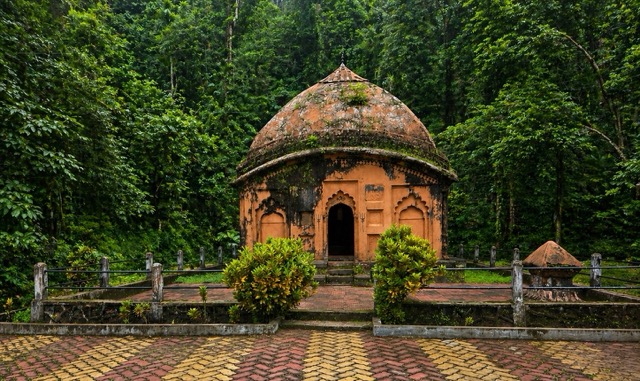
 Tucked away near the Indo-Bangladesh border, in the serene village of Borghat, stands an ancient Shiva temple — weathered by time yet rich with history.
Believed to be over 400 years old, the temple is thought to have been built during the reign of the Jaintia kings, whose dominion once extended from the hills of present-day Meghalaya to the plains of Sylhet.
Though now in a partially ruined state, the temple continues to draw quiet attention—not just for its historical significance, but for the remarkable story of communal harmony it represents today.
Local accounts suggest that Borghat served as an important halt for Jaintia rulers during their seasonal journeys between the plains and the hills. Given its location, the village likely marked one of the earliest resting points after crossing from Sylhet into the hill regions—a journey that, as oral traditions recount, would take nearly a day.
The Shiva temple, constructed of burnt bricks and enclosed within a boundary, is believed to have functioned as both a place of worship and a royal landmark. While much of its original structure has succumbed to natural forces—particularly the devastating earthquake of 1897—the remains still hint at its past prominence.
The temple stands near the banks of the Leshka river, surrounded by dense greenery and open skies. A massive banyan tree, said to be as old as the temple itself, spreads its branches wide, offering shade to passersby and villagers alike.
Together, the river and the tree seem to guard the site—silent witnesses to centuries of change.
Perhaps the most striking aspect of the Borghat Shiva Temple is not its antiquity, but its present.
There are no Hindu families residing in the village today. Yet, the local Christian community has taken it upon themselves to care for the temple grounds. They till the surrounding land, keep the area clean, and ensure that the site remains undisturbed.
In an age often marked by religious divisions, Borghat offers a different narrative—one of quiet respect and shared responsibility. Here, heritage transcends identity, and reverence is expressed not through ritual alone, but through care.
The history of the Jaintia Hills reflects a confluence of indigenous traditions and Hindu influences. Temples like the one at Borghat stand as reminders of a time when cultural boundaries were more fluid, shaped by trade, migration, and royal patronage.
While rituals once performed here may no longer continue, the spiritual essence of the place endures—subtle, unclaimed, yet deeply felt.
Despite its historical and cultural value, the Borghat Shiva Temple remains largely undocumented and unprotected. There is little formal conservation effort in place, and the structure continues to deteriorate with time.
Historians and heritage enthusiasts believe that recognition and preservation of such sites are essential — not only to safeguard history but also to highlight stories of coexistence that are increasingly rare.
The Shiva temple of Borghat may stand in ruins, but its message is intact.
It speaks of journeys across landscapes, of kings and cultures long gone, and of a present where humanity quietly upholds what history has left behind.
In its stillness, Borghat reminds us that faith need not divide—and that sometimes, the most powerful acts of devotion are the simplest ones: to preserve, to respect, and to remember.