


From rights to red tape: India’s Transgender Law Amendment
The move narrows legal recognition and removes self-identification, leaving community members, shelter homes and healthcare providers in uncertainty

Divya Tiwari, Indiaspend.com/FactChecker.in
Only I knew what I felt, trapped in a body I did not recognise or feel at home in,” says Ayaan, a 24-year-old transman. In 2016, his parents took him to consult a doctor in Uttar Pradesh’s Muzaffarnagar, who tried to counsel his family of his need for support, hormone-replacement therapy (HRT), and eventually surgery. For the first time, Ayaan felt heard.
His family did not take the advice; they said he was mentally ill. For years, his attempts to assert his identity were met with verbal, physical and mental violence. In December 2025, he left home with nothing but a bag and an address to a Garima Greh, a shelter home for trans persons, in Delhi. There, he found a community, is being counselled, and getting HRT at the All India Institute of Medical Sciences. He does not yet have a transgender identity card.
Stories of familial violence and opposition to assertion of trans identity are commonplace, and leave young persons without shelter, support and a sense of security. But now, with the enactment of the Transgender Persons (Protection of Rights) Amendment Act, 2026, this assertion is further complicated.
The Supreme Court in 2014 had recognised transgender persons as a ‘third gender’, affirming their fundamental rights under the Constitution.
The judgment in a case between the government of India and the National Legal Services Authority (NALSA)—known popularly as the NALSA case—gave transgender people the right to “self-identification” as male, female or third-gender and held that they would be granted reservations in educational institutions as well as public employment.
India was one of the few South Asian countries to have led an active struggle towards equal rights to transgender persons and communities. Nepal, for instance, has maintained self-identification since 2007, reaffirmed as recently as 2024.
The 2026 amendment reverses this, making state and medical approval a prerequisite for legal identity—a shift critics describe as a legislative U-turn.
“What we are moving towards is a very narrow understanding of transness, which is sort of rooted in biology and not what it was stated to be in the NALSA judgment,” says Raghavi Shukla, a transwoman and an advocate at the Supreme Court.
The definitional problem
The amendment removes from the definition trans-man, trans-woman and gender queer, retrospectively applying this exclusion by stating that the definition “shall not include, nor shall ever have been so included, persons with different sexual orientations and self-perceived sexual identities”.
It includes specifically persons with socio-cultural identities as kinner, hijra, aravani and jogta, or eunuch, or a person with intersex variations, and persons/children who were, with or without consent, “compelled to assume…a transgender identity” by surgical, chemical or hormonal procedure. This last provision has created other fears and insecurities, as we explain below.
Further, the new amendment makes legal recognition subject to a medical board’s recommendation, before an approval from the district magistrate, adding scrutiny and bureaucracy. Several members of the National Council of Transgender Persons resigned after the amendment was passed in March 2026, and parts of the country saw protests against it.
The amendment is “clearly unconstitutional” and “a breach of rights that have been recognised by court and have been traced within the framework of the Constitution”, such as the right to privacy, dignity, autonomy and self-determination, Shukla added.
Even before the amendment, it was not easy to get a transgender identity card—mandatory to access government welfare schemes. The 2011 Census estimates that India had about 490,000 transgender persons. Activists say this in itself is an underestimate. Yet, government data show that about 33,000 identity cards have been issued so far, which is 7% of the estimated population.
“By dismantling the principle of self identification, the Act fundamentally clashes with the judicial precedents established over the last decade,” says Katyayani Vishnupriya, female of trans experience from intersex variation, and an advocate practising at the Chhattisgarh high court.
IndiaSpend reached out to the social justice ministry for comment on the new amendment. We will update this story when we receive a response.
Whose welfare is it anyway?
“We are stuck in uncertainty,” says Rudrani Chhetri, director of a Garima Greh in Delhi. “Because of the way this law has been framed, we do not know what will be the government’s interpretation, and how we can interpret it according to the Constitution.
“Maybe under our own interpretation we can continue some services, but it is possible that later it will be challenged,” she says. “Secondly, those who are already in the Garima Greh are very hassled and have already started leaving, gradually. They have realised that suddenly things are changing. We are trying to give them courage and tell them to stay put and keep up the work.”
Chhetri questions the hurried enactment of the amendment, leaving all schemes including shelter homes in uncertainty.
A 2018 study by the National Human Rights Commission found that 96% of transgender persons were denied jobs despite meeting eligibility criteria. Even today, only a small proportion are part of the formal workforce, with a large number pushed into informal sectors such as begging, sex work, and daily wage labour.
Under the 2019 Act, the government had promised a framework of recognition and welfare, including the right to self-perceived gender identity, protection from discrimination, and access to schemes for healthcare, housing, education, and employment. Even those promises remained unrealised. Between 2021 and 2024, only about 11% of the allocated funds were spent, as IndiaSpend reported in April 2025.
Government initiatives such as SMILE have attempted to address this gap through skilling and rehabilitation. Under this scheme, Garima Greh shelter homes were set up in 2020 to provide housing and support to transgender persons. However, there are only 18 Garima Grehs in the country reflecting the narrow reach of institutional support. With the new Act, residents and staff members at Garima Greh also find themselves in an information black hole.
“The work had just begun,” Chhetri says. For instance, she cites the case of Ayushman Bharat transgender plan, under which beneficiaries were eligible for Rs 5 lakh in health insurance at empaneled hospitals for surgeries, HRT and therapy. “Even the hospital empanelment had not been completed,” she says. “You have made the plan yourself, after understanding the definition of gender. Now you’re saying that whatever you had learned was wrong.”
Stranded, with no clarity
Kiara, 22, a transwoman from Mathura found the Delhi shelter home when she had to run away from home at 18. She has a transgender ID card and certification, but is waiting for the web portal to work so she can change her name on the card. She was recently turned away by her healthcare provider stating that the new rules are yet to set a guideline.
She has been undergoing HRT for a few years now and was looking forward to a gender reaffirming surgery next year. That too now is a distant possibility, she says.
Aqsa Shaikh, a medical practitioner and transwoman, worries about the ramifications on all aspects of a trans person’s identity, legal IDs, healthcare, education and employment.
It creates a lot of confusion specifically for gender-affirming healthcare, she says. “Even before NALSA, people were undergoing gender-affirming healthcare and getting their name and gender changed. However, the NALSA judgment said that you don’t need to undergo medical or a surgical process to affirm your identity,” adds Shaikh.
While transgender persons can still undergo gender-affirming services, Shaikh explains, there is a lot of doubt in the minds of healthcare providers and seekers. Further, reporting requirements mean “they will be under the surveillance of the government. And that’s something that they are not comfortable with”.
The amendment cites “misuse” of the schemes as a reason to redefine “transgender person”.
“Where is the data on the welfare schemes, who is availing them and if there is any misuse,” Shukla asks. “There is no data around that. There’s no justification or clarification provided. We know how difficult it is to even access the transgender certificate and ID cards, and then to go on to avail any schemes if they are available.”
The second part of the definition reads: any person or child who has been, by force, allurement, inducement, deceit or undue influence, either with or without consent, compelled to assume, adopt, or outwardly present a transgender identity, by mutilation, emasculation, castration, amputation, or any surgical, chemical, or hormonal procedure or otherwise. And such “force, allurement, inducement, deceit or influence” are punishable by imprisonment up to a life term.
“Young kids who are abandoned by their parents, shunned by society have come to me over the years,” says Rashmi* (name changed), a guru ma at a ‘gharana’ (trans household) of nine transwomen in a town on the edge of Delhi. “I have nurtured them, raised them and now I fear if I ever take a new chela, the new law could be used against me if someone says that I am trying to convert their child.”
Transpersons in the gharanas depend on traditional toli-badhai (ritual blessing) as a way of income, but now fear violence if someone reports them. “Where was the medical board and the government when I was begging for food and selling my body?” she asks.
“How can the government or a medical board affirm or reject my identity?,” Ayaan echoes.
(The article was first published in Indiaspend. Indiaspend.com is a data-driven, public-interest journalism non-profit / FactChecker.in is a fact-checking initiative, scrutinising for veracity and context statements made by individuals and organisations in public life.)
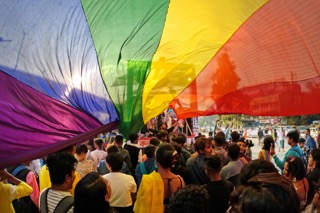
Banner image by Dibakar Roy from Pexels: https://www.pexels.com/photo/pride-celebration-14-19608212/