


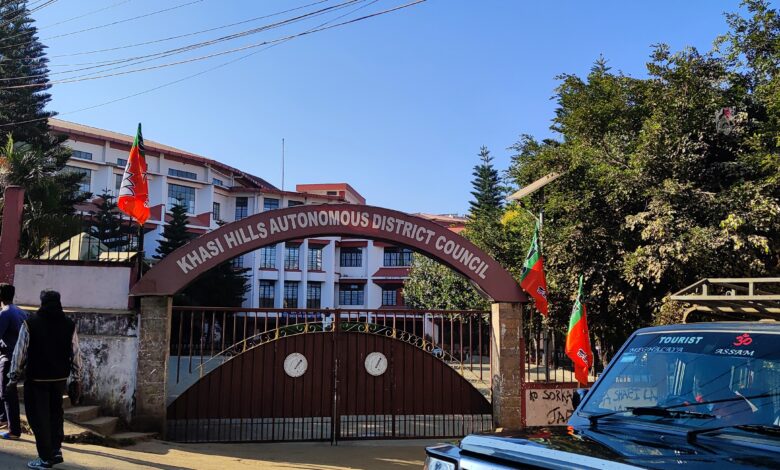
 When the Khasi Hills Autonomous District Council (KHADC) refused to grant a trading licence to quick-commerce giant Blinkit, it defended its decision as one aimed at protecting more than 4,000 indigenous grocery shops across its jurisdiction. Chief Executive Member Winston Tony Lyngdoh argued that platforms offering deep discounts and rapid doorstep delivery could threaten the livelihood of local traders, many of whom support thousands of Khasi families.
On paper, the decision aligns with the Council’s constitutional mandate under the Sixth Schedule—to safeguard the economic interests of indigenous communities. Yet the controversy has reignited an old debate: Is KHADC consistently protecting local interests, or is it selectively intervening without a clear policy framework?
The Blinkit controversy is not the first time KHADC has opposed a modern business model.
According to the CEM himself, the Council had earlier refused trading licences to Instamart and other home-delivery models, arguing that such businesses would adversely affect local retailers. The Council maintains that businesses operating in Khasi Hills must obtain trading licences under the United Khasi-Jaintia Hills District (Trading by Non-Tribals) Regulation, 1954, and comply with its licensing rules.
The reasoning has remained largely unchanged over the years:
• Protect indigenous traders from corporate competition.
• Prevent monopolisation by national companies.
• Ensure compliance with Sixth Schedule regulations.
• Preserve employment generated by local businesses.
To many residents, these arguments resonate. Shillong’s economy is still dominated by family-run grocery stores, small enterprises and traditional markets that lack the financial muscle of national corporations.
However, the Blinkit decision quickly evolved into a debate over KHADC’s own consistency.
Opposition MDC Barikupar Synrem questioned why Blinkit’s operations were halted in the interest of protecting local businesses while a bar and restaurant was subsequently allowed to operate from the very same premises. He alleged that the Council was practising “selective enforcement” and demanded greater transparency in the granting of trading licences.
The criticism did not stop there.
Synrem also alleged that despite repeated assurances that certain trades would be reserved for indigenous Khasi entrepreneurs, licences continue to be issued to non-local operators in sectors where locals are equally capable of doing business. He further questioned why previous directives to Dorbar Shnongs regarding bonded warehouses had not been uniformly enforced.
The Executive Committee rejected these allegations.
CEM Lyngdoh responded that the bar and restaurant in question was a legitimate local partnership involving a Khasi entrepreneur and that all legal requirements had been fulfilled before the licence was granted. He further stated that the current Executive Committee has actually reduced the number of trading licences issued compared to previous administrations, demonstrating a stricter approach rather than a more lenient one.
On one hand are those who believe KHADC is carrying out exactly what the Constitution intended—shielding indigenous businesses from the overwhelming financial power of multinational corporations and national retail chains. They argue that once local shops disappear, they are unlikely to return, leaving consumers dependent on a handful of corporate players.
On the other hand are those who argue that protectionism cannot become a substitute for competitiveness.
Quick-commerce platforms create employment in logistics, warehousing, delivery services and technology. They also offer convenience to consumers, particularly working professionals and elderly residents who may benefit from home deliveries. Restricting such services could discourage investment, delay technological adoption and reinforce the perception that Meghalaya is difficult for businesses to enter.
Perhaps the most significant issue exposed by the Blinkit controversy is not whether the company should be allowed to operate, but the absence of a transparent regulatory framework.
Businesses often remain uncertain about which sectors are protected, what criteria determine licence approval or rejection, and whether similar applicants are treated equally. The lack of clearly published guidelines means that each new commercial proposal risks becoming another public controversy.
If KHADC believes certain industries should remain exclusively in indigenous hands, it could publish an explicit policy identifying those sectors and outlining the legal basis for such restrictions. Likewise, if modern digital platforms are to be permitted under specific conditions, those requirements should be clearly communicated.
The debate surrounding Blinkit is ultimately larger than one company.
It raises fundamental questions about how Meghalaya intends to balance constitutional safeguards with economic modernisation. The Sixth Schedule undoubtedly gives KHADC a responsibility to protect indigenous interests. Yet that responsibility must also be exercised through transparent, predictable and consistently applied policies.
Without such clarity, every new investor may face uncertainty.
As Shillong continues to grow and consumer habits evolve, the challenge before KHADC is no longer simply deciding who receives a trading licence. It is demonstrating that the rules governing Meghalaya’s economy are fair, transparent and capable of protecting indigenous rights while allowing responsible development to flourish.
WATCH MORE VIDEOS