


 “A poem is a lump in the throat, a sense of wrong, a homesickness, a lovesickness. It is a reaching out toward expression; an effort to find fulfilment. A complete poem is one where an emotion finds the thought and the thought finds the words.” American poet Robert Frost, in one of his letters to his friend Louis Untermeyer, made this comment on his thoughts about poetry. It outlines his appreciation of how poetry begins as an emotion that arises from a desire to express oneself and finds fulfilment through writing, breathing life into words and allowing them to carry the message of one’s thoughts and emotions to a wider universe.
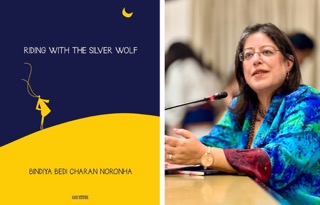
Bindiya Bedi Charan Noronha balances a distinguished professional career at a diplomatic mission with her deep passion for writing. This duality finds eloquent expression in her new poetry collection, Riding With The Silver Wolf, a profound exploration of the inner self and the intimate contemplations it evokes.
The poems embark on a journey of self-discovery that ultimately finds its rhythm in spiritual awakening, while remaining deeply rooted in the realities of the external world. Published by Red River, this is a collection of 55 poems exploring different dimensions of life.
The book begins with a heartfelt recollection in “My Mother’s Song”, where the poet remembers her mother singing the sacred Sikh prayer “Sukhmani”.
As a child, she admits, “Ignorant of its wisdom, I hummed along,” highlighting how we often overlook profound truths in our early years, only appreciating them later through life’s trials. These simple, everyday moments of affection become anchors of guidance and comfort.
Her renewed hope is found in almost all her poems, where life catches a new breath.
In “Birds Are Singing on My Windowsill”, Bindiya masterfully plays with words – “The sun breaks through the clouds/time to catch the spring/to renew, recharge, rejuvenate”, and in the same breath hope emerges when she writes – “I wait to fish out the silver star/of my destiny from the far reaches of the ocean./My nebulous dreams are emerging/as I become one with nature’s delight/in flight with magic, day and night”.
It is this hope that moves flawlessly through the poems. The poet masterfully portrays hope as something that turns ordinary moments into cherished keepsakes, especially in the face of hardship. She urges readers to rise above uncertainty and anxiety, captured vividly in lines like – “Casting aside the murmurs of doubt, I sing the Sukhmani and soar – A flying crane, Rising above the flames”. This powerful image symbolises endurance, spiritual strength and the ability of love and belief to conquer difficulties.
Her work also brims with striking metaphors and lively descriptions. In “Water Speaks”, the poet eloquently captures moments where she asks us to “celebrate peacocks’ voices” that “echo through our land, /groves that hang heavy with mangoes, / flowering vines perfume the air” and beautifully brings out the eternal philosophy and the rejuvenating power of water that “flows abundantly, /nourishing nature women, men and children alike”, where “the earth sings in harmony with the waters”.
Bindiya’s poems explore the intertwined experiences of pain and perseverance while gently reaffirming our faith in hope and renewal. In “Ephemeral Love”, she suggests that even the darkest moments are transient, assuring us that “the dark clouds will lift, / the Buddha will smile.” Her poetry encourages readers to confront adversity without surrendering their dreams, creating a delicate balance between darkness and light. This spirit is beautifully captured in “Moonrise”, where the poet “follows the moonrise / in a stupor of delight to / wherever the light may lead/opening immense possibilities.”
These lines embody a willingness to embrace uncertainty with hope, revealing the transformative potential of life’s journey. In this way, Bindiya’s poetry transcends social and cultural boundaries, speaking to universal human emotions and experiences that resonate with readers across cultures.
Through evocative metaphors in “Downpour,” such as “storms” and “fury,” Bindiya poignantly captures the hardships and uncertainties of life, while affirming that hope continues to illuminate the human spirit. As she writes, “I call upon hope – / shine the sun on us.” Hope becomes not merely a physical space but a sanctuary sustained by optimism and faith. Her unwavering belief in steadfastness and resilience is further reflected in the lines, “Storms will not beat me down. / I too will survive to rise in peace,” which celebrate the indomitable strength of the human spirit. Even amid the “cast of sterile pessimism of unfulfilled dreams,” she refuses to surrender to despair. Instead, in “September Song”, she offers a vision of renewal through the uplifting affirmation: “Hope reverberates/ending today, rising tomorrow,” beautifully expressing the enduring power of hope to transcend suffering and inspire new beginnings.
At times, Bindiya’s poetry is unflinchingly stark, as in “Stampede” and “Last Rites”. Without euphemism or restraint, she exposes the absence of the ‘Godman’ when he is needed most and reflects upon the priestly rituals that promise a final “liberation” from “a life, fair or unfair;” or when she questions herself on the power of optimism and if it at all exists in “Et Tu Optimism” and turns her gaze inward, questioning whether optimism retains any meaning amid relentless suffering and violence.
She writes: “What words for the young widow,/who mourns her mother’s absence? /Can I wipe the tears of one, crouched in a camp waiting for a miracle? /What of the hill folk, /torched from their homes/where do they turn? … Optimism, /do you still exist? Hatred crashes;/a collision of souls. /Death, destruction abound….
Further, while “Flowing” and “At the Edge of the Tempest” inspire introspection and hope, “Pondicherry” reflects a journey of self-discovery. In “Varanasi,” Noronha poignantly portrays the abandonment of widows in their search for nirvana. In clear contrast, the poet points out that “Ageing is Slow Yet Sure” and embraces growing older with grace, thus encouraging readers to celebrate the “feisty fifties” and flourish, which in turn leads us to a point where, despite “dark dungeons of doubt and despondency, one can “learn to love again”, for can one then hear Krishna’s flute singing through silence in “The Golden Truth Meditation” and enable mortals to “walk in His music,/healed, and healing./His light flows through me/to those still hurting”. This guides the poet to transform personal light into compassion for others.
But her poems aren’t merely about the metaphysical. In “Beyond Denial”, she addresses challenges like corruption, global warming, homelessness, and human trafficking. She suggests that we must not slumber in apathy and that we must act before time runs out.
Amid turmoil, uncertainty and despair, the collection unfolds with a renewed sense of optimism, love, and hope. Through its evocative verses, it invites readers into a deeply personal experience of oneness, allowing them to see their own journeys reflected in the poet’s exploration of the human spirit, for the poet doesn’t pause in “The Pause”, when she tells – “I put my pen down and /close my little poetry book/and I am the vessel ready to receive/to start again, in happiness for the/best is yet to be.
It is this hope that binds the readers throughout the poems, and hope is one on which the poet “want to ride again with the Silver Wolf,/holding on to the wisdom from” her “father’s sunshine”.
Book: Riding With The Silver Wolf; Author: Bindiya Bedi Charan Noronha; Publisher: Red River; Pages: 90; Price: Rs 349
OTHER ARTICLES BY AUTHOR
The alluring idea of nonviolence in times of global conflict
Addressing water pollution and waterborne diseases for survival